





Why the Rotation Summit Is on the Right Track to Balance Power in Kogi State
By Temiloluwa Samuel
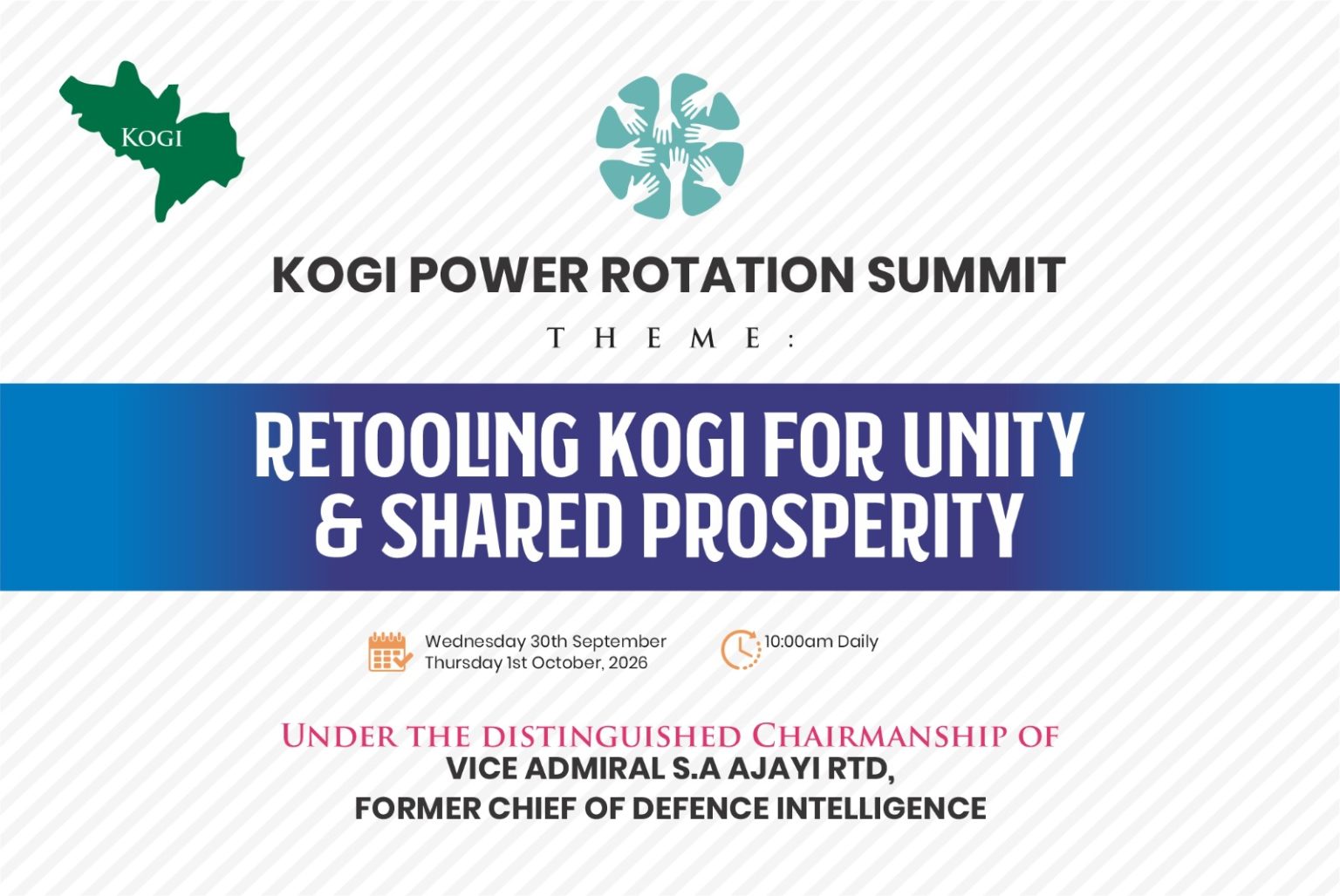
The forthcoming Kogi Power Rotation Summit being powered by Kogi Unity Agenda, led by Omoluabi Bode Adeyemi has opened a fresh chapter in the long-running conversation about political inclusion, equity and the distribution of leadership opportunities among the three senatorial districts of Kogi State.
Scheduled for September 30, 2026, in Lokoja, the summit is themed “Rotation Kogi for Unity & Shared Prosperity.” According to reports on the organisers’ plans, the gathering is intended to provide a platform for stakeholders to discuss political inclusion, equity, peaceful coexistence and the future of leadership in the state.
- Advertisement -
The significance of the summit lies largely in the fact that the question of power rotation is no longer merely a campaign slogan. It has become part of a broader public conversation about how a multi-ethnic state can create a political arrangement in which its different parts feel represented and included.
Kogi State is broadly organised into three senatorial districts—Kogi East, Kogi Central and Kogi West. Since the return to democratic rule in 1999, elected governors have come from Kogi East and Kogi Central, while Kogi West has not produced an elected governor.
Abubakar Audu, Ibrahim Idris and Idris Wada emerged from Kogi East, while Yahaya Bello and the incumbent, Ahmed Usman Ododo, are from Kogi Central.
That political history provides the background against which the rotation debate has continued to gain attention, particularly among stakeholders who argue that a deliberate understanding among the three districts could help address perceptions of exclusion.
The issue is not entirely new. Previous political discussions in Kogi have included proposals for power-sharing and rotation, including reported efforts by political stakeholders and, more recently, discussions within the State House of Assembly concerning possible legislative backing for rotation among the three senatorial districts.
One important feature of the proposed summit is that its stated objective goes beyond determining who should occupy the Government House.
Reports about the summit indicate that its organisers are presenting rotation as a mechanism for political inclusion, fairness, mutual trust and stability, while also stressing that rotation should be accompanied by competence, integrity, accountability and commitment to the welfare of citizens.
Power rotation, by itself, cannot guarantee good governance. A rotational arrangement would still leave voters, political parties and other stakeholders to consider candidates through the established democratic and electoral processes.
But an agreed framework for sharing political opportunities can potentially reduce the perception that political power is permanently concentrated in particular areas.
For a state as diverse as Kogi, that perception matters.
A summit involving stakeholders from Kogi East, Central and West creates an opportunity to move the discussion away from accusations and counter-accusations and towards a conversation about the future.
Rather than treating rotation as a contest between ethnic or regional interests, the discussion can focus on how the three districts can develop a mutually acceptable understanding of political succession.
Such an approach could also help prevent the rotation debate from becoming a source of division.
The organisers have reportedly emphasised that the objective is not simply the sharing of offices, but creating a stronger sense of belonging among the different sections of the state.
Kogi West occupies a particularly important place in the debate because it remains the only senatorial district without an elected governor since the state was created in 1991. This historical fact has repeatedly featured in political discussions about zoning and power-sharing in Kogi.
For advocates of rotation, the argument is therefore that a political arrangement which recognises the three districts could provide a pathway for addressing this longstanding imbalance.
However, there are also differing views about how the process should work. Recent public commentary has included calls for the West to have the opportunity in 2027, while other stakeholders favour a broader summit to establish a framework for future rotation.
That difference of emphasis makes dialogue particularly relevant.
From political competition to political understanding
The real test of the Rotation Summit will not necessarily be the speeches delivered at the event, but whether stakeholders can develop principles that command broad acceptance.
Such principles could address the sequence of rotation, the role of political parties, the place of competence and capacity, the relationship between rotation and voters’ constitutional rights, and mechanisms for sustaining any agreement reached.
A successful conversation would therefore need to recognise two realities at the same time: every citizen has the democratic right to aspire to political office, while political stakeholders can voluntarily negotiate arrangements that promote inclusion and peaceful coexistence.
This is where the summit could become significant.
A chance to build a broader Kogi political compact
Kogi’s political history shows that the question of equitable access to power has been debated for many years. The new summit provides an opportunity to revisit the issue in a more structured and state-wide manner.
The presence of traditional rulers and religious leaders from different parts of the state, as reported in connection with the event, also points to an effort to broaden the conversation beyond partisan politics.
Ultimately, the strength of any rotation arrangement will depend on the willingness of stakeholders to respect an agreed framework, accommodate differing perspectives and maintain the principle that governance should serve all parts of Kogi.
If the summit succeeds in producing a transparent, inclusive and broadly acceptable understanding among Kogi’s three senatorial districts, it could mark an important step in the state’s continuing search for political balance.
For that reason, the Rotation Kogi for Unity & Shared Prosperity initiative is not simply another political gathering. It represents an attempt to confront one of Kogi’s longest-running political questions through dialogue, consensus-building and a broader conversation about shared ownership of the state’s future.
DemocracyNewslineNewspaper September 28, 2026