





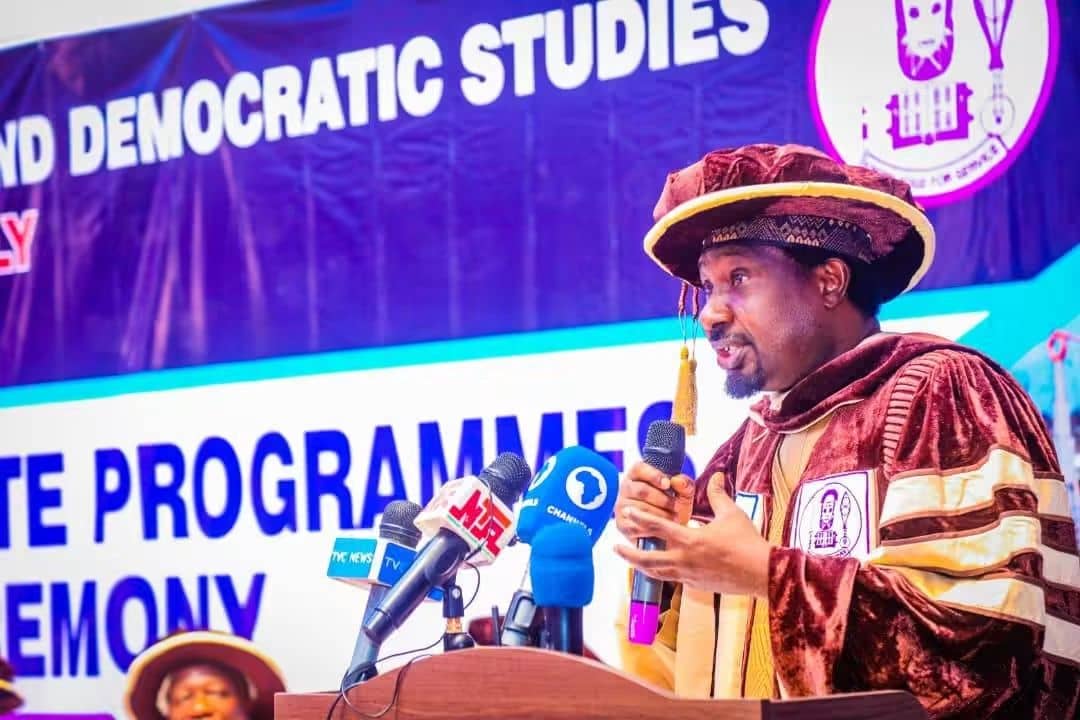

Barau Backs Safeguards in Proposed State Police Framework, Pledges Bill to Upgrade NILDS to University.
By Bala Salihu Dawakin Kudu October 27, 2026.
ABUJA — Deputy President of the Senate, Senator Barau I Jibrin, has reaffirmed the commitment of the National Assembly to strengthening Nigeria’s security architecture, promoting democratic governance and building institutions capable of responding to the country’s evolving challenges.
Senator Barau, who represents Kano North Senatorial District, stated this while representing the President of the Senate and Chairman of the Governing Council of the National Institute for Legislative and Democratic Studies (NILDS), Senator Godswill Obot Akpabio, GCON, at the 10th NILDS–University of Benin (UNIBEN) Postgraduate Programmes Convocation Ceremony in Abuja.
- Advertisement -


The Deputy Senate President delivered the Senate President’s convocation address and subsequently made additional remarks following a convocation lecture delivered by Professor Etannibi E. Alemika, titled “State Police: Issues, Challenges and Prospects.”
The event brought together academics, policymakers, legislative experts, graduates and other stakeholders to reflect on the relationship between education, democratic institutions, public administration and Nigeria’s governance challenges.
Speaking on the proposed establishment of state police, Senator Barau highlighted the collaborative process underpinning the ongoing constitutional reform, emphasising the importance of cooperation between the Executive, the Legislature and the Nigerian people.
He explained that public hearings and consultations were important components of the process, providing opportunities for citizens and stakeholders to contribute their perspectives to a constitutional question with significant implications for national security, federalism and the protection of fundamental rights.
According to him, the proposed reform must be approached with a clear understanding of both its potential benefits and the institutional challenges that could arise from its implementation.
State Police Reform Must Protect Citizens’ Rights
Senator Barau stressed that the success of state police would depend not merely on establishing police structures at the state level, but also on creating effective safeguards to ensure professionalism, accountability and respect for the rights of citizens.
He noted that the proposed framework must be designed to prevent the abuse of authority, political intimidation, partisan interference and the misuse of security institutions against political opponents or vulnerable members of society.
The Deputy Senate President’s remarks underscored the need for an effective system of checks and balances capable of ensuring that any decentralised policing arrangement serves the public interest rather than the political interests of individuals or groups.
The debate over state police has remained a significant issue in Nigeria’s national discourse, particularly amid concerns about insecurity, criminal activities, kidnapping, banditry and the capacity of existing security institutions to respond effectively to threats across the country.
Supporters of state police argue that decentralising policing could improve local intelligence gathering, strengthen community relations and enable security agencies to respond more quickly to threats peculiar to individual states and communities.
However, concerns have also been raised about the possibility of state governments using local police formations to intimidate political opponents, undermine civil liberties or weaken the impartial enforcement of the law.
These competing considerations have made constitutional safeguards, transparent oversight, adequate funding, professional training and clear operational standards essential elements of the ongoing debate.
Senator Barau’s emphasis on accountability and citizens’ rights reflects the importance of addressing these concerns as the constitutional reform process progresses.
For the proposed system to achieve its objectives, institutional arrangements would need to establish clear lines of authority, mechanisms for investigating misconduct, safeguards against unlawful political interference and procedures for holding officers accountable for violations of the law.
Equally important would be the need to ensure that policing remains guided by the Constitution, the rule of law and the fundamental rights of every Nigerian, irrespective of political affiliation, religion, ethnicity or social status.
Barau Plans Bill to Upgrade NILDS to a Full-Fledged University
In another significant development at the ceremony, Senator Barau disclosed his intention to sponsor a bill seeking to transform the National Institute for Legislative and Democratic Studies into a full-fledged university specialising in legislative and democratic studies.
The proposed initiative is aimed at expanding the institute’s institutional capacity and strengthening its role in research, professional training and the development of expertise in legislative administration, democratic governance and public policy.
NILDS plays an important role in providing training and research support in legislative practice, parliamentary administration, democratic institutions and governance. Its activities contribute to the development of knowledge and professional capacity among legislators, legislative staff, public officials, researchers and other stakeholders.
The proposed university status could provide an expanded platform for postgraduate education, specialised academic programmes, research and the training of future leaders and professionals in legislative and democratic affairs.
According to the proposal outlined by Senator Barau, the institution’s prospective mandate could extend beyond Nigeria to serve countries across the wider West African sub-region.
Such an ambition, if realised, could position the institution as a regional centre of excellence for parliamentary studies, constitutional development, democratic governance and legislative capacity-building.
West African countries share a number of governance challenges, including the need to strengthen democratic institutions, improve legislative effectiveness, promote constitutionalism and enhance public confidence in government.
A specialised university dedicated to these fields could provide opportunities for regional academic cooperation, comparative research, professional exchanges and the development of practical solutions to common institutional challenges.
However, the proposed transformation would require the necessary legislative approval and appropriate institutional arrangements, including academic governance structures, accreditation, sustainable funding, staffing and the development of relevant curricula.
The initiative nevertheless signals an ambition to expand the role of NILDS from its existing legislative research and training functions into a broader academic institution with national and regional relevance.
Strengthening Democratic Institutions Through Education
The convocation ceremony also highlighted the relationship between higher education and the development of strong democratic institutions.
Legislative institutions are central to democratic governance because they make laws, exercise oversight over the Executive, represent citizens and provide a platform for public debate on national priorities.
For these responsibilities to be discharged effectively, legislators and parliamentary personnel require sound knowledge of constitutional law, legislative drafting, public finance, public policy, democratic accountability and institutional administration.
Specialised education and research can help strengthen these capacities by equipping public officials and future leaders with the knowledge required to develop sound policies, scrutinise government programmes and improve the quality of legislation.
The proposed elevation of NILDS to university status could therefore broaden opportunities for specialised education and research while reinforcing the importance of evidence-based policymaking and institutional development.
It could also create a structured environment for examining Nigeria’s constitutional evolution, the performance of democratic institutions and the practical challenges facing legislative governance across Africa.
Senator Barau’s participation in the ceremony reflects the broader responsibility of the National Assembly to support initiatives that strengthen democratic governance, improve public institutions and promote national development.
The twin issues highlighted at the event—the proposed state police framework and the planned transformation of NILDS into a specialised university—address two important dimensions of governance: public security and institutional capacity.
While effective policing is essential for protecting lives, property and economic activities, strong legislative and democratic institutions are necessary to ensure that public authority is exercised responsibly and in accordance with the law.
The two priorities are therefore closely connected. Security institutions require effective oversight, while democratic institutions need skilled personnel, credible research and professional training to perform their responsibilities.
As discussions on constitutional reform continue, the challenge before policymakers will be to translate proposals into practical arrangements that deliver measurable improvements in public safety, accountability and democratic participation.
Similarly, the proposed NILDS university initiative will require sustained legislative and institutional support to become a reality and fulfil its envisioned role in Nigeria and the wider West African region.
The ceremony provided an opportunity to reflect on these priorities and the importance of investing in knowledge, institutional reform and democratic development.
Senator Barau reiterated the commitment to building stronger institutions, advancing effective governance and working towards a safer, more prosperous Nigeria for all citizens.
The proposed reforms, if carefully designed and effectively implemented, could contribute to strengthening the country’s democratic foundations while improving its capacity to respond to security challenges and develop the next generation of legislative and governance professionals.
For Nigeria, the ultimate measure of success will be whether such initiatives produce accountable institutions, more effective public services, greater protection for citizens and a democratic system that commands the confidence of the people.
DemocracyNewslineNewspaper October 27th, 2026