


Dangote’s Remark on Nigeria Filled With Private Jets Instead of Factories: The Paradox of a Misguided Nation
By Wilson Macaulay
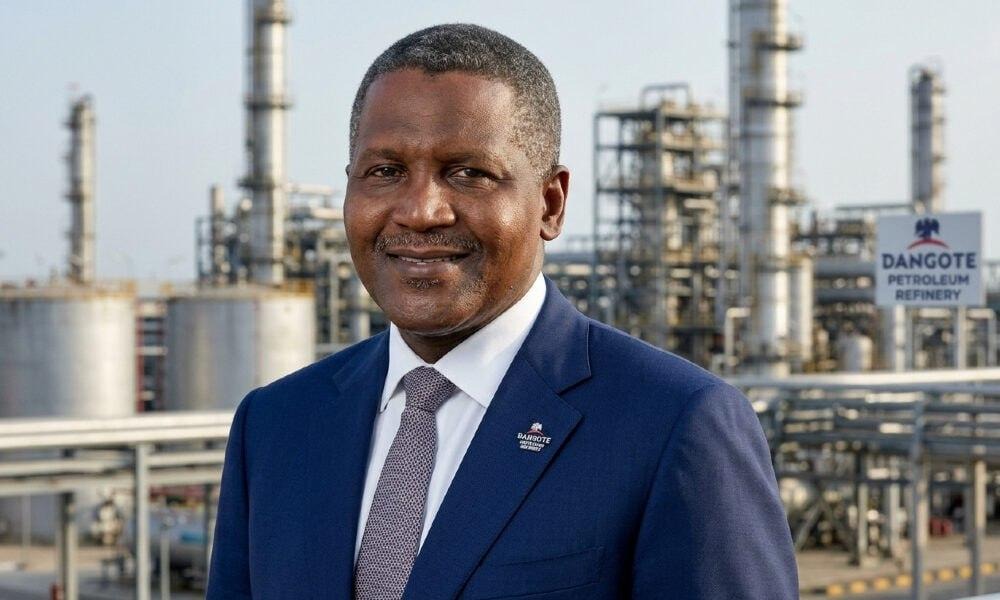
Nigeria’s enduring struggle with underdevelopment has once again come under the spotlight following a thought-provoking remark by Africa’s richest man and industrialist, Alhaji Aliko Dangote, that the country desperately needs factories and productive investments rather than an expanding culture of luxury and conspicuous consumption.
Dangote, who spoke while reflecting on wealth, investment and industrialization, said he was struck by the number of private aircraft around Abuja and wished that the space occupied by them could instead be filled with factories producing goods, creating jobs and expanding Nigeria’s productive capacity.
- Advertisement -

The billionaire industrialist also disclosed that he acquired his first private jet at the age of 22, but stressed that his priorities have evolved considerably, with greater emphasis now placed on productive investment and industrial development.
His observation has sounded far beyond the issue of private jets. It speaks about one of Nigeria’s most fundamental economic contradictions: a country blessed with enormous human and natural resources, yet still struggling to build the productive industrial base required to convert those resources into widespread prosperity.
Dangote’s central argument is that wealth should not merely be displayed; it should be deployed.
For a nation of more than 200 million people, factories represent more than physical structures. They represent employment, skills acquisition, technology transfer, local supply chains, tax revenues, exports and the possibility of economic independence.
A factory creates an ecosystem.
It requires engineers, technicians, drivers, accountants, security personnel, suppliers, distributors, marketers and thousands of other workers. It buys raw materials from farmers and other producers and creates markets for businesses operating far beyond its immediate location.
A private aircraft, by contrast, may represent extraordinary personal wealth and mobility, but its economic impact is fundamentally different from that of a productive industrial investment.
This is the paradox that Dangote’s remark exposes.
Nigeria has produced extraordinarily wealthy individuals, but the country is yet to develop an industrial ecosystem commensurate with its population, entrepreneurial energy and natural-resource endowment.
The issue, therefore, is not that private jets are inherently undesirable. Wealth creation is legitimate, and successful entrepreneurs have every right to enjoy the fruits of their labour.
The more profound question is what proportion of private wealth is being recycled into productive activities capable of generating employment and sustainable economic value.
Dangote himself provides a striking example of what industrial investment can accomplish.
His business interests span cement, fertiliser, petrochemicals, refining and other industrial activities. The Dangote Petroleum Refinery, which began operations in 2024, has become one of Nigeria’s most significant industrial projects and is now being opened to wider public investment through an initial public offering.
The refinery’s emergence has also altered Nigeria’s position in the petroleum-products market, while Dangote Group’s wider industrial strategy has been built around import substitution, local production and expansion of manufacturing capacity.
It is against this background that his latest comment assumes particular significance.
When an industrialist who has himself enjoyed immense wealth warns that society cannot build a great nation without doing something productive, the message transcends personal lifestyle.
It becomes a question of national priorities.
Nigeria has for decades battled excessive dependence on imported goods, inadequate power supply, weak infrastructure, high production costs, limited access to affordable capital and policy uncertainty.
These challenges have discouraged many potential investors from establishing factories, particularly in sectors where long-term capital commitments are required.
Yet the solution to Nigeria’s economic challenges cannot be consumption alone.
A nation cannot consume its way into prosperity.
It must produce.
It must manufacture.
It must export.
It must process its raw materials locally.
It must create businesses capable of absorbing its rapidly expanding labour force.
And it must deliberately create an environment where private capital finds productive investment more attractive than speculative or purely status-driven expenditure.
Dangote’s remark should therefore be understood as a challenge not only to wealthy Nigerians but also to policymakers.
Our Governments at all tiers have a responsibility to provide the enabling environment for industries to survive: reliable electricity, efficient transportation networks, predictable taxation, accessible financing, security and policies that encourage rather than punish long-term investment.
The private sector, on its part, must recognise that economic patriotism is not simply about flying the national flag or speaking passionately about Nigeria.
It is also about building enterprises that employ Nigerians, paying taxes, developing skills, producing competitively and creating opportunities for younger generations.
The contrast between a private jet and a factory is therefore symbolic.
One can represent the consumption of accumulated wealth; the other can represent the multiplication of wealth through production.
One can transport a few people rapidly from one destination to another; the other can potentially transform an entire community through employment and economic activity.
This does not mean every wealthy Nigerian must establish a factory. Rather, Dangote’s argument raises a broader national-development question: how can more private capital be channelled into productive enterprises capable of creating jobs and strengthening Nigeria’s economic foundation?
That question is particularly urgent in a country with a rapidly growing population and enormous pressure to create employment opportunities.
Nigeria does not lack wealthy people.
Nigeria does not lack entrepreneurs.
Nigeria does not lack natural resources.
What remains a critical challenge is converting these advantages into a sufficiently broad industrial and productive base.
Dangote’s Abuja experience, therefore, may have been a simple observation about finding parking space for private aircraft, but the metaphor behind it is profound.
A nation should aspire to have its cities filled not merely with symbols of private affluence, but with factories, technology hubs, farms, processing plants, research centres, logistics networks and businesses that create opportunities for millions.
The real measure of national wealth is ultimately not how many billionaires own private jets, but how many citizens can find dignified work, how many businesses can thrive, how much a country produces and how effectively it transforms its resources into shared economic opportunities.
That is the paradox confronting Nigeria.
A country can be extraordinarily wealthy at the individual level while remaining economically fragile at the collective level.
Dangote’s message is therefore a timely invitation to rethink the meaning of wealth, success and national development.
Nigeria does not merely need more wealthy Nigerians; it needs more wealth-producing Nigerians.
And perhaps the most important lesson from Dangote’s observation is that the ultimate symbol of a prosperous nation should not simply be the number of private jets parked at its airports, but the number of factories operating at full capacity, the millions of jobs they create and the productive future they make possible.
God bless Aliko Dangote, the economic torchbearer and industrial champion of Africa.”
Wilson Macaulay is a Journalist, Author,Public Affairs Analyst based in Warri Anchor of the Column Titled: The Prism of The Ruled Contact 09033058817 Whatsapp only
DemocracyNewslineNewspaper, September 16, 2026