

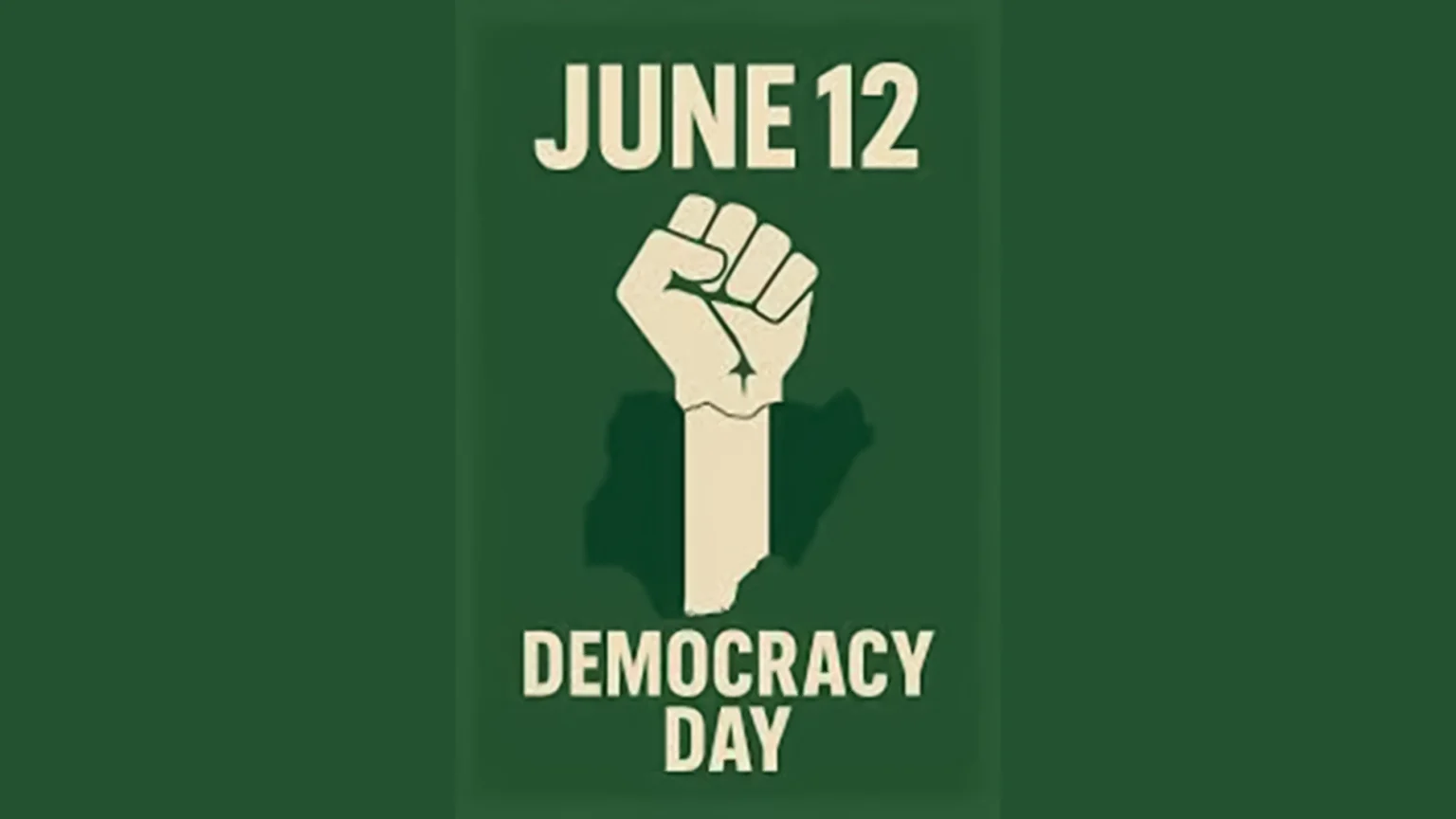

DEMOCRACY DAY IN NIGERIA: DEMOCRACY, DEVELOPMENT AND THE UNFINISHED JOURNEY OF NATION BUILDING
A June 12 Reflection on Leadership, Citizenship, Accountability and the Promise of a Greater Nigeria
By Dr. Aiyeku Olufemi Samuel
Economic Planning, Development, Policy and Political Analyst
- Advertisement -
Introduction: Democracy Beyond Elections
Every year on June 12, Nigeria pauses to commemorate Democracy Day—a day that symbolizes the sacrifices of patriots, activists, civil society groups, and ordinary citizens who fought for democratic governance, freedom, justice, and the right of the people to determine their collective destiny.
June 12 is not merely a public holiday. It is a mirror through which Nigeria must examine itself. It is a day for honest reflection rather than political celebration. It is a day to ask difficult but necessary questions:
Has democracy improved the quality of life of the average Nigerian?
Has political freedom translated into economic freedom?
Have elected leaders delivered the dividends of democracy to the citizens who entrusted them with power?
Are citizens themselves contributing positively to nation-building, accountability, and sustainable development?
More importantly:
Can democracy truly succeed where poverty, insecurity, corruption, unemployment, poor healthcare, and weak institutions continue to dominate daily life?
The answers to these questions will determine whether Nigeria’s democratic journey becomes a success story or remains a promise yet to be fulfilled.
Democracy and Development: The Missing Link
The late American President, Abraham Lincoln famously described democracy as:
“Government of the people, by the people, and for the people.”
However, democracy is not merely about conducting elections every four years.
True democracy must deliver amongst other things:
Security, Economic opportunities, Quality education, Accessible healthcare
Infrastructure, Justice, Rule of law, Human dignity
When these are absent, democracy risks becoming an expensive political ritual rather than a developmental instrument.
Nigeria’s Democratic Gains Since 1999
To be objective, Nigeria has recorded significant democratic achievements.
Since the return to civilian rule in 1999:
Political Stability
Nigeria has witnessed uninterrupted democratic governance for over two decades.
This represents the longest democratic period in the nation’s history.
Growth of Democratic Institutions
Institutions such as:
The Judiciary, National Assembly, Electoral bodies, Civil society organizations
Independent media have expanded their influence and participation in governance.
Telecommunications Revolution
The telecom sector has transformed Nigeria from fewer than one million active telephone lines in 1999 to hundreds of millions of mobile subscriptions today, creating jobs and expanding economic opportunities.
Financial Inclusion and Digital Innovation
Nigeria has emerged as one of Africa’s leading fintech hubs, producing innovative digital solutions and attracting significant investments.
Infrastructure Expansion
Several administrations have invested in roads, railways, airports, ports, and power projects, although the outcomes remain far below national expectations.
These gains deserve recognition.
However, democracy must ultimately be measured not by political processes but by human outcomes.
The Reality Check: Why Are Millions Still Left Behind?
According to Nigeria’s National Bureau of Statistics (NBS), approximately 133 million Nigerians—about 63% of the population—are multidimensionally poor, lacking adequate access to healthcare, education, sanitation, housing, food security, and other essential services.
This raises a troubling question:
How can a nation blessed with vast natural resources, Africa’s largest economy, and one of the continent’s largest democratic systems still have over half of its population trapped in multidimensional poverty?
Democracy should reduce poverty—not institutionalize it.
Poverty: The Greatest Threat to Democracy
Poverty is not merely an economic condition, It is a democratic threat.
A hungry citizen becomes vulnerable to:
Vote buying, Political manipulation, Ethnic propaganda, Religious extremism,
Criminal recruitment.
When stomach infrastructure replaces critical thinking, democracy suffers.
When bags of rice determine electoral outcomes, governance quality declines.
When citizens exchange their future for temporary handouts, national development becomes impossible.
A democracy driven by poverty inevitably produces leaders who focus on political survival rather than transformational leadership.
Security Challenges and National Stability
A nation cannot develop without security.
Nigeria continues to battle:
Terrorism, Banditry, Kidnapping, Farmer-herder conflicts, Oil theft, Separatist agitations, Organized crime amongst others.
Recent reports indicate millions continue to face severe consequences arising from insecurity and displacement across affected regions. Security challenges have also disrupted agricultural production, economic activities, and investments.
The economic implications are enormous.
When farmers abandon their farms, food production declines.
When businesses relocate, jobs disappear.
When investors lose confidence, economic growth stagnates. Food Security: Can a Nation Prosper While Its People Are Hungry?
Food insecurity remains one of Nigeria’s most pressing challenges.
Recent assessments estimated that over 31 million Nigerians face acute food shortages, driven by insecurity, inflation, rising production costs, and economic pressures.
The paradox is painful.
Nigeria possesses: Vast arable land, Favorable climate, Large labor force
Significant agricultural potential, yet millions struggle daily to afford basic meals.
The challenge is not the absence of resources.
The challenge is policy consistency, implementation, security, storage infrastructure, and market efficiency.
Healthcare: A Democracy’s Moral Test
A nation’s healthcare system reflects its development priorities.
Millions of Nigerians continue to experience challenges accessing affordable and quality healthcare services, particularly in rural communities. Healthcare access remains a critical development priority identified by both national and international agencies.
The questions remain:
Why should citizens travel abroad for medical treatment when local hospitals should be world-class?
Why should preventable diseases continue to claim lives?
Why should healthcare financing remain a burden on ordinary families?
A healthy population is not a luxury.
It is an economic asset. Water and Sanitation: Basic Rights, Not Privileges
The United Nations recognizes access to clean water as a fundamental human right.
Yet millions across developing nations continue to face challenges accessing safe drinking water and sanitation facilities.
For many communities:
Clean water remains inaccessible.
Sanitation infrastructure remains inadequate.
Waterborne diseases persist.
No democracy can claim full success while citizens struggle for basic necessities.
Leadership: The Crisis of Vision and Accountability
Nigeria’s greatest challenge may not be resources.
It may be leadership.
Leadership is not about occupying office.
Leadership is about solving problems.
It is about creating systems that outlive personalities.
It is about converting public resources into public value.
The philosopher and statesman Nelson Mandela once observed:
“A good head and a good heart are always a formidable combination.”
Engr. Sani Ndanusa, FNIM, FNICE, FNIM, Marafan Nupe
Nigeria needs leaders who combine competence with character, Vision with integrity, Authority with accountability, Power without purpose becomes oppression. So that Power with purpose becomes transformation.
Citizens Must Also Accept Responsibility, because Democracy is a partnership.
Leaders alone cannot build nations. Citizens also have responsibilities: Obey laws, Pay taxes, Demand accountability
Reject corruption, Participate constructively, Vote responsibly.
A corrupt society cannot consistently produce transparent leadership.
If citizens celebrate ill-gotten wealth, democracy weakens.
If voters prioritize ethnicity, religion, and patronage above competence, governance quality suffers.
The transformation Nigeria seeks must begin with both leaders and followers.
The Cost of Stomach Infrastructure Politics
One of the greatest threats to democratic development is what many Nigerians call “stomach infrastructure.”
This occurs when:
Immediate gratification replaces long-term thinking.
Political gifts replace policy evaluation.
Temporary handouts replace sustainable development.
A bag of rice may last a few weeks.
Bad governance can last generations.
The true dividend of democracy is not charity.
It is opportunity, It is empowerment, It is dignity,It is prosperity created through productive systems.
The Nigeria We Must Build
As Nigeria commemorates another Democracy Day, the challenge before us is clear.
We must build a nation where:
Merit triumphs over mediocrity.
Competence outweighs connections. Institutions are stronger than individuals.
Policies outlive political cycles.
Citizens trust government.
Government earns that trust.
The future of Nigeria cannot be outsourced.
It must be built deliberately by Nigerians.
Conclusion: Democracy Is a Journey, Not a Destination
June 12 reminds us that democracy was never the final destination.
It was merely the vehicle.
The destination remains:
Prosperity, Justice, Security, Inclusion, Opportunity, National development
The question before every Nigerian is therefore simple:
What kind of democracy do we want to leave behind for future generations?
A democracy of promises?
Or a democracy of performance?
A democracy of personalities?
Or a democracy of institutions?
A democracy of survival? Or a democracy of prosperity?
The answers will define Nigeria’s next chapter.
As we celebrate Democracy Day, let us remember:
The strength of a democracy is not measured by the number of elections conducted, but by the number of lives transformed.
Nigeria’s democratic journey continues.
The unfinished work remains before us.
The responsibility belongs to all of us.
Happy Democracy Day, Nigeria.
Credit:
Dr. Aiyeku Olufemi Samuel
Economic Planning, Development, Policy and Political Analyst
June 12 Democracy Day Special Publication, 2026
(DEMOCRACY NEWSLINE NEWSPAPER, JUNE 12TH 2026)