





The Parody of Consensus Arrangement: The Charade in the contest for the APC Ticket for Kabba-Bunu 1 State Constituency of Kogi State
By Tai Hassan Ejibunu
In democratic theory, consensus is often celebrated as a noble ideal—an approach that fosters unity, minimizes conflict, and reflects collective will. Within party politics, especially at the grassroots level, consensus arrangements are meant to streamline candidate selection while preserving harmony among stakeholders. This was the position of the Executive Governor of Kogi State, His Excellency, Ahmed Usman Ododo, during his meeting with the aspirants and stakeholders from the Kogi West Senatorial District on Wednesday, 29th April, 2026. However, when manipulated, consensus ceases to be a tool for inclusion and becomes instead a convenient façade for imposition. What has unfolded in Kabba for the race to the Assembly seat is a telling example of how a process designed to unify can be distorted into a charade that undermines both party integrity and democratic credibility.
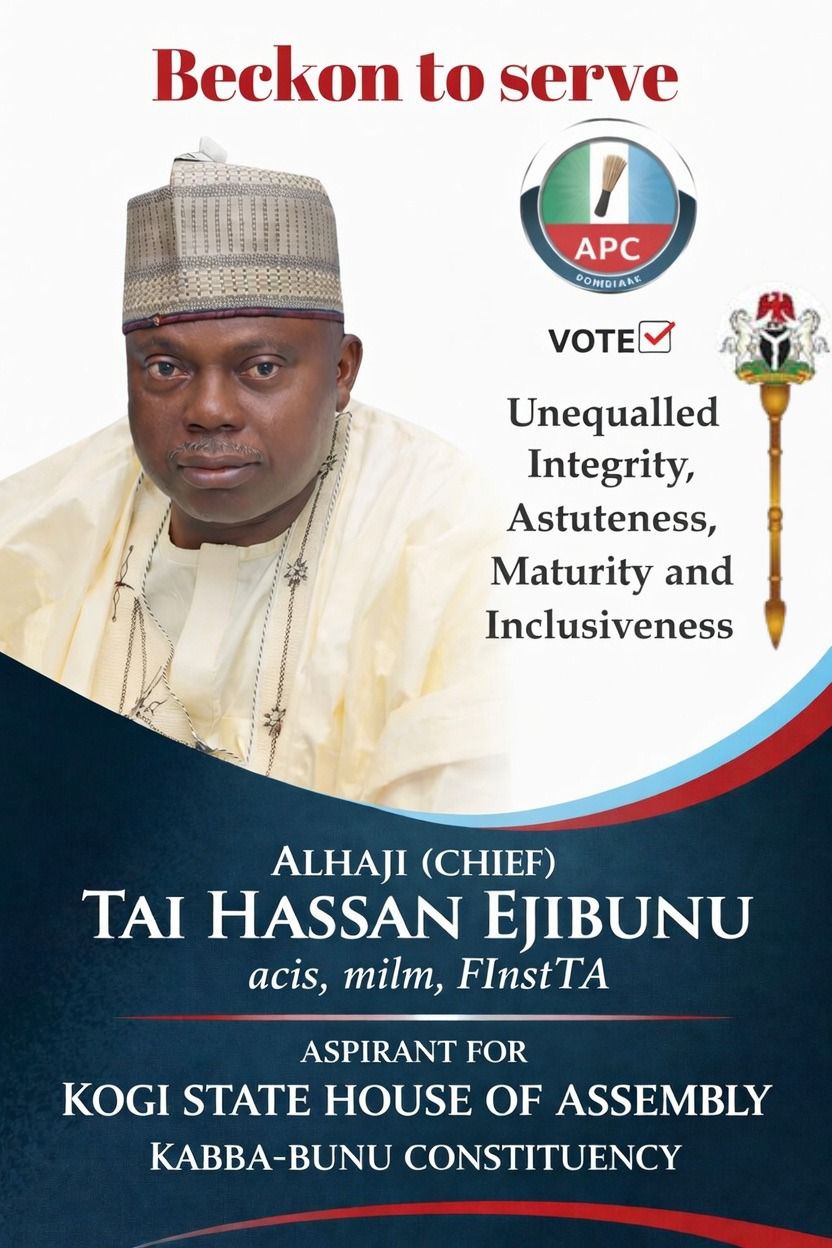
The people of Kabba in Kogi State have long been recognized for their political consciousness and active grassroots engagement. Historically, political participation in the town has been robust, with aspirants and party members alike embracing competitive processes as a means of legitimizing leadership. It is against this backdrop that the recent attempt to enforce a so-called “consensus arrangement” has raised serious concerns among party faithful and observers. In the race to the Assembly seat, six (6) candidates indicated interest. However, following the meeting of the critical stakeholders of the party with the aspirants, the number of contestants was pruned to five {5}, with three aspirants from Asuta Ward; and two (2) from Okeke Ward. Candidates from Asuta Ward were Tai Hassan Ejibunu; Folashade Olobatoke {Daviva}; and Bolurotimi Emmanuel Funsho. Okekoko ward had Moturayo Olonikadi and Bank-Anthony Omonisaiye.
At face value, consensus implies agreement—an outcome reached after genuine consultation, negotiation, and compromise among all stakeholders. It presupposes that aspirants willingly step down in favour of a mutually acceptable candidate, often in the interest of party unity. This was the route taken by Okekoko Ward with Moturanyo Olonikadi stepping down for Bank-Anthony Omonisaiye. With this arrangement, Omonisaiye was expected to square it up with the consensus candidate from Asuta Ward in the party’s primary for the Assembly seat.
However, what played out in Asuta Ward, 2nd May, 2026 to select the consensus candidate of the Ward did not bear resemblance to this ideal. Instead of broad-based consultation and arrangement to select a suitable candidate between the trio of Tai Hassan Ejibunu; Folashade Olobatoke {Daviva}; and Bolurotimi Emmanuel Funsho, at the residence of the Leader of the Ward, Olusegun Ola-Odano, Esq, what played out was distasteful and at variance to the directive of the Governor. While two of the aspirants-Ejibunu and Olobatoke, were present at the venue, the third aspirant, Bolurotimi was not present and no where to be found. Rumour had it, which came to be true, that he had travelled to Lokoja in company of the member of the House of Representatives representing Kabba-Bunu-Ijumu Federal Constituency, Hon. Salmam Idris, to obtain the nomination form without participating in any form of selection process. We have clear evidence in the social media to substantiate this.
The charade that took place in Lokoja with Bolurotimi obtaining the party’s nomination form is clear distortion of the processes of selecting a candidate for elective position, as APC stakeholders in Kabba were neither adequately consulted nor given the freedom to make independent decisions, therefore the legitimacy of the outcome is immediately called into question. Rather than unifying the party, this approach breeds resentment, suspicion, and fragmentation. The people behind this nonsensical act should be ashamed of themselves, as their democratic credential is at stake.
It should be noted that political parties are foundational to democratic governance, and their internal processes must reflect the principles they claim to uphold. When candidate selection is manipulated, it sends a troubling signal that loyalty to a few power brokers outweighs merit, competence, and popular support. This not only discourages credible aspirants but also erodes public trust in the party as a vehicle for genuine representation.
In Kabba APC, the perception that consensus was engineered to serve vested interests has further deepened scepticisms about the process. The broader implication of this charade is the weakening of democratic culture at the grassroots level. Democracy thrives on participation, competition, and transparency. When these elements are replaced with opaque arrangements disguised as consensus, the political system becomes less responsive to the will of the people.
The situation calls for introspection among party leaders and stakeholders. There is a need to return to the principles of fairness and inclusivity in political processes. Open primaries, transparent consultations, and respect for the choices of party members are essential to restoring confidence. Anything short of these risks entrenching a culture of manipulation that ultimately weakens both the party and the democratic system.
In conclusion, the so-called consensus arrangement and working towards producing Bolurotimi, as the consensus candidate for the Kabba-Bunu House of Assembly Constituency 1 represents a parody of what consensus is meant to achieve. It is deceptive and can not stand. Rather than fostering unity, it has exposed fault lines within the political structure and raised questions about the sincerity of party leadership. If democracy is to have meaning at the grassroots, processes must be genuine, participatory, and fair—not a carefully staged charade designed to mask predetermined outcomes.
(DEMOCRACY NEWSLINE NEWSPAPER, MAY 3RD 2026)
- Advertisement -