





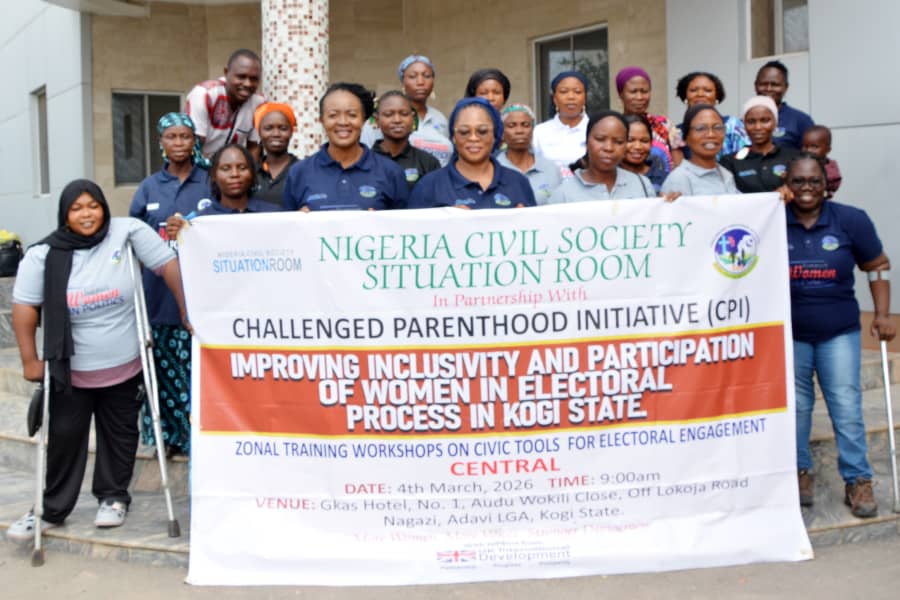

CPI TRAINS WOMEN ON CIVIC TOOLS FOR ELECTORAL ENGAGEMENT IN KOGI.
The Challenged Parenthood Initiative (CPI) in collaboration with Nigeria Civil Society Situation Room has organized a one-day capacity-building training for the Women Electoral Engagement and Governance Coalition (WEEGC). The training was aimed at improving inclusivity and the participation of women in the electoral process in Kogi State.
Speaking at the event, the Executive Director of CPI, Eunice Abimbola Agbogun, said the programme was designed as a knowledge-based training to deepen women’s understanding of civic tools for electoral process and how they can effectively engage the system.
She noted that cultural norms have continued to relegate women to being used merely as tools for winning elections, without giving them the opportunity to actively participate or vie for elective and appointive positions as decision-makers in society.
- Advertisement -


Agbogun explained that the overall objective of the training is to enhance a functional, non-partisan and women-led coalition that will be operational across the three senatorial districts of Kogi State.
The training was facilitated by the Deputy Director of the Institute of Gender Studies, Federal University Lokoja, and a member of the WEEGC, Dr. Aisha Abimbola Adaranijo.
Delivering a session titled “Civic Tools For Electoral Engagement In Nigeria: Improving Inclusivity And Participation of Women in the Electoral Process in Kogi State”
Dr. Adaranijo urged women to rise up and break the barriers that hinder their participation in decision-making processes.
She emphasized the need for women to unite in order to promote social change and cautioned them against allowing themselves to be manipulated through fear or inducement.
According to her, women should focus on supporting credible female candidates with the capacity to deliver, regardless of party affiliation or ethnicity.
She further observed that women possess significant numerical strength in elections, which is why they are often targeted with gifts such as money and food items to suppress their voices.
Dr. Adaranijo also advised women to avoid voting apathy and use their civic tools to actively engage the electoral process.
Participants at the training applauded the initiative, describing it as enlightening and impactful. They pledged to intensify sensitization and mobilization efforts among women to ensure meaningful participation in the upcoming elections.
(DEMOCRACY NEWSLINE NEWSPAPER, MARCH 5TH 2026)