




Dr Austin Orette: The Voice Delta South Needs to Fast-Track Development Come 2027
Why the ADC Senatorial Candidate is Building His Campaign Around Competence, Development and Effective Representation
By Democracy Newsline Feature Desk
As political activities gradually gather momentum ahead of the 2027 National Assembly elections, the battle for the Delta South Senatorial District seat is beginning to generate fresh conversations about the quality of representation the people of the district require to accelerate development.
- Advertisement -


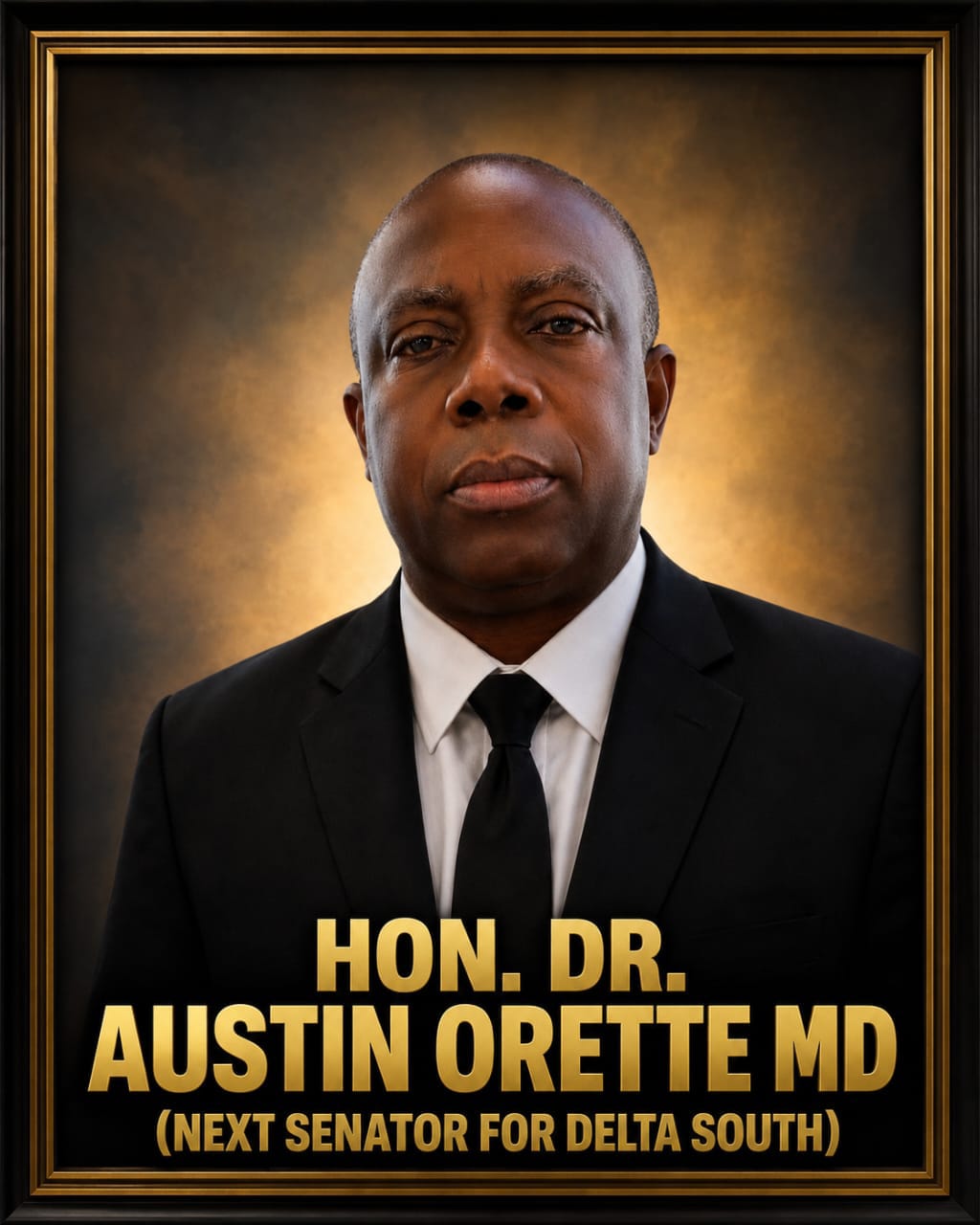
Among the personalities seeking to redefine that conversation is the African Democratic Congress (ADC) senatorial candidate for Delta South, Dr. Austin Orette, a Nigerian-American family medicine physician and politician whose campaign is centred on the proposition that public office must be used as an instrument for solving problems and improving the lives of the people.
For his supporters, Orette represents a different voice in the political equation—one they believe can speak firmly and consistently for the people of Delta South and pursue development opportunities at the federal level.
The description of Orette as “the only voice that can truly speak for Delta South” is, however, a political assessment made by his supporters rather than an established fact. What is clear from his campaign statements is that he is presenting himself as a candidate focused on development-driven representation, accessibility, competence and accountability.
A Senate Ambition Built Around Development
Orette has consistently argued that representation should go beyond speeches and political appearances.
In a recent interview, he said he wants to become a senator because he sees public office as an opportunity to solve problems rather than merely occupy a position. He identified quality education, skills development, youth employment, entrepreneurship, healthcare, infrastructure, rural development and economic empowerment as key areas of his proposed legislative agenda.
That five-point agenda provides the foundation of his campaign message.
For Delta South, where communities face different development challenges, the question of effective federal representation is particularly significant. A senator has constitutional responsibilities that include lawmaking, representation and oversight, while also using legislative influence to advocate for projects and policies that benefit constituents.
Orette’s campaign is therefore presenting the 2027 election as an opportunity for voters to examine what they expect from their representative at the National Assembly.
Healthcare, Education and Human Capital
As a medical doctor with a professional background in family medicine, Orette has placed healthcare among the key pillars of his proposed agenda.
His campaign says better healthcare services should form part of a broader development strategy, alongside education and skills acquisition.
For a district with a large youthful population, the emphasis on education, vocational skills, entrepreneurship and employment is equally central to his political message.
Orette has argued that empowering young people should not be restricted to political appointments but should include creating an environment in which they can acquire skills, establish businesses and participate meaningfully in the economy.
Infrastructure and Rural Development
Another major component of the Orette agenda is infrastructure and rural development.
For many communities across Delta South, infrastructure remains directly connected to economic activity. Roads, electricity, healthcare facilities, schools, water systems and other public infrastructure affect agriculture, commerce, transportation and access to essential services.
Orette’s stated position is that effective representation should actively pursue development interventions rather than simply observe the challenges facing constituents.
His supporters believe that his professional exposure and engagement with communities can help strengthen advocacy for federal projects in the senatorial district.
A Candidate Talking About Competence
One recurring theme in Orette’s campaign is competence.
He has argued that political leadership should be based on preparation, integrity, capacity and vision, while acknowledging that experience also has value.
“Representation goes beyond making speeches in Abuja,” Orette said in a recent interview, stressing the importance of accessibility, competence, integrity and the courage to defend constituents’ interests.
That position has become one of the distinguishing elements of his campaign.
Rather than presenting the Senate seat simply as a political position, Orette is attempting to frame it as a responsibility requiring technical knowledge, legislative understanding and the ability to engage government institutions on behalf of constituents.
The Voice of a Diverse Delta South
Delta South is made up of communities with diverse ethnic, cultural, economic and geographical interests. Consequently, effective representation requires a senator capable of articulating issues that transcend individual communities.
This is where Orette’s campaign seeks to make its strongest argument.
His stated intention is to ensure that communities across the senatorial district have a voice in the National Assembly, while his development agenda focuses on issues that cut across local boundaries—education, healthcare, employment, infrastructure and economic empowerment.
Support for his aspiration has also been publicly expressed by some youth and community groups, who have cited his professional background, international exposure and development agenda as reasons for backing his candidacy. Those endorsements represent the views of the respective groups and should not be treated as evidence of universal support across Delta South.
Beyond Politics: A Development Conversation
Perhaps the most important dimension of Orette’s candidacy is the attempt to move the 2027 conversation towards development.
His campaign has also raised broader questions about Nigeria’s political structure, including restructuring and greater devolution of powers to the component parts of the federation. In an article published in August, Orette argued for genuine federalism and greater capacity for regions and states to drive their own development.
For Delta South, such arguments connect the senatorial contest to larger questions about how the Niger Delta can better utilise its human and economic resources.
The challenge, ultimately, is how such broad ideas can be translated into practical legislation, effective oversight and measurable benefits for constituents.
Why 2027 Matters
The 2027 election will provide voters in Delta South with an opportunity to compare the programmes, records, experience and priorities of the various candidates seeking their mandate.
Orette is offering voters a platform built around five principal priorities: quality education and skills development; youth employment and entrepreneurship; improved healthcare; infrastructure and rural development; and economic empowerment through agriculture, technology and support for small businesses.
Whether those proposals will resonate with the electorate will ultimately be determined by the people of Delta South.
But one thing is already evident: Dr. Austin Orette has positioned his candidacy as a campaign for a different style of representation—one that places development, accessibility, professional competence and advocacy at the centre of the senatorial mandate.
For his supporters, that makes him the voice they believe Delta South needs to fast-track development after 2027.
For the electorate, the task is to examine that proposition alongside those of the other candidates and determine which vision most closely reflects their expectations for the future of the senatorial district.
DemocracyNewslineNewspaper, September 18, 2026