




GANDUJE–GOVERNOR YUSUF ALIGNMENT OPENS A NEW ERA OF EFFECTIVE GOVERNANCE IN KANO.
By Bala Salihu Dawakin Kudu
Democracy Newsline
January 2, 2026.
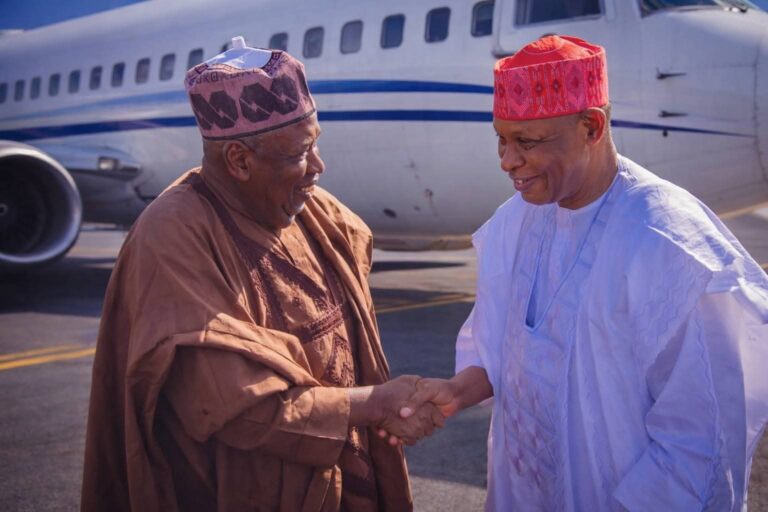
The recent political alignment between former Governor Dr. Abdullahi Umar Ganduje and the incumbent Governor of Kano State, Abba Kabir Yusuf, marks a defining moment in the state’s contemporary political history. Beyond the predictable headlines and partisan interpretations, the development presents a rare opportunity to recalibrate governance—away from rivalry and toward purposeful service delivery.
For years, governance in Kano has not suffered from a lack of ideas or vision.
Rather, progress has been slowed by overlapping political influences, informal power centres, and lingering vendettas that quietly but effectively undermine decision-making. When unelected actors or rival blocs attempt to impose themselves on a constitutionally elected administration, tension becomes inevitable and outcomes often disappointing. It is this very culture of imposed influence that the Ganduje–Governor Yusuf alignment seeks to dismantle.
- Advertisement -
Contrary to the anxieties that often accompany political realignments, Dr. Abdullahi Umar Ganduje has not positioned himself—nor shown any inclination—to act as a domineering force or shadow authority within the present government. Instead, his approach reflects political maturity and restraint: allowing constitutional authority to rest firmly with the sitting governor, while offering experience, strategic networks, and goodwill where necessary.
Such restraint is not weakness; it is wisdom. Governance thrives when counsel strengthens institutions rather than overwhelms them, and when influence supports leadership without eclipsing it.
Governor Abba Kabir Yusuf, on his part, has consistently demonstrated a calm, inclusive, and people-centred leadership style. His openness to dialogue, consensus-building, and respect for differing political views has earned him goodwill across party lines. In this context, alignment does not diminish his authority—it reinforces it. By reducing friction and isolating destabilizing elements that thrive on division, the partnership strengthens the capacity of government to function effectively.
Decision-making becomes faster and clearer when there is no shadow contest for authority. Policies move from conception to implementation without unnecessary bottlenecks—often deliberate—created by internal resistance or loyalty tests. Ministries, departments, and agencies regain their primacy when directives emanate from a single, widely recognized centre of authority, backed by broad political support rather than competing interests.
Equally important, the alignment lowers the political temperature of the state. Investors, development partners, civil servants, and citizens alike respond positively to signals of unity and predictability. Under the leadership of Governor Abba Kabir Yusuf, Kano State stands to benefit both politically and economically, as stability remains a prerequisite for sustainable development.
Perhaps most significantly, the absence of imposed influence allows the governor to fully govern—free to focus on empowering the people rather than managing egos or settling political scores. Energy once consumed by internal conflict can now be redirected toward critical sectors such as education, infrastructure, healthcare, and economic opportunity.
The current political realities in Kano should not be misconstrued as the victory of one individual over another. Rather, they represent a shared understanding that the progress of Kano State matters more than factional dominance. Mature politics is not about who exerts the loudest influence behind the scenes, but about who allows institutions to function without obstruction.
If sustained, the Ganduje–Governor Yusuf alignment could serve as a national model for post-election reconciliation and cooperative governance—where experience supports leadership, respect replaces rivalry, and governance is freed from the drag of imposed or external control.
For Kano State, this alignment is not merely good politics.
It is good governance.
Aminu Dahiru
Visual Communication Aide to Dr. Abdullahi Umar Ganduje, CON
February 2, 2026
(DEMOCRACY NEWSLINE NEWSPAPER, FEBRUARY 2ND 2026)