






JUST IN: APC Releases Timetable for 2027 Elections, Fixes Presidential Nomination Form at N100m.
By Bala Salihu Dawakin Kudu, Democracy Newsline Northern Bureau Chief
April 20, 2026.
In what political observers are already describing as an early signal of intense preparations for Nigeria’s next democratic cycle, the All Progressives Congress (APC) has officially unveiled its timetable and schedule of activities for the 2027 General Elections, setting the stage for what could become one of the most competitive electoral seasons in the nation’s recent history.
- Advertisement -

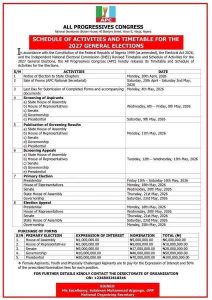
The announcement, contained in a detailed document signed by the Party’s National Organising Secretary, Sulaiman Muhammad Argungu, outlines a comprehensive roadmap that includes timelines for the sale of nomination forms, screening exercises, primary elections, and appeal processes across all elective positions.
According to the schedule, the sale of expression of interest and nomination forms will commence on Saturday, April 25, and conclude on Monday, May 4, 2026. This narrow window suggests a deliberate attempt by the party to streamline its internal processes and avoid prolonged pre-primary disputes that have historically plagued political parties in Nigeria.
The timetable further indicates that the presidential primary election is scheduled to take place between May 15 and 16, 2026. This will be followed in quick succession by primaries for other key positions: House of Representatives on May 18, Senate on May 20, State Houses of Assembly on May 21, and Governorship elections on May 23.
Appeal processes have also been carefully integrated into the schedule. The presidential appeal is slated for May 18, while appeals for the House of Representatives, Senate, State Houses of Assembly, and Governorship primaries will occur on May 20, May 21, May 23, and May 25 respectively. Analysts note that this structured timeline reflects lessons learned from past electoral cycles, where unresolved grievances often escalated into legal battles that weakened party cohesion.
Perhaps the most striking aspect of the announcement is the cost attached to the nomination process, particularly for presidential aspirants. The APC has pegged the expression of interest form at N30 million and the nomination form at a staggering N70 million, bringing the total cost of entry for the presidential race to N100 million. This figure is expected to spark widespread debate about the monetization of Nigeria’s political process and the barriers it may pose to emerging leaders.
For governorship aspirants, the expression of interest form is set at N10 million, while the nomination form costs N40 million. Senate hopefuls are required to pay N3 million for the expression of interest and N17 million for nomination. Similarly, House of Representatives aspirants will pay N1 million and N9 million respectively, while those contesting for State Houses of Assembly positions are to pay N1 million for expression of interest and N5 million for nomination.
In a move that the party describes as part of its inclusivity policy, female aspirants, youths, and persons living with disabilities are granted a concession: they are required to pay only for the expression of interest form and 50 percent of the nomination fee. Political inclusion advocates have cautiously welcomed this provision, though some argue that even the discounted rates remain prohibitively high for many grassroots candidates.
“The APC reassures members, stakeholders, and Nigerians of its commitment to conducting a credible and transparent primary election that will further strengthen the Party’s internal democracy and consolidate its progressive ideals,” the statement read.
Beyond the numbers and dates, the release of this timetable carries broader political implications. It signals the beginning of strategic alignments, consultations, and power negotiations within the ruling party. Political heavyweights, emerging contenders, and regional blocs are expected to intensify behind-the-scenes engagements as the race for party tickets gathers momentum.
Experts in electoral politics suggest that the early release of the timetable may also be aimed at giving the APC a strategic advantage, allowing it to organize its internal processes ahead of rival parties. This could help the party present a more united front going into the general elections, a factor widely regarded as critical in Nigeria’s highly competitive political landscape.
However, concerns remain about the high cost of participation and its potential impact on democratic inclusiveness. Civil society organizations have repeatedly called for reforms that would lower financial barriers and encourage broader participation, particularly among young Nigerians who represent a significant portion of the electorate.
As the countdown to 2027 begins in earnest, all eyes will be on how the APC manages its internal processes, balances competing interests, and navigates the complex dynamics of Nigerian politics. The coming weeks are expected to reveal not just the aspirants, but also the evolving alliances that will shape the future of the nation’s leadership.
For now, the timetable stands as both a roadmap and a signal: the race has officially begun.
(DEMOCRACY NEWSLINE NEWSPAPER, APRIL 20TH 2026)