

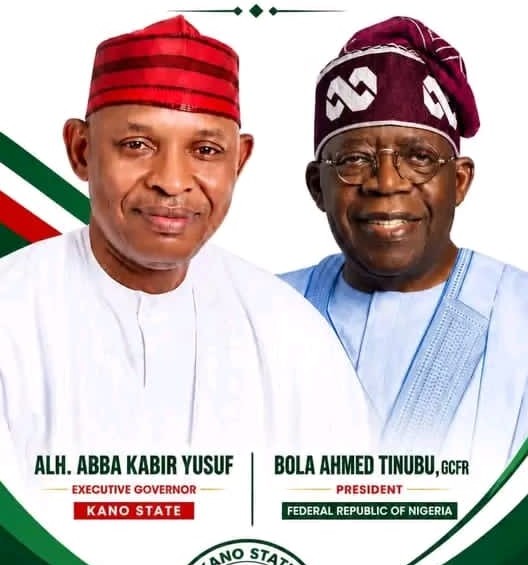

KANO 2027: YUSUF UNLEASHES APC POLITICAL OFFENSIVE, 136,000 DEFECTORS SWELL TINUBU CAMP.
By Bala Salihu Dawakin Kudu
Northern Bureau Chief
September 6, 2026.
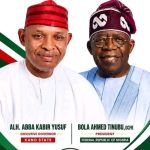
KANO — The political temperature in Kano has risen sharply as Governor Abba Kabir Yusuf throws his weight behind President Bola Ahmed Tinubu’s 2027 re-election bid, even as the All Progressives Congress (APC) receives more than 136,000 new members and a formidable list of politicians crossing from opposition platforms into the ruling party.
The development, coming barely months into the political preparations for the 2027 general elections, represents one of the most significant political realignments in Kano in recent times and has triggered fresh calculations among the major political camps in the state.
- Advertisement -

For a state widely regarded as one of Nigeria’s most politically consequential electoral battlegrounds, the message from the APC is clear: the 2027 contest has effectively moved into the mobilisation phase, and Kano is being positioned as a major front in the battle for the presidency and other elective offices.
Governor Yusuf, who received the new APC members, described the development as evidence of growing confidence in the party and its leadership.
The mass defection was contained in a statement issued by the Governor’s spokesman, Sunusi Bature Dawakin Tofa, on Saturday.
.
According to the statement, the new entrants came from various political parties and groups and pledged their support for President Tinubu and Governor Yusuf ahead of the 2027 elections.
The Governor welcomed the new members and urged them to remain committed to peace, unity and the development of Kano State and Nigeria.
But beyond the ceremony and the political symbolism lies a much bigger question: Can the latest influx translate into a formidable electoral machine capable of changing the political equation in Kano by 2027?
Among the most politically significant developments is the defection of Senator Rufa’i Sani Hanga, alongside his supporters, into the APC after leaving the NDC Kwankwasiyya political group.
Hanga is not a newcomer to Kano politics. His movement into the APC therefore carries political significance beyond the addition of another party member.
Governor Yusuf welcomed the former senator, describing his arrival and that of his supporters as an important addition to the APC family.
The Governor said the APC remained an open platform for politicians and citizens committed to the progress of Kano State and Nigeria.
Hanga, on his part, pledged to work with Governor Yusuf and other APC leaders towards strengthening the party and securing victory in the 2027 elections.
His defection could further complicate the calculations of opposition parties seeking to retain or regain political influence in the state.
Hanga’s arrival was accompanied by the emergence of several other prominent political figures in the APC camp.
Those listed as joining the ruling party include former Kano State Governor and Senator Kabiru Ibrahim Gaya; former PDP Deputy Governorship Candidate Yusuf Bello Dambatta; former NDC Deputy Chairman Aliyu Datti Yako; former Speaker of the Kano State House of Assembly Rt. Hon. Isyaku Ali Danja; and Senator Mas’ud El-Jibrin Doguwa.
Others include former NNPP Kano State Chairman Abdullahi Zubairu Imam Abiya; former NNPP Senatorial Candidate Senator Abdulmajid Dauda Dandawaki; former Commissioner and Special Adviser Senator Baraka Sani; and former Ungogo Local Government Chairman Muhammad Badaru Umar.
Also named are former NDC Kano State Woman Leader Amina Sirajo, former NDC Assistant Woman Leader Hauwa’u Turaki, former NDC Chairman Gezawa Gambo Hamza, former NDC Chairman Kura Handanu Umar, and former NDC Director-General Saminu Shehu Kura.
The list further includes former NDC Youth Leader Danladi Musa Garko, former NDC Auditor Sahabi Garba, former Gwale Local Government Chairman Sani Jibrin Dan Zara, former Makoda Local Government Chairman Hassan Abba Makoda, among others.
For the APC, the significance of the development lies not simply in the number of defectors but in the political networks, local structures and relationships that the individuals could potentially bring into the party.
A defection does not automatically translate into votes.
The real test will be whether these new political alliances can be converted into functioning ward-level structures, voter mobilisation and sustained grassroots engagement when the election eventually arrives.
While the APC was receiving defectors, Governor Yusuf was simultaneously stepping up his campaign for support for President Tinubu’s second-term bid.
The Governor made the call while receiving members of the Tinubu Support Group, led by its Coordinator, Chief James Faleke, during their visit to Kano as part of efforts to strengthen grassroots mobilisation ahead of 2027.
Yusuf called on Kano residents, APC members, support groups, youths and other stakeholders to mobilise massively for Tinubu and other APC candidates.
He assured the gathering that Kano would continue to play a significant role in supporting the President’s re-election effort.
The Governor also appealed to APC members to remain united, organised and focused, stressing that electoral victory would require sustained grassroots mobilisation and collective commitment.
The development places Yusuf at the centre of a potentially important political equation: consolidating his own political base in Kano while simultaneously helping to build support for the Tinubu presidency.
With its enormous electorate, extensive grassroots political networks and history of intense electoral competition, Kano remains a critical state in the calculations of presidential and gubernatorial contenders.
Success in Kano can provide a major psychological and numerical advantage to any political coalition, while a weak showing can significantly affect the national electoral arithmetic.
This explains why political parties traditionally begin their serious mobilisation in the state long before election day.
The latest APC strategy appears to be based on a combination of grassroots expansion, elite realignment and presidential mobilisation.
The 136,000 new members provide the numerical headline.
The entry of experienced politicians provides the political machinery.
And Yusuf’s endorsement of Tinubu provides the broader national direction.
The question is whether these three elements can be successfully integrated into one coherent electoral strategy.
The movement of politicians associated with opposition platforms into the APC could also have implications for the wider Kwankwasiyya political movement in Kano.
Kwankwasiyya has for years represented one of the most recognisable political tendencies in the state, built around a strong grassroots identity and an extensive network of supporters.
The latest defections therefore raise questions about whether the opposition’s political coalition can maintain its cohesion as 2027 approaches.
However, it would be premature to interpret every defection as evidence of the collapse of any political movement.
Nigeria’s political landscape is fluid, and politicians frequently realign as elections approach.
What matters ultimately is whether such movements produce sustainable organisational structures and voter support.
A rapidly expanding political coalition can create opportunities, but it can also generate competition over influence, positions, recognition and control of party structures.
The Governor’s call for unity and discipline therefore assumes particular importance.
Existing APC members must accommodate the new entrants, while the defectors must demonstrate commitment to the party beyond the ceremony of joining.
The party will also have to reconcile the interests of old members with those of influential newcomers if it hopes to maintain cohesion.
He must convert the current momentum into an organised electoral structure extending from the state leadership down to local government areas, wards and polling units. That is where the real battle for 2027 will eventually be fought.
But elections are not won by membership figures alone.
They are won by voters who turn out and cast their ballots.
The APC will therefore need to demonstrate that its new members are properly registered, politically engaged and capable of participating in the party’s grassroots mobilisation architecture.
Their real value will ultimately be measured by the strength of the political structures they can activate and the voters they can mobilise.
With the latest developments, Kano’s political contest is already taking shape. Governor Yusuf is openly mobilising support for Tinubu. The APC is expanding its membership base.
Prominent opposition figures are crossing into the ruling party.
Support groups are activating their structures.
And the major political camps are beginning to calculate what the emerging alliances could mean for 2027.
For the APC, the immediate objective is consolidation.
For the opposition, the latest movement represents a challenge to their existing political structures.
For Governor Yusuf, it is an opportunity to strengthen his political standing while positioning Kano as a major pillar of Tinubu’s re-election campaign.
And for the electorate, the unfolding realignment presents another chapter in Kano’s long history of fiercely contested politics.
The ultimate verdict, however, will not be delivered at political rallies or defection ceremonies.
It will be delivered by the voters.
For now, one thing is unmistakable: the 2027 political battle in Kano has started early—and the APC is moving aggressively to occupy the political terrain before its rivals can.
This version is deliberately written in a front-page feature/investigative political-analysis style: stronger lead, sharper subheads, more political context, and a clear distinction between party mobilisation claims and what will ultimately be demonstrated at the ballot box.
DemocracyNewslineNewspaper September 6, 2026