





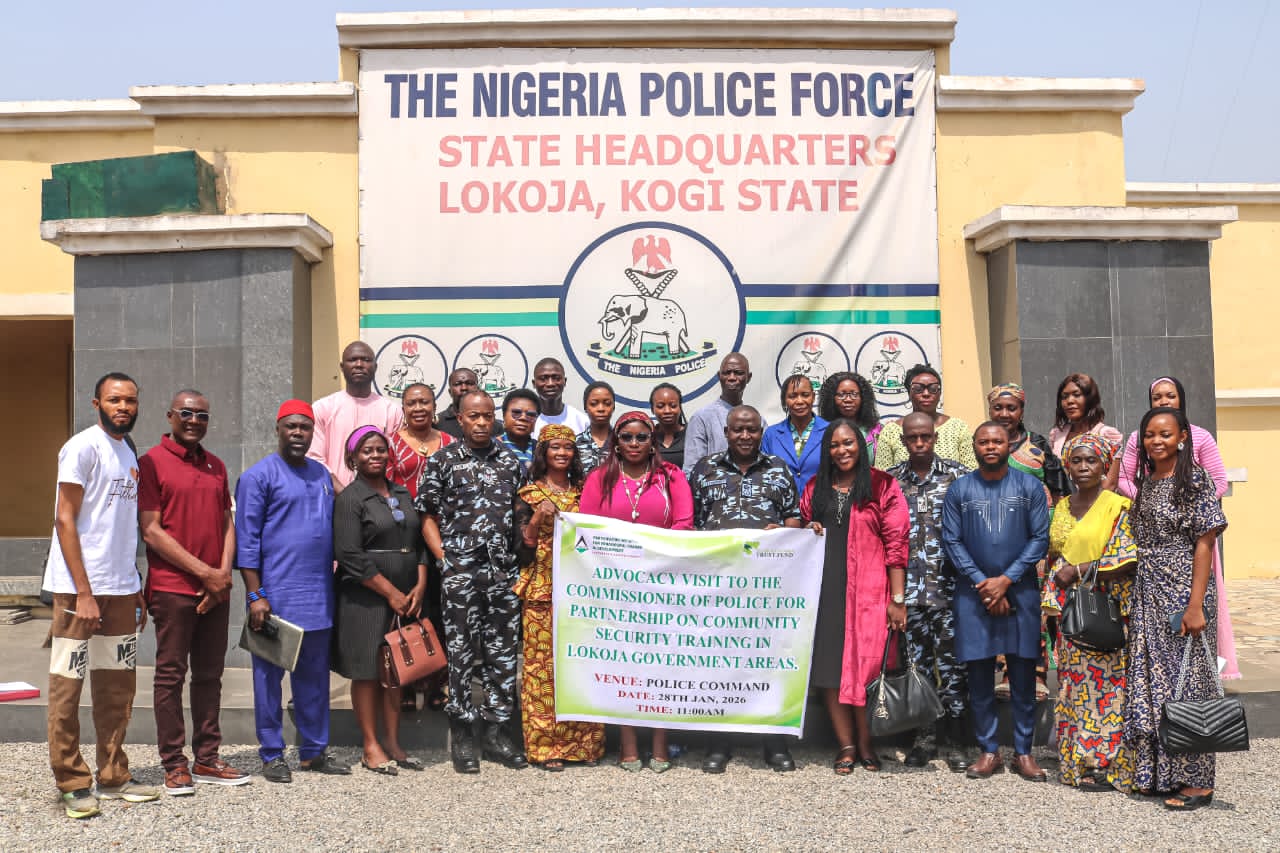

Kogi CP Kankarofi assures PIBCID, NWTF of Police collaboration in the fight against GBV
The Commissioner of Police, Kogi State Command, CP Naziru Bello Kankarofi, has assured members of Participation Initiative for Behavioral Change in Development (PIBCID), and other stakeholders in the state, that his command will collaborate effectively with them in the fight against Gender Based Violent (GBV) and other violent crimes in the state.
The CP gave the assurance yesterday in his office at the command headquarters in Lokoja, when members of Participation Initiative for Behavioral Change in Development (PIBCID), led other civil society groups to pay him an advocacy visit.
According to the police commissioner, members of civil societies, stakeholders and government must work together to ensure that gender Based violence is reduced to the bearest minimum across the state
- Advertisement -


“Speaking further he said “The fight against Gender Based violence must be the collective responsibility of everyone. We have mothers, sisters and daughters, therefore the problem affects all of us, hence the need to collectively fight the problem.
Earlier the Executive Direct of PIBCID, Akande Racheal Remilekun, noted that the visit was to seek the collaboration of the police command in the areas of capacity building for women, sensitization, collaboration and the necessary institutional support.
According to her the project is being supported with funding from the Nigeria Women Trust Fund (NWTF).
She added that PIBCID had carried out interventions in Ujagba, Okpachala (Igalamela LGA), Nagazi/Osisi (Adavi LGA), Serikinoma, Adankolo, Felele, and Zango/Ajanaku communities in Lokoja Local Government areas.
According to her, the interventions focused on building the capacity of women and children, ensuring full implementation of relevant policy documents, and promoting access to information in order to reduce vulnerability in project communities.
“Beneficiaries were also empowered with adequate knowledge of their rights under various laws, including the Child Rights Act and the Violence Against Persons Prohibition (VAPP) Law.
“The intervention was strategic and timely. However, in the course of project implementation, a number of gaps were identified, which informed the need for a scale-up phase to address these gaps effectively.
“These gaps include insecurity, among other factors, which limit strategic and quality engagement with key state actors, partners, and duty bearers. She stressed
She noted that Insecurity has emerged as a significant driver of Gender-Based Violence (GBV) in Kogi State, adding that insecurity has increasingly become a major challenge in Kogi State, creating conditions that heighten the risk and prevalence of Gender-Based Violence (GBV).
“As communities grapple with kidnapping, banditry, communal clashes, and weak law enforcement, women and girls become more vulnerable to various forms of abuse and exploitation. She said
“The breakdown of community safety exposes women and girls to sexual violence, particularly in areas where armed groups operate. Perpetrators take advantage of poor surveillance, inadequate lighting, and weak policing to commit rape, harassment, and abduction with little or no consequence.
She noted that displacement caused by insecurity often forces families to flee their homes in search of safer environments, stressing that in such situations, women and girls are at higher risk of survival sex, exploitation by caregivers, and abuse within overcrowded shelters or temporary settlements.
“Economic hardship further worsens their vulnerability. Furthermore, the psychological stress and economic pressure on households due to insecurity can escalate domestic violence.
“Loss of livelihoods, fear of attacks, and trauma associated with insecurity can increase tension within families, with women and children bearing the brunt of physical and emotional abuse.
“Additionally, limited access to justice and weak reporting systems in the face of insecurity discourage survivors from seeking help. In many rural communities in Kogi State, fear of retaliation, stigma, and lack of trust in security agencies prevent survivors from reporting perpetrators, allowing GBV to persist.
She noted that the proposed community engagement is to build the capacity of communities on early warning signs and identification of security red flags, adding that it also strengthen community surveillance by promoting monitoring of unusual or suspicious individuals around neighbourhoods or homes, as well as identifying aggressive behaviour, vandalism, or damage to property.
Others she said includes; “To increase awareness of reporting mechanisms and strengthen reporting structures within community systems.
She listed to the proposed communities for this intervention to include Ganaja Village, Zango/Ajanaku, Felele, and Serikinoma communities.
“Finally, Sir, I humbly seek your partnership and support towards the successful implementation of community security training in Lokoja Local Government Area of the state.
(DEMOCRACY NEWSLINE NEWSPAPER, JANUARY 29TH 2026)