





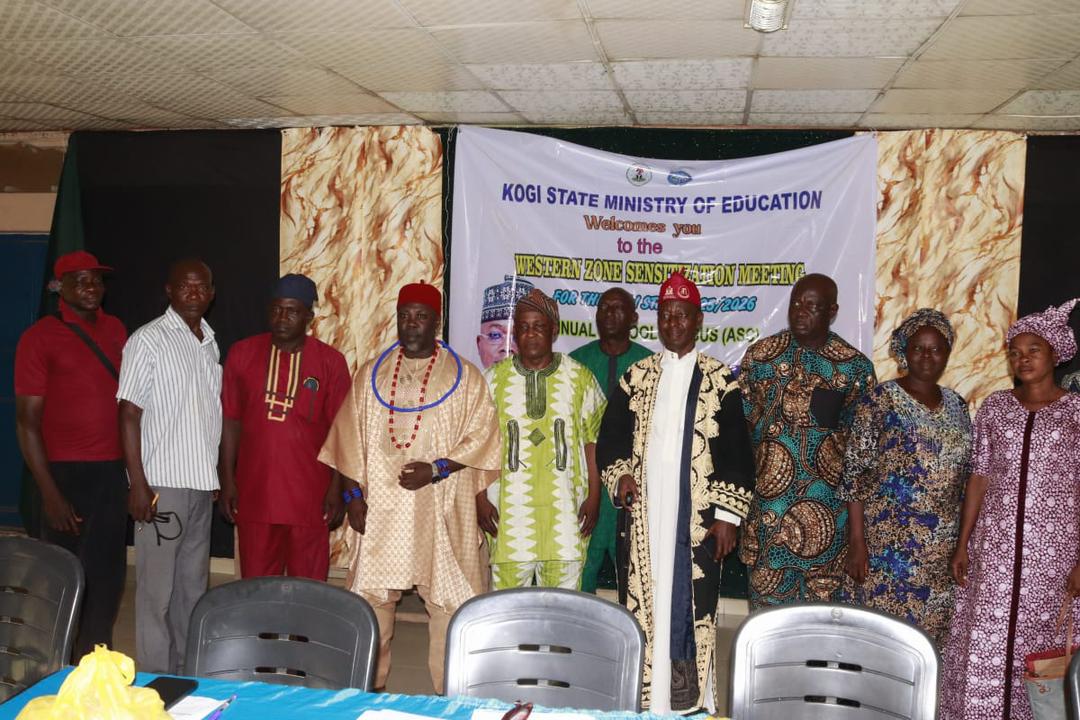

Kogi Moves to Strengthen Education Planning as Wemi Jones Flags Off 2025/2026 Annual School Census Sensitisation in Kogi West
***Commissioner warns schools against non-compliance as DNEMIS introduces Learner Identification Number for all Nigerian students
The Kogi State Government has intensified efforts to strengthen educational planning, resource allocation, and policy implementation with the commencement of sensitisation activities for the 2025/2026 Annual School Census (ASC) across the three senatorial districts of the state.
Speaking during the Kogi West sensitisation programme in St. Augustine College, Kabba, the Kogi State Commissioner for Education, Hon. Wemi Jones, FCIB, described the Annual School Census as a critical instrument for building a responsive and inclusive education system, stressing that accurate data remains the foundation for effective educational interventions.
- Advertisement -
According to the Commissioner, every piece of information captured during the census represents a child, a teacher, a classroom, and ultimately the future of Kogi State.
Quoting the late Nelson Mandela, Hon. Jones noted that education remains the most powerful weapon for changing society, adding that reliable data is indispensable in ensuring that government policies and educational programmes achieve their intended objectives.
He cited the state’s free education policy and the payment of external examination registration fees for learners as examples of interventions made possible through credible educational data, noting that such initiatives have significantly improved access to education and learning outcomes across the state.
The Commissioner called on proprietors, principals, head teachers, education secretaries, area education evaluators, local government chairmen, and school data officers to fully support the exercise by providing accurate and timely information.
He revealed that the Federal Ministry of Education has adopted the Digital Nigeria Education Management Information System (DNEMIS) as the national platform for educational data management and warned that any school that fails to participate in the Annual School Census risks denying its learners access to the Learner Identification Number (LIN).
Hon. Jones explained that the LIN would serve as a unique educational identity for every learner from primary school through tertiary education and even during the National Youth Service Corps (NYSC) programme.
“Not being captured implies that the learner is not recognised within the national education database,” he emphasized, urging schools to upload complete and accurate information on learners, staff, and school facilities to the DNEMIS portal.
He further disclosed that step-down trainings would be organised for school officials to ensure seamless participation in the census exercise.
In his presentation, the State Education Management Information System (EMIS) Officer, Mr. Victor Iselewa, described the Annual School Census as the backbone of educational planning and decision-making.
He explained that the exercise provides comprehensive statistics on learner enrolment, teacher distribution, school infrastructure, sanitation facilities, learning resources, and other critical indicators necessary for policy formulation and resource allocation.
According to Iselewa, the newly introduced DNEMIS platform serves as a centralized national database for schools and learners, assigning every school a unique 10-digit identification number while integrating learners into a unified national educational record system.
He highlighted the benefits of the platform, including improved planning, enhanced examination integrity, tracking of out-of-school children and dropouts, monitoring learner movement across schools, and integration with the National Identity Management Commission (NIMC) and the National Education Repository and Databank (NERD).
The EMIS Officer disclosed that the Ministry had already conducted a two-day training programme for school data officers in Lokoja Local Government Area, while similar trainings would be extended to other local government areas ahead of the official commencement of the census on June 24, 2026.
He noted that accurate census data would facilitate equitable distribution of educational resources, improve teacher deployment, support gender inclusion policies, strengthen educational reforms, and enable targeted interventions across schools in the state.
Addressing concerns among private school operators, Iselewa clarified that the Annual School Census is not intended for taxation purposes but rather for educational planning, research, development, and policy formulation.
Earlier, the Chairman of
All Nigeria Confederation of Principals of Secondary Schools ANCOPSS, Kabba-Bunu Local Government Area chapter, Mr. Emmanuel Abolusoro, welcomed participants to the sensitisation programme and commended the Commissioner for taking the awareness campaign to the senatorial zones.
He noted that the zonal approach had made participation easier and safer for stakeholders, particularly in view of prevailing security concerns in parts of the country.
Also speaking, the Onu-Igala Kabba and Oga-Ataa Igala Ede, His Royal Highness Chief Onuche Zico Isaac Idoko, who represented traditional institutions, described the initiative as timely and beneficial to the future of education in the state.
The traditional ruler emphasized that the Learner Identification Number would help generate accurate educational data, thereby enabling government to plan effectively and make adequate provisions for school children.
He praised Governor Ahmed Usman Ododo and Hon. Wemi Jones for championing the initiative and reaffirmed the support of traditional institutions toward the successful implementation of the 2025/2026 Annual School Census.
The Ministry of Education announced that sensitisation meetings would be held across the three senatorial districts, with Kogi West hosted at St. Augustine’s College, Kabba; Kogi Central scheduled for Abdul Atta Memorial College, Okene; and Kogi East at Our Lady of Schools, Anyigba.
Stakeholders expressed optimism that the exercise would provide the accurate data needed to drive educational development, improve planning, and position Kogi State for greater success in the delivery of quality education.
Signed:
Media Office of the Honorable Commissioner for Education, Kogi State
(DEMOCRACY NEWSLINE NEWSPAPER, JUNE 19TH 2026)