


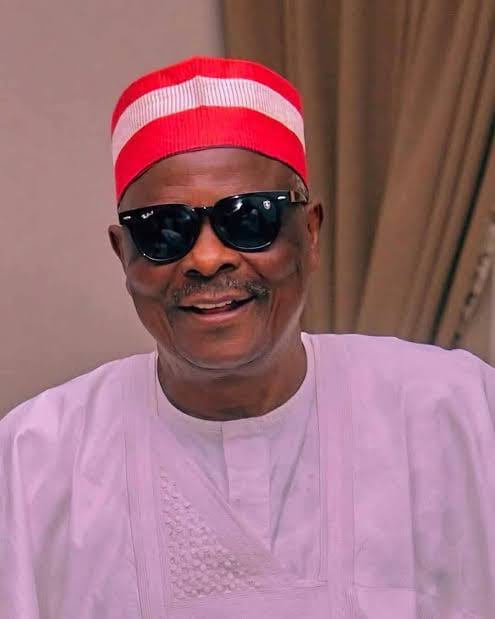

Kwankwaso: Shekarau, Ganduje, Abba Yusuf Have Lost Political Grip in Kano
2027: Ex-Governor Says.
By Bala Salihu Dawakin Kudu
Northern Bureau Chief, Democracy Newsline
August 17, 2026.
ABUJA — Former Kano State Governor and Vice-Presidential Candidate of the National Democratic Congress (NDC) in the 2027 general election, Senator Rabiu Musa Kwankwaso, has declared that former governors Ibrahim Shekarau and Abdullahi Umar Ganduje, as well as incumbent Governor Abba Kabir Yusuf, have lost or are losing their political grip in Kano State.
Kwankwaso made the assertion while reflecting on his political journey and relationships with former allies during an interview with the News Agency of Nigeria (NAN) Personality Interview Series in Abuja on Sunday.
- Advertisement -
The former governor, who has remained one of the most influential political figures in Kano politics for more than two decades, attributed the decline in the fortunes of some former associates to what he described as “treachery” and the abandonment of political structures that helped them rise to prominence.
According to Kwankwaso, political success built on betrayal of trusted allies is rarely sustainable.
“You cannot succeed with treachery. I have not seen one,” he said, adding that his experience of more than two decades in politics had convinced him that politicians who betray their political allies often end up in political oblivion.
Ganduje’s Political Fortune
Kwankwaso particularly focused on the political trajectory of Ganduje, who served as his deputy governor for eight years before succeeding him as governor in 2015.
The relationship between the two former political allies later deteriorated, with Ganduje establishing an independent political base and eventually emerging as one of Kwankwaso’s strongest political rivals in Kano.
Reflecting on the development, Kwankwaso argued that Ganduje would have enjoyed greater political influence had he maintained the political structure they jointly built.
He said Ganduje’s political difficulties began when he started distancing himself from the political camp that had supported his emergence as governor.
“If you can even see the issue of Ganduje, who we came together and supported, and became governor free of charge. The day when he started fighting was the beginning of his problem. If I may ask: where is he now? It is difficult to see him,” Kwankwaso stated.
He maintained that political loyalty and patience were essential for sustaining influence, suggesting that the current state of Ganduje’s political career was partly a consequence of the former governor’s decision to break away from the political structure.
‘We Chose Abba Yusuf to Avoid a Repeat of Ganduje’
Kwankwaso also turned his attention to Governor Abba Yusuf, whom he described as another politician whose political rise was made possible by the support of the Kwankwasiyya political movement.
He said Yusuf was deliberately selected as the movement’s candidate because the group wanted to avoid a repeat of the experience it had with Ganduje.
According to him, members of the political movement worked extensively to secure Yusuf’s emergence as its governorship candidate in the 2019 election.
Although Yusuf won that election, his victory was later overturned through litigation.
Kwankwaso said the political structure regrouped ahead of the 2023 election and eventually secured Yusuf’s victory despite what he described as attempts to deploy similar tactics against the party.
However, he alleged that Yusuf had subsequently distanced himself from the political group that helped bring him to power.
“He left us, but he is not with Ganduje now. He is in-between because I don’t think he is happy for anybody to call him Dan Gandujiyya,” Kwankwaso said.
The former governor also claimed that Yusuf’s association with Ganduje had created political difficulties for the incumbent governor, while suggesting that Yusuf was attempting to establish himself as the dominant political force in Kano.
Kwankwaso, however, maintained that political influence cannot be transferred overnight, urging politicians to exercise patience.
“People have no patience and that is why they are making those mistakes. It is just a matter of patience,” he said.
Shekarau Also Mentioned
Kwankwaso’s comments also placed former Kano State Governor Ibrahim Shekarau among politicians whose political influence in the state has significantly diminished.
Although he did not dwell extensively on Shekarau in the interview, his broader argument was that politicians who once occupied powerful positions could eventually lose their relevance when political alliances shift and new structures emerge.
The comments come against the backdrop of Kano’s intensely competitive political environment, where rival political camps have historically competed for control of the state’s powerful grassroots structures.
Political Alliances Are Not Permanent, Says Kwankwaso
The former governor said the pattern was not peculiar to Kano, describing political fallouts and the collapse of once-powerful alliances as recurring features of Nigerian politics.
Kwankwaso recalled a conversation with President Bola Ahmed Tinubu in which the President reportedly encouraged him to reconcile with Ganduje.
According to him, he responded by drawing attention to several politicians who had once been close to the President but were no longer prominent within his political circle.
He cited former Lagos State Deputy Governor Kofoworola Bucknor-Akerele and former Lagos State Governor Akinwunmi Ambode as examples.
“I told him that when I come here, I don’t see Bucknor. When I come here, I don’t see Ambode. I started counting the people,” he recalled.
Kwankwaso said his long experience in Nigerian politics had taught him that political relationships could change dramatically, even among individuals who had once worked closely together.
He noted that political associates could become estranged despite having shared years of common political struggles and objectives.
While acknowledging that political disagreements and shifting alliances were common across Nigeria, Kwankwaso argued that the Kano experience had its own peculiar characteristics.
“It’s not very peculiar to Kano, but I think the Kano experience is special out of the general lots,” he said.
He nevertheless singled out former Osun State Governor, Chief Bisi Akande, as one of the political figures he still regards as a friend, despite the changing nature of Nigerian politics.
Kwankwaso likened some political relationships to friendships formed during school years, where people could remain connected despite taking different paths later in life.
2027 Politics Looms Large
Kwankwaso’s latest comments are likely to further intensify political debate in Kano ahead of the 2027 general elections, as rival political camps position themselves for control of the state’s influential political machinery.
Kano remains one of Nigeria’s most politically strategic states, with its large electorate and highly organised grassroots structures making it a major battleground in national and regional elections.
His remarks also underscore the continuing importance of the Kwankwasiyya political movement in Kano politics and the former governor’s determination to retain his influence over the political direction of the state.
For now, however, the former governor’s assessment of the political fortunes of Shekarau, Ganduje and Yusuf is certain to provoke responses from their supporters and deepen the already intense political conversations surrounding Kano ahead of 2027.
(DEMOCRACY NEWSLINE NEWSPAPER 16TH AUGUST, 2026)