





Opposition Parties Reject the 2026 Electoral Act Signed by President Tinubu.
By Bala Salihu Dawakin Kudu
Democracy Newsline Newspaper
February 27, 2026.
Several opposition political parties in Nigeria have rejected the newly enacted 2026 Electoral Act, recently passed by the National Assembly and assented to by President Bola Ahmed Tinubu. They have called for an urgent amendment of what they described as “anti-democratic provisions” embedded in the law.
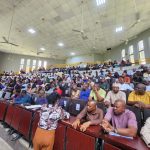
At a press conference titled “Emergency Call to Rescue Nigeria’s Democracy” held in Abuja on Thursday, opposition leaders warned that the Act, in its current form, could undermine the credibility of elections and erode public trust in the electoral system ahead of the 2027 general elections.
Key Opposition Figures in Attendance.
- Advertisement -
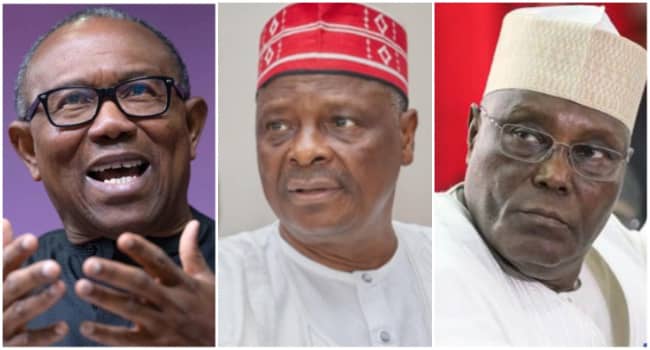
The event brought together prominent political actors, including former Senate President David Mark, former Osun State Governor Rauf Aregbesola, former Vice President Atiku Abubakar, former Rivers State Governor Rotimi Amaechi, and former Anambra State Governor Peter Obi, all associated with the African Democratic Congress (ADC).
Also present were the National Chairman of the New Nigeria Peoples Party (NNPP), Ahmed Ajuji, and other senior party figures including Buba Galadima.
Controversial Provisions of the 2026 Electoral Act.
One of the most contentious provisions is the amendment to Section 60(3), which allows electoral officers to revert to manual transmission of results where technological challenges occur.
Opposition leaders argue that this clause weakens the mandatory electronic transmission of results and could create loopholes for manipulation. They insist that Nigeria’s electoral technology infrastructure has improved significantly in recent years, and that the Independent National Electoral Commission (INEC) has previously affirmed its capacity to conduct electronic result transmission nationwide.
Critics fear that permitting manual fallback options may reopen avenues for electoral malpractice, particularly in remote or politically sensitive areas.
Another controversial amendment concerns Section 84, which limits political parties to either direct primaries or consensus arrangements for selecting candidates, effectively excluding indirect primaries.
Opposition parties argue that this constitutes undue interference in the internal affairs of political parties. They maintain that indirect primaries remain a legitimate democratic method and provide flexibility for large parties with complex structures.
Opposition leaders referenced alleged irregularities in recent local government elections in the Federal Capital Territory (FCT), describing them as deeply flawed. They argue that such experiences heighten concerns about the readiness of Nigeria’s electoral system to conduct credible elections in 2027 under the new legal framework. They warn that unless the 2026 Electoral Act is comprehensively reviewed, public confidence in Nigeria’s democracy may continue to decline.
If the National Assembly declines to revisit the law, several potential consequences may follow:
Increased Political Tension
Opposition parties may intensify protests, political mobilization, and public campaigns against the Act, increasing political polarization ahead of 2027,
Legal Challenges Yes, opposition parties and civil society organizations can take legal action. They may:
File suits in the Federal High Court challenging the constitutionality of certain provisions and argue that specific clauses violate constitutional guarantees such as fair hearing, political participation, or party autonomy. Seek judicial interpretation from appellate courts or ultimately the Supreme Court.
However, legal processes can be lengthy, and court rulings may not come before critical electoral timelines unless expedited.
If citizens perceive the system as compromised, voter turnout in 2027 may decline, weakening democratic legitimacy.
with the 2026 Electoral Act
Several structural and practical challenges are emerging: Technological Trust Deficit and Allowing manual transmission may undermine public trust in electronic voting reforms introduced in recent cycles.
Party Autonomy Concerns
Restricting the mode of primaries may be interpreted as federal overreach into internal party governance. INEC may face operational confusion if hybrid systems (manual and electronic) operate simultaneously and
Prolonged legal battles could create uncertainty close to election periods, destabilizing preparations.
If lawmakers choose to respond constructively, they could: Conduct public hearings involving political parties, civil society, and electoral experts. Also
Clarify the conditions under which manual transmission is permitted. Therefore they can Reinstate flexibility for indirect primaries under regulated conditions.
Strengthen oversight mechanisms to ensure transparency in both electronic and manual processes, Set up an independent technical audit framework to build public trust, Constructive dialogue rather than confrontation may prevent deeper democratic strain.
Technically, the law is workable. However, its success depends heavily on:
Clear implementation guidelines by INEC,
Transparent communication with stakeholders,
Strong judicial oversight,
Political goodwill across party lines. Without these, even a well-drafted law can fail in practice.
The 2027 general elections could be affected in several ways:bPositive Scenario
If amended and clarified, the Act could strengthen electoral credibility and reduce disputes.
Negative Scenario
If left contentious:
Court cases may delay candidate nominations.
Parties may struggle with internal primaries.
Public distrust may suppress voter turnout.
Post-election litigation may increase.
The stability of Nigeria’s democracy heading into 2027 will largely depend on whether political actors prioritize consensus and institutional integrity over partisan advantage.
The rejection of the 2026 Electoral Act by opposition parties marks the beginning of what could become a defining debate in Nigeria’s democratic journey. Whether through legislative amendment or judicial intervention, the coming months will determine whether the law becomes a stabilizing framework or a source of renewed political conflict. If dialogue prevails, Nigeria’s democracy may emerge stronger. If not, the stakes for 2027 could be considerably higher than anticipated.
(DEMOCRACY NEWSLINE NEWSPAPER, FEBRUARY 27TH 2026)