


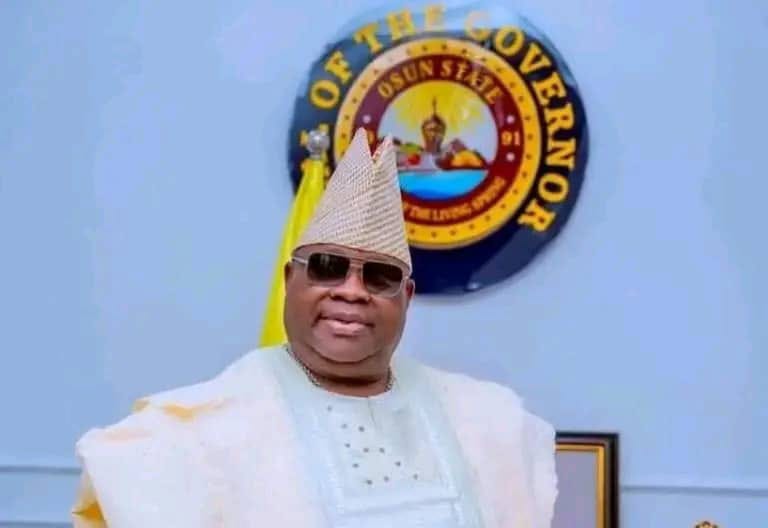

OSUN 2026: THE MESSAGE BEYOND ADELEKE’S VICTORY — WHAT 2027 MUST TEACH NIGERIA’S POLITICAL CLASS
A Critical Rejoinder on Elections, Political Strategy, Governance, Reform and the New Psychology of the Nigerian Electorate
By Dr. Aiyeku Olufemi Samuel Adeyinka
Political, Policy & Economic Development Analyst
The Osun State governorship election of 15 August 2026 has produced a result that deserves more than celebration, condemnation or partisan interpretation.
- Advertisement -
It deserves serious political surgery.
Governor Ademola Adeleke has won a second term, this time under the Accord Party, defeating the APC candidate Bola Oyebamiji by 511,067 votes to 444,815. Adeleke won 19 of the 30 local government areas, while Oyebamiji won 11. The margin was 66,252 votes.
Congratulations to Governor Ademola Adeleke.
Congratulations also to the people of Osun State.
But perhaps the more important congratulations should go to the electorate themselves.
They have once again demonstrated that the Nigerian voter is not necessarily the political captive that politicians often assume.
The voter may listen to your promises, attend your rally, collect your campaign materials, smile at your convoy and still walk into the polling booth carrying a completely different decision.
That is the first lesson.
The ballot belongs to the voter.
And politicians ignore that reality at their own peril.
There is perhaps no stronger foundation for a second-term mandate than good governance and demonstrable performance. The desire of an incumbent to return for another term is legitimate, but the electorate is equally justified in asking whether that desire has been earned and sufficiently justified by the record of the first term. In the case of Governor Ademola Adeleke, his re-election should therefore be viewed not merely as the advantage of incumbency, but as a political reward that was, in the assessment of many voters, reinforced by his visible performance and connection with the people. Incumbency may open the ectoral door, but performance provides the key to walk through it successfully. The lesson for every governor seeking a second term is simple: do not campaign on the privilege of occupying office; campaign on the evidence of what you accomplished with it. A return to office is desirable, but it must be justified by results, strengthened by trust and ultimately validated by the people at the ballot box.
THE OSUN VERDICT IS NOT JUST ABOUT ADELEKE
There is a temptation to reduce the Osun election to Adeleke versus Oyetola, Accord versus APC, or PDP history versus APC machinery.
That would be intellectually lazy.
This election was much bigger than two political personalities.
It was about identity, performance, political structure, alliances, emotional connection, party organisation, federal influence, local grievances, campaign psychology, voter expectations and, importantly, the electorate’s perception of who was speaking to them rather than merely speaking at them.
Osun had 2,339,233 registered voters spread across 30 local government areas, 332 wards and 3,763 polling units.
That is not a small electoral laboratory.
It is a significant political case study.
And the fact that an incumbent governor seeking re-election under Accord, a relatively smaller party, could defeat the APC machinery in the state should force every major political party in Nigeria to revisit its assumptions about political strength.
The APC should pay particular attention.
A BIG PARTY CAN LOSE TO A SMALLER PARTY
What does it mean when a sitting governor leaves the traditional platform on which he originally won office, moves to a smaller political party and still wins re-election?
It means the political brand of the candidate can sometimes become more powerful than the political brand of the party.
That is uncomfortable for political parties.
But it is reality.
A political party may have governors, senators, ministers, legislators, money, national structures and powerful godfathers.
But if the voter identifies more strongly with the candidate, the party machinery can become secondary.
That is precisely why political parties should stop confusing institutional power with electoral popularity.
The Accord victory is particularly instructive because Adeleke did not merely scrape through.
He secured 511,067 votes against 444,815 for APC’s Oyebamiji.
That is a substantial mandate.
THE ADELEKE FACTOR
There is another uncomfortable truth.
Personality matters in Nigerian politics.
Ademola Adeleke has developed an unusual political identity. His public persona, accessibility, dancing, emotional communication style and ability to connect with ordinary voters have frequently attracted both ridicule and affection.
But politics is not a beauty contest.
It is about connection.
The politician who understands the emotional language of his electorate can sometimes defeat the politician with the better résumé but weaker connection.
This raises a fundamental question.
Why do some politicians spend millions designing sophisticated campaign messages while failing to understand the emotional language of the people they want to govern?
Because they are often speaking from the boardroom to the marketplace.
Politics is not only about what you say.
It is about what people believe you represent.
THE PRESIDENTIAL CALCULATION
My earlier observation was that President Bola Ahmed Tinubu could potentially be comfortable with different outcomes in Osun because his larger political calculation is national and ultimately connected to 2027.
I would, however, refine that argument after the actual result.
It would be intellectually dangerous to claim that the President was indifferent to who won Osun without direct evidence.
There is evidence that the presidency and APC leadership invested politically in the contest. President Tinubu had publicly congratulated Bola Oyebamiji on his emergence as the APC candidate and described the mission as reclaiming Osun for the progressive fold.
Therefore, the more defensible argument is this:
The President’s political horizon is considerably larger than Osun.
Osun matters, but Osun is not Nigeria.
The President’s central electoral challenge remains the 2027 presidential election, for which he has already emerged as the APC candidate. The State House announced that Tinubu secured 10,999,162 votes in the APC presidential primary.
So the analytical question should not simply be, “Did Tinubu want Adeleke or Oyebamiji?”
The better question is:
What lessons will the President and the APC extract from Osun before 2027?
That is where the real political homework begins.
TINUBU’S ADVANTAGE IS ALSO HIS RESPONSIBILITY
President Tinubu has demonstrated a political capacity for coalition-building and cross-party engagement.
That is an advantage.
But coalition politics is not the same thing as electoral ownership.
The President can build alliances across political parties and political tendencies, but those alliances must eventually translate into votes.
And votes are earned locally.
A presidential election is not won in Abuja.
It is won in polling units.
The same principle applies to governors, senators and members of the House of Representatives.
The Abuja politician who forgets his ward has already begun losing the election.
THE OYETOLA QUESTION
The Oyetola factor also deserves sober examination.
Gboyega Oyetola remains an important figure in Osun politics. He was born in Iragbiji and has deep roots in the state’s political structure. He is also closely associated with President Tinubu politically and has served at the federal level.
There is also a documented family relationship between the Tinubu and Oyetola families in accounts about their Iragbiji ancestry. However, such family narratives should be treated carefully and not converted into simplistic explanations for electoral outcomes.
Political relationships matter.
But voters matter more.
A political leader may control a structure.
The voter controls the ballot.
That distinction is fundamental.
THE GODFATHER VERSUS THE GRASSROOTS
One of the greatest misconceptions in Nigerian politics is that controlling party structures automatically means controlling voters.
It does not.
A political leader can control the party secretariat and still lose the polling unit.
A senator can control appointments and still lose his ward.
A governor can control state machinery and still lose a local government.
A president can control national institutions and still discover that voters have their own independent calculations.
So what is political power?
Political power is not merely the ability to mobilise people to a rally.
It is the ability to persuade citizens that your leadership deserves another mandate.
THE “DAVID VERSUS GOLIATH” EFFECT
I agree with the observation that the heavy national mobilisation around the APC campaign may have unintentionally strengthened Adeleke’s victim narrative.
When the entire political establishment appears to converge on one state against one incumbent, psychology enters the election.
The electorate begins asking:
Why is everybody coming here?
Why is this election being treated like a national war?
Who is really fighting whom?
And sometimes, the more powerful side becomes less attractive to voters because the underdog begins to look like the victim.
Politics is psychology.
Campaigns therefore require not only numbers but emotional intelligence.
THE EFCC AND THE POLITICS OF SYMPATHY
The freezing of Osun State Government accounts by the EFCC also became part of the political narrative around the election.
Regardless of one’s legal or political interpretation of that episode, the political consequence was clear: it became ammunition for competing narratives about federal pressure, state autonomy, accountability and political victimisation.
This is an important lesson for institutions.
When law-enforcement actions occur close to an election, perception matters.
Even when an institution believes it is acting strictly within the law, political actors may interpret the action differently.
That is why transparency, timing, communication and institutional independence are essential.
THE ELECTORATE ALSO DESERVES A MIRROR
We must not blame politicians for everything.
The electorate has responsibilities too.
A democracy cannot mature if voters sell their votes today and complain about bad governance tomorrow.
Reports before and during the Osun election continued to raise concerns about vote buying, voter inducement and electoral integrity. Civil society organisations had warned about security, voter education and evolving forms of vote buying even before election day.
This problem did not begin in 2026.
In the 2022 Osun election, FIDA observers reported vote trading in about 16 percent of polling units they observed.
So the problem is systemic.
If N5,000 today can determine your vote, what happens to the next four years?
If a politician gives you N10,000 and takes control of a public budget worth billions, who really won the transaction?
That is the hard question.
The electorate must evolve from transactional citizenship to performance-based citizenship.
WE MUST ALSO COMMEND THE ELECTORATE
Despite all these challenges, the people of Osun deserve commendation.
They participated.
They made choices.
They rejected the assumption that political power is permanently transferable from one elite bloc to another.
They demonstrated that even a smaller political platform can become electorally competitive when it carries a candidate who has established sufficient personal political capital.
That is democracy.
But the electorate must now demand something more important from Adeleke:
Performance.
The election is over.
The dancing can continue.
The celebrations can continue.
But governance must now become even more serious.
Adeleke has been given another four years.
What will he do with it?
THE REAL TEST FOR ADELEKE STARTS NOW
Winning an election is not the same thing as governing successfully.
An election gives legitimacy.
Governance gives legacy.
Adeleke should therefore treat his second mandate not as a reward but as a contract.
The people have said, “Continue.”
The appropriate response should be:
“Then hold me accountable.”
His second administration should focus on measurable outcomes in education, healthcare, agriculture, roads, water, electricity, youth employment, digital economy, industrialisation and local economic development.
The people should see budgets translated into projects.
They should see policies translated into jobs.
They should see roads translated into commerce.
They should see schools translated into skills.
They should see healthcare translated into lives saved.
That is the difference between political victory and developmental success.
THE 2027 MESSAGE FOR GOVERNORS
Every governor should study Osun carefully.
Do not assume that your party will save you.
Do not assume federal influence will save you.
Do not assume your political godfather will save you.
Do not assume social media will save you.
Do not assume poverty will make people permanently dependent on you.
Governors must govern.
They must publish measurable performance indicators.
They must publish project locations.
They must publish project costs.
They must publish completion dates.
They must publish internally generated revenue figures.
They must publish debt obligations.
They must publish employment outcomes.
The era of “we are working” without measurable evidence should be ending.
THE MESSAGE FOR SENATORS
Senators must return to the meaning of representation.
A senator should not become visible only when seeking re-election.
What legislation have you sponsored?
What national policies have you influenced?
What constituency interventions have you facilitated?
How many young people have benefited from skills programmes?
How many communities have gained access to water?
What has happened to healthcare?
What has happened to education?
What economic opportunities have you created?
The Senate seat is not an award.
It is a public trust.
THE MESSAGE FOR MEMBERS OF THE HOUSE OF REPRESENTATIVES
House members should understand that proximity to ministries is not the same thing as constituency development.
The modern legislator must combine lawmaking, oversight, constituency representation and economic advocacy.
Every federal constituency should have a publicly accessible development scorecard.
What was promised?
What was delivered?
What did it cost?
Who benefited?
What remains outstanding?
That is accountability.
THE MESSAGE FOR THE PRESIDENCY
The presidency must learn one central lesson from Osun:
National popularity cannot substitute for local political intelligence.
The Federal Government should deepen institutional neutrality and ensure that federal agencies are not perceived as instruments of partisan warfare.
Security agencies must protect elections, not political interests.
The EFCC must pursue corruption wherever the evidence leads, but timing and transparency around politically sensitive investigations are critical to public confidence.
INEC must continue improving election technology, logistics and result transparency.
The President himself said in his 2026 Democracy Day address that Nigeria’s democracy is not perfect but must be strengthened, and he urged INEC, security agencies and political parties to ensure peaceful and credible elections in Osun and Ekiti.
That principle must become institutional practice.
THE 2027 CLOCK IS ALREADY TICKING
INEC has fixed 16 January 2027 for the presidential and National Assembly elections and 6 February 2027 for governorship and State House of Assembly elections.
That means 2027 is no longer a distant political conversation.
It is already here.
The lesson from Osun should therefore be converted into action.
What should political parties do?
First, stop choosing candidates merely because they are wealthy.
Second, stop mistaking political loyalty for competence.
Third, stop imposing unpopular candidates on constituencies.
Fourth, conduct credible internal elections.
Fifth, reconcile factions before elections rather than after defeat.
Sixth, invest in permanent grassroots structures.
Seventh, build data-driven voter engagement.
Eighth, develop policies that people can understand.
Ninth, train young people as political professionals rather than political thugs.
Tenth, make women and persons with disabilities genuine participants in political decision-making.
THE REFORM AGENDA
Nigeria urgently needs electoral and political reforms that go beyond changing election technology.
We need stronger internal party democracy.
We need transparent political financing.
We need tougher enforcement against vote buying.
We need stronger protection for ballot secrecy.
We need better sanctions for electoral violence.
We need transparent collation systems.
We need faster resolution of electoral disputes.
We need credible party membership registers.
We need improved voter education.
We need better regulation of campaign spending.
We need stronger civic education in schools.
And we need politicians to understand that democracy is not simply the freedom to win.
It is also the responsibility to govern fairly after winning.
THE REAL MEANING OF 2027
2027 should not become another four-year cycle of slogans.
Nigeria can not afford it.
We need a contest of ideas.
A contest of competence.
A contest of records.
A contest of economic visions.
A contest of development models.
A contest of integrity.
The question should no longer be:
“Who is your godfather?”
The question should be:
“What have you achieved?”
Not:
“How much money can you spend?”
But:
“What problem can you solve?”
Not:
“How many people attended your rally?”
But:
“How many lives improved because of your leadership?”
That is the political evolution Nigeria needs.
MY WORD TO APC
As an APC member and as someone with a particular interest in Kogi State, I will not pretend to speak for every state.
My sympathy for the APC is therefore particularly for Kogi.
That is my political homework.
If you do not do your homework in your own state, why should you expect emotional solidarity from somebody elsewhere?
Osun is Osun.
Kogi is Kogi.
Lagos is Lagos.
Kano is Kano.
Rivers is Rivers.
Every state has its own political arithmetic.
The APC should therefore conduct a genuine post-mortem.
Not a blame game.
Not a witch-hunt.
Not another meeting where everybody praises the leadership and blames the electorate.
A real post-mortem.
Where did we lose?
Where did we win?
Which wards performed below expectation?
Which local governments rejected us?
Why?
Were our candidates acceptable?
Were our grassroots structures functional?
Did internal divisions hurt us?
Did national political messaging help or hurt?
Did the campaign speak to the economic realities of ordinary Osun people?
Were we too dependent on national figures?
Did the electorate perceive the contest as an external political battle?
What did Adeleke understand about the voter that we failed to understand?
Those are the questions that matter.
THE GREATEST DANGER AFTER DEFEAT
The greatest danger for a political party after defeat is denial.
When a party loses and says, “They rigged us,” without examining its own weaknesses, it learns nothing.
When it says, “The people were deceived,” it insults the voter.
When it says, “We had more money,” it misunderstands democracy.
When it says, “We had the Federal Government,” it confuses power with persuasion.
And when it says, “Next time we will spend more,” it has learned absolutely nothing.
The correct response is:
We lost.
Why?
What must change?
Who must change?
And when do we start?
That is how serious organisations respond to failure.
A FINAL WORD TO ADELEKE
Governor Adeleke, congratulations.
You have earned another opportunity to lead Osun.
But remember this:
The same people who gave you victory can also give history its verdict on your second term.
Your first victory made you governor.
Your second victory has given you the opportunity to become a statesman.
Do not waste it.
Build institutions.
Strengthen the economy.
Invest in human capital.
Create jobs.
Modernise agriculture.
Improve education.
Improve healthcare.
Develop infrastructure.
Attract investment.
Protect public resources.
Build across party lines.
And remember that an election victory is temporary, but the consequences of governance can last for generations.
THE PEOPLE HAVE SPOKEN — NOW GOVERN
The most beautiful thing about democracy is not that one candidate wins.
It is that the people get to speak.
Osun has spoken.
The electorate has delivered its verdict.
Governor Ademola Adeleke has secured a second term under the Accord Party, winning 511,067 votes against Bola Oyebamiji’s 444,815.
Now the campaign should end.
The insults should end.
The political warfare should end.
The development work must begin.
And the opposition should not disappear.
A strong opposition is not an enemy of democracy.
It is one of democracy’s accountability mechanisms.
Adeleke should govern even for those who did not vote for him.
Oyebamiji and the APC should scrutinise the result, rebuild where necessary and remain constructive.
The electorate should remain vigilant.
INEC should continue improving.
The media should continue questioning.
Civil society should continue observing.
And political leaders should understand one enduring truth:
The voter is not a statistic.
The voter is the sovereign participant in the democratic transaction.
The ballot is not a favour.
It is a mandate.
And a mandate is not ownership.
It is borrowed power.
As Abraham Lincoln famously reminded the world, government is “of the people, by the people, for the people.”
Nigeria must stop celebrating only the “by the people” part.
We must begin demanding the “for the people” part.
That is the real lesson of Osun 2026.
And that is the conversation we must carry into 2027.
By Dr. Aiyeku Olufemi Samuel Adeyinka
Political, Policy & Economic Development Analyst
aiyekuolufemi@gmail.com
±234 803 786 6085
(DEMOCRACY NEWSLINE NEWSPAPER 16TH AUGUST, 2026)