





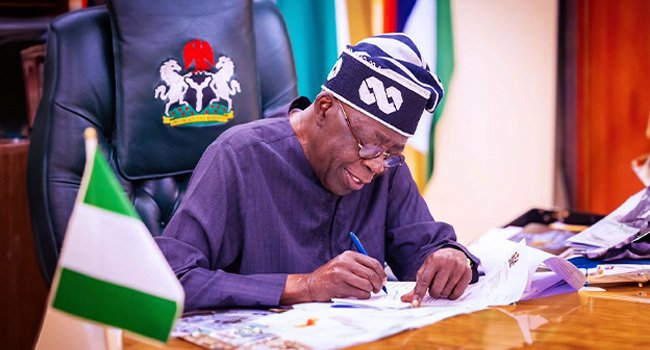

President Tinubu Signs Amended Electoral Act 202 into Law.
By Bala Salihu Dawakin Kudu, Democracy Newsline
February 18, 2026.
In what many observers have described as a defining moment in Nigeria’s democratic journey, President Bola Tinubu on Wednesday signed the Electoral Act, 2022 (Repeal and Re-Enactment) Bill 2026 into law.
The signing ceremony, held at the Presidential Villa in Abuja, drew applause from lawmakers of the ruling party while opposition voices watched with measured caution.
- Advertisement -

The new law follows months of intense deliberations by the National Assembly, marked by dramatic sessions in both chambers and sharp disagreements over the method of transmitting election results ahead of the 2027 general elections.
For many Nigerians, the amendment is more than just legislative paperwork; it is a story of a nation wrestling with the mechanics of democracy — how votes are cast, counted, transmitted, and trusted.
The climax of the legislative drama unfolded in the Senate chamber under the leadership of Senate President Godswill Akpabio. Proceedings turned rowdy when Senator Enyinnaya Abaribe invoked Order 72(1) to demand a division on Clause 60(3), which deals with the transmission of election results.
At the heart of the controversy was a proviso stating that if electronic transmission fails due to technical issues, manual transmission using Form EC8A may be used. Abaribe and other opposition lawmakers argued that allowing manual transmission could open the door to manipulation.
Deputy Senate President Barau Jibrin cited Order 52(6), insisting that revisiting the clause would be out of order. The exchange sparked uproar, with Senator Sunday Karimi briefly confronting Abaribe on the Senate floor.
Senate Leader Opeyemi Bamidele intervened, reminding lawmakers that he had moved a motion for rescission, meaning prior decisions on the clause were no longer binding.
When the vote was eventually taken, 55 senators supported retaining the proviso allowing manual transmission in the event of electronic failure, while 15 opposed it.
The chamber later moved into a closed-door session before final passage of the bill.
The atmosphere was equally tense in the House of Representatives. Speaker Tajudeen Abbas presided over a contentious session after a motion to rescind the House’s earlier position on compulsory real-time electronic transmission to the Independent National Electoral Commission’s Result Viewing Portal (IReV) was introduced.
The Chairman of the House Committee on Rules and Business, Francis Waive, moved the motion in alignment with the Senate’s revised position. When subjected to a voice vote, the “nays” appeared louder than the “ayes,” but the Speaker ruled in favour of the motion, triggering protests and forcing the House into executive session.
Earlier in December 2025, the House had supported mandatory real-time electronic transmission of results, reflecting public demand for transparency.
The amended Electoral Act introduces significant reforms aimed at strengthening Nigeria’s electoral framework: Legal Backing for Electronic Transmission, The law affirms electronic transmission of results as the primary method, thereby reducing opportunities for tampering between polling units and collation centres.
By including a fallback provision in cases of verified network failure, the Act attempts to balance technological innovation with Nigeria’s infrastructural realities, especially in rural areas where connectivity remains unstable.
The law enhances penalties for electoral malpractice and empowers the Independent National Electoral Commission (INEC) with clearer regulatory authority.
The retention of. result-viewing mechanisms such as IReV ensures that citizens, observers, and political parties can monitor outcomes in real time, boosting public confidence.
Collectively, these measures aim to address long-standing concerns about ballot snatching, result alteration, and opaque collation processes.
If effectively implemented, the Act could mark a new era of electoral credibility in Africa’s largest democracy.
The 2027 general elections will serve as the first real test of the amended Act.
For President Tinubu, who came into office following a highly contested 2023 election, the signing of this bill signals a political commitment to electoral reform. Analysts say the law could reduce post-election litigation and strengthen democratic legitimacy if faithfully enforced.
Despite its ambitions, the new Electoral Act faces significant hurdles include
Infrastructure Limitations
Large parts of rural Nigeria lack reliable internet connectivity. Network disruptions on election day could trigger disputes over whether electronic transmission genuinely failed, Public skepticism remains high. Opposition parties worry that the manual transmission proviso could be exploited.
INEC must ensure adequate training of staff, cybersecurity protection, and deployment of secure technology. A failure in logistics could undermine the law’s intent.
Ultimately, laws are only as strong as the will to enforce them. Effective prosecution of offenders and strict adherence to procedures will determine whether reforms translate into credible elections.
Nigeria’s democratic history has been shaped by both resilience and turbulence. From military rule to successive civilian administrations, the nation has gradually strengthened its institutions.
The signing of the Electoral Act, 2022 (Repeal and Re-Enactment) Bill 2026 represents another chapter in that evolving story. Whether it will deliver the free and fair elections Nigerians desire depends not only on its provisions but on the collective commitment of leaders, institutions, and citizens.
As the ink dries on the presidential signature, the message is clear: the future of Nigeria’s democracy rests not just in legislation, but in implementation, vigilance, and the courage to uphold the sanctity of the ballot.
(DEMOCRACY NEWSLINE NEWSPAPER, FEBRUARY 19TH 2026)