





PROFESSOR OLUSHOLA JAMIU SALIU DELIVERS 26TH INAUGURAL LECTURE OF PRINCE ABUBAKAR AUDU UNIVERSITY, ANYIGBA
…Recommends NADTTC, Outgrower Schemes to Revolutionise Nigerian Farming
Professor of Agricultural Extension and Technology Advocacy, Professor Olushola Jamiu Saliu, has called for the establishment of a National Agricultural Development and Technology Transformation Commission (NADTTC) and the widespread adoption of outgrower schemes as part of a Three-Legged Approach to revolutionise agricultural technology adoption and food security in Nigeria.
He made the call while delivering the 26th Inaugural Lecture of Prince Abubakar Audu University, Anyigba, titled “Breaking the Jinx of Agricultural Technology Adoption: The Three-Legged Approach,” on Tuesday, 1st September, 2026, at the University Auditorium.
- Advertisement -


Prof. Saliu explained that despite Nigeria’s elaborate research and extension institutions, including 17 commodity-based research institutes, three International Research Centres, over 66 faculties of agriculture with extension mandates and the Agricultural Extension Research Liaison Services (AERLS), agricultural technology adoption remains a persistent challenge.
He noted that Nigeria is blessed with over 200 million people, 71 million hectares of arable land and a huge farming population, yet the country continues to struggle with food insecurity and massive food importation.
The Inaugural Lecturer maintained that if agricultural technologies churned out by these research institutions are appropriately adopted, Nigeria should be self-sufficient in food production and even have enough to feed other nations.
He stressed that Agricultural Extension remains a pivot course to pursue for massive food output through technology adoption and consequently recommended the establishment of an Agricultural Extension and Technology Advancement Studies Department in every Faculty of Agriculture across Nigerian Universities.
Presenting findings from several adoption studies, Prof. Saliu revealed that improved oil palm variety (Tenera) was only adopted and sustained by 29% of farmers, with 53% not adopting it at all, while 18% adopted and later discontinued due to unavailability of extension back-up support.
He noted that pest attack by termites at a young age (56%) was responsible for poor oil palm seedlings survival, while poor access to extension services was identified as the most serious constraint to adoption of improved oil palm technology.
On fertiliser use, the Inaugural Lecturer revealed that only 0.7% of maize farmers tested their soil before fertiliser application, implying that more than 99.2% applied fertiliser based on blanket recommendation without considering specific soil nutrient deficiency.
He contrasted this with India, where fertiliser companies and State governments engage in free soil testing for farming communities before introducing fertiliser to them.
On agroforestry adoption, Prof. Saliu reported a downward trend in adoption between 2008 and 2013 in Kogi and Benue states, with farmers discontinuing adoption due to limited land size (3.79 mean score), inadequate management knowledge (3.71), old age with no younger successors (3.59), and lack of market for agroforestry produce at peak production season (3.55).
The Inaugural Lecturer stressed that fruits such as mangoes, cashew fruits and oranges often suffer post-harvest losses due to lack of storage or processing facilities and unattractive markets.
On livestock production, Prof. Saliu noted that despite the availability of vaccines against Newcastle disease and Peste des Petits Ruminants (PPR), adoption levels remained low, with only 11.21% adopting Newcastle vaccination alone and about 34.80% adopting both vaccination and ethnoveterinary treatment.
He attributed the low adoption to inadequate knowledge, high cost of technology, and poor access to extension services.
On cassava processing, the Inaugural Lecturer reported that IFAD participants had a benefit-cost ratio of 1:3.22 compared to 1:2.03 for non-participants, with Z-test analysis showing significant income differentials at 1% level of significance.
Proposing the Three-Legged Model, Prof. Saliu explained that it comprises three pillars: government support, public/private agro-processing industry, and smallholder farmers’ network, each removing critical barriers such as high cost, post-harvest losses and poor market access that farmers cannot overcome alone.
He explained that government provides policies, funding and infrastructure, while agro-processing industries create steady markets for farm produce, reduce post-harvest losses through storage and processing and add economic value to raw crops and livestock.
He added that smallholder farmer organisations strengthen bargaining power for better prices, ease access to credit and shared machinery, train members on new farming technologies and aggregate produce for large-scale buyers.
The Inaugural Lecturer argued that the three pillars synergize for food security, with governments absorbing policy risks, processors guaranteeing sales and groups sharing operational risk.
Prof. Saliu recommended the establishment of the National Agricultural Development and Technology Transformation Commission (NADTTC), expanding the existing National Agricultural Development Fund (NADF) to accommodate wider coverage and ensure functional, effective, efficient and accountable service delivery.
He proposed that the Three-Legged Approach be applied to empower the commission in providing infrastructural facilities, promoting privatisation through Public-Private Partnership and ensuring accountability.
The Inaugural Lecturer cited successful examples of private sector agro-processing industries including Okomu Oil Palm Company Plc, Presco Oil, and Psaltry International Company Limited, which run outgrower schemes with thousands of smallholder farmers, providing them with suitable and cost-effective agricultural technologies.
He noted that between 2023 and 2026, Nigeria has enjoyed Public-Private Partnership across twenty (20) different agro-industrial investors from China, Brazil, Singapore, Saudi-Arabia, Germany, United States, Norway and Switzerland.
Prof. Saliu specifically recommended that Kogi State Government adopt the Three-Legged Model to establish a public-private giant Cashew Processing Factory in Anyigba, an Oil Palm Processing Industry in Ajaokuta/Itobe axis and Alujuafara in Gbede land and a Cassava flour/ethanol industry in Ayetoro-Gbede, with thousands of small-scale farmers serving as out-growers.
He further recommended a Mega Rice Processing Plant around Omi River and River Niger in Kotonkarfe, with small-scale farmers in groups serving as out-growers for the rice processing plant.
The Inaugural Lecturer called for the decentralisation and partial privatisation of certain agricultural services through Public-Private Partnership, noting that the cost of agriculture technologies cannot be left in the hands of private extension service providers and agro-industrialists to the exclusion of the large majority of small-scale farmers who contribute meaningfully to the nation’s gross domestic product.
He stressed that agricultural development cannot be achieved without the adoption of modern agricultural technology to boost output, reduce waste, minimise post-harvest losses and add value to the quality and quantity of food produced.
Earlier, the Chairman of the Inaugural Lecture Committee, Professor S.S. Arogba, congratulated the Inaugural Lecturer on attaining the distinguished academic milestone, and commended his immense contributions to scholarship in Agricultural Extension and Technology Advocacy.
In his address, the Vice-Chancellor of Prince Abubakar Audu University (PAAU), Professor Salisu Ogbo Usman, described the 26th Inaugural Lecture as another remarkable milestone in the academic history of the University.
Prof. Usman noted that the lecture was the ninth (9th) inaugural lecture delivered since his assumption of office on 11th February, 2026, as the sixth (6th) substantive Vice-Chancellor of the University, describing the sustained tempo of intellectual engagement as a testament to the vibrant research culture taking firm root in the institution.
The Vice-Chancellor congratulated Prof. Saliu on attaining the distinguished academic milestone, and commended him for presenting a lecture that connected agricultural science with the everyday realities of the Nigerian farmer.
He noted that despite decades of research and investment in improved technologies, many innovations designed to increase productivity and improve farmers’ livelihoods do not sufficiently translate into actual practices on farms, stressing that technology does not adopt itself.
Prof. Usman added that the lecture was particularly relevant to Nigeria as the nation grapples with food insecurity, rising food prices, population growth and the continuing gap between agricultural research and practical impact.
He reaffirmed the University’s commitment to excellence in teaching, research, innovation and character development.
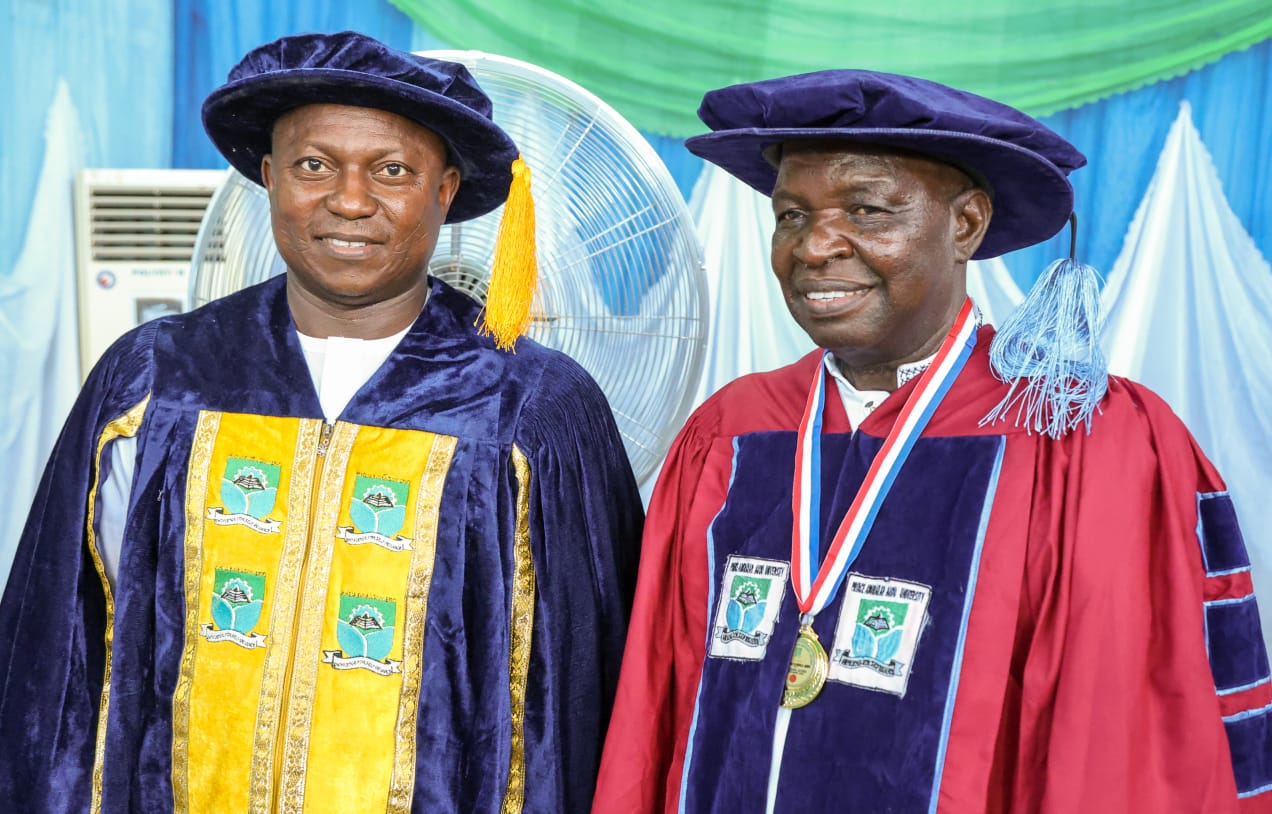
The highlight of the event was the presentation of the inaugural lecture certificate, plaque and medal to the Inaugural Lecturer.
The lecture attracted members of the University Governing Council, members of Management and Senate, academic and non-teaching staff members, students, scholars from other institutions, religious and traditional leaders, and other distinguished guests from within and outside the University community.
Uredo Omale,
Public Relations Officer,
Prince Abubakar Audu University, Anyigba.
Democracy NEWSLINE Newspaper, September 2, 2026.