





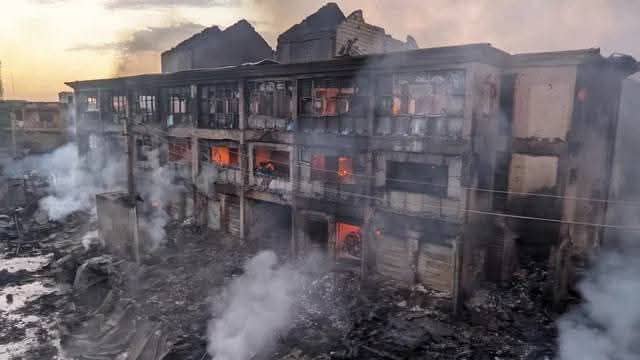

Singer Market Fire: 1,000 Businesses Destroyed, N5bn Property Lost, 7 Dead.
By Bala Salihu Dawakin Kudu
Democracy Newsline | February 15, 2026.
A catastrophic fire has razed the historic Singer Market in Kano, destroying more than 1,000 shops and leaving property losses estimated at over ₦5 billion. Seven persons are feared dead, while dozens sustained varying degrees of injuries in what officials describe as one of the worst commercial disasters in the state’s recent history.
The blaze, which reportedly began on Saturday evening, spread rapidly through the densely packed market, catching traders and customers off guard. Firefighters battled through the night and into Sunday afternoon to contain the inferno, struggling to prevent it from engulfing adjoining residential areas.
- Advertisement -

Although investigations are ongoing, preliminary findings point to a possible electrical fault as the trigger. Eyewitnesses reported hearing a loud spark followed by sudden flames from a section of the market where electrical appliances and textile materials were stored.
Overloaded and poorly maintained electrical wiring.
Storage of highly flammable goods such as fabrics, plastics, and fuel-powered generators.
Narrow access routes that delayed firefighting trucks from reaching the epicenter.
Absence of functional fire hydrants and extinguishers within the market.
The tragedy marks the second fire outbreak at Singer Market in less than two weeks, raising serious concerns about structural safety, enforcement of building codes, and emergency preparedness in major commercial centers.
Governor Abba Yusuf visited the scene early Sunday morning, inspecting the charred remains of shops and commiserating with victims. Describing the incident as “heartbreaking and unacceptable,” he announced a series of immediate interventions.
Set up a high-powered investigative committee comprising representatives from the State Fire Service, market associations, and security agencies.
Directed the Ministry of Humanitarian Affairs to provide temporary relief materials, including food items and medical support for affected families.
Promised a comprehensive rebuilding plan to modernize Singer Market with improved safety infrastructure.
Appealed to the Federal Government for modern firefighting equipment, including aerial firefighting support and advanced rescue tools. Governor Yusuf emphasized that the state’s growing commercial status demands upgraded emergency response systems, noting that current firefighting capacity is overstretched.
President Bola Tinubu has ordered a full-scale investigation into the cause of the fire. In a statement released on Sunday, the President directed relevant agencies, including the Federal Fire Service and the National Emergency Management Agency (NEMA), to collaborate with Kano State authorities.
The Presidency also pledged federal assistance to support victims and prevent future occurrences. Officials indicated that recommendations from the investigation may lead to stricter enforcement of safety regulations in public markets nationwide.
Economic Impact on Local Businesses
Singer Market is one of northern Nigeria’s busiest commercial hubs, serving as a wholesale distribution center for goods supplied to neighboring states and border communities. Its destruction carries significant economic implications.
Massive Financial Losses
Many traders operated without insurance coverage, meaning losses will be borne personally. For small-scale entrepreneurs, the destruction of goods represents not just lost stock but lost capital accumulated over years.
Supply Chain Disruptions
The market supplied textiles, electronics, foodstuffs, and household goods to surrounding states. The sudden loss of inventory is expected to create shortages and push up prices in the coming weeks.
Job Losses
Beyond shop owners, hundreds of apprentices, transport workers, loaders, food vendors, and artisans who depend on the market for daily income have been left without work.
Psychological and Social Toll
Families are mourning loved ones, while many survivors are grappling with trauma and uncertainty about their future.
Calls for Reform
Business associations are urging the government to provide soft loans, grants, and tax waivers to affected traders. There are also calls for:
Mandatory fire insurance schemes for market operators.
Installation of functional fire hydrants and alarm systems.
Regular electrical inspections.
Expansion of access roads within markets.
Training programs on fire prevention and emergency response.
Urban development experts argue that as Kano’s population and commercial activities expand, infrastructure must keep pace with safety standards.
A Market in Ashes, A Community in Hope
Despite the devastation, community leaders and charitable organizations have begun mobilizing support for victims. Religious institutions have opened their doors to displaced traders, while youth volunteers assist in clearing debris.
For many, the road to recovery will be long and difficult. Yet amid the ashes of Singer Market, determination remains strong. Traders who lost everything are already discussing plans to rebuild, hopeful that promised government interventions will translate into lasting reforms.
As investigations continue, attention now turns to ensuring accountability, strengthening safety measures, and restoring confidence in one of Kano’s most vital economic centers. The Singer Market tragedy stands as a stark reminder that without proactive investment in safety infrastructure, the cost of neglect can be devastating.
(DEMOCRACY NEWSLINE NEWSPAPER, FEBRUARY 16TH 2026)