


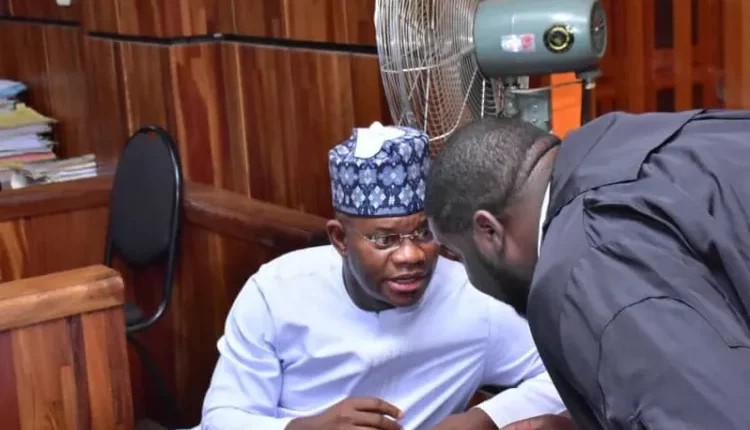

Alleged N80.2bn Fraud: Yahaya Bello Challenges Fresh Evidence as EFCC Pushes Property Documents.
By Bala Salihu Dawakin Kudu | Democracy Newsline | March 3, 2026.
The trial of the immediate past Governor of Kogi State, Alhaji Yahaya Bello, entered a dramatic phase on Tuesday as the former governor challenged the admissibility of fresh documentary evidence the Economic and Financial Crimes Commission (EFCC) sought to tender before the court.
Bello, who governed Kogi State between 2016 and 2024, is currently facing a 19-count charge bordering on alleged money laundering and criminal breach of trust to the tune of N80.2 billion. He has, however, pleaded not guilty to all the charges.
- Advertisement -
At the resumed proceedings before the Federal High Court in Abuja, the anti-graft agency attempted to tender a Deed of Assignment and an Irrevocable Power of Attorney in respect of a property located at Plot 1160, Cadastral Zone C03, Gwarinpa II District, Abuja.
The property, allegedly purchased for N100 million, was said to have been sold by Dantata & Sawoe Construction Company to Azba Real Estate Limited, a firm the EFCC claims is linked to the former governor.
The 10th prosecution witness, Mahmoud Abdulazeez, Chief Accountant and Head of Accounts at Dantata & Sawoe, told the court that the Deed of Assignment was executed on behalf of the company by Mubarak Dantata. He further disclosed that Ali Bello — nephew to the defendant and current Chief of Staff to Governor Ahmed Ododo of Kogi State — signed the documents on behalf of Azba Real Estate Limited.
However, Bello’s lead counsel, Mr. J. B. Daudu, SAN, strongly objected to the admissibility of the documents. He argued that the exhibits were not properly certified in accordance with land registration laws and therefore lacked probate value.
Daudu further contended that the EFCC had no statutory authority to certify such documents, insisting that the Abuja Geographical Information Service (AGIS) remains the only body legally empowered to register and authenticate land-related documents within the Federal Capital Territory.
Following submissions from both parties, trial Justice Emeka Nwite adjourned the case until March 9, 2026, to rule on the admissibility of the contested documents.
Earlier in the proceedings, the prosecution presented two bank compliance officers as witnesses. Gabriel Ochoche of FCMB testified as the eighth prosecution witness, while Ms. Oluwafemi Victoria of Polaris Bank appeared as the ninth witness. Both officials provided testimony concerning bank accounts allegedly used in transactions flagged by the EFCC as suspicious.
The EFCC alleges that Bello deployed five proxies to acquire 13 high-value properties in choice locations across Abuja and Dubai using proceeds of crime. The agency further claimed that over N3 billion was handed to associates for safekeeping in an attempt to conceal the funds.
In addition, the prosecution alleged that the former governor wired over $700,000 to a personal account maintained in the United States, purportedly in violation of the Money Laundering (Prohibition) Act.
Among individuals mentioned in the alleged scheme are Ali Bello, Dauda Suleiman, Shehu Bello, Rabiu Musa, and one Hudu, who is reportedly at large.
Legal observers note that the dispute over the admissibility of documentary evidence may prove pivotal in the unfolding trial. If the court rules against the EFCC on procedural grounds, it could significantly affect the prosecution’s strategy.
The case is widely regarded as one of the most high-profile corruption trials involving a former state governor in recent years, reflecting ongoing efforts by anti-corruption authorities to hold public officials accountable.
Bello remains on bail pending the determination of the charges against him. As proceedings continue, the court’s forthcoming ruling on the disputed property documents is expected to shape the next phase of what promises to be a closely watched legal battle.
(DEMOCRACY NEWSLINE NEWSPAPER, MARCH 4TH 2026)