


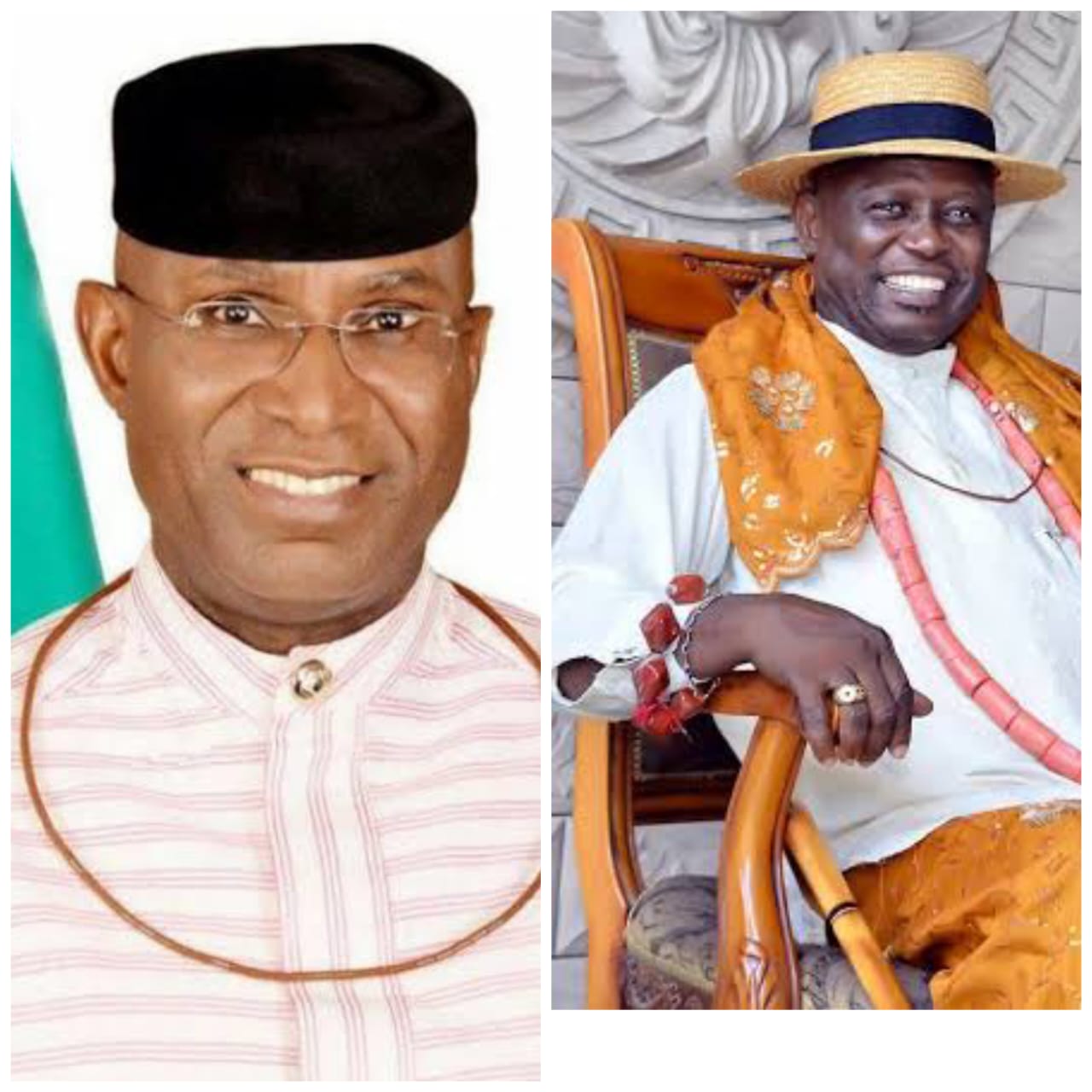

Dr Wilson Omene is Right: Omo-Agege for Senate Will Serve the Best Interest of Urhobo Nation, Ufuoma Egbe Got It Wrong
In every democratic society, political debate remains a vital instrument for evaluating leadership, preserving accountability, and shaping the future direction of a people. However, political commentary loses balance and intellectual depth when emotions, personal loyalty, and selective memory are allowed to overshadow objective realities. This appears to be the fundamental weakness in the recent article authored by Ufuoma Egbe against Dr. Wilson Omene over his support for former Deputy Senate President, Ovie Omo-Agege.
Contrary to the attempt to portray Dr. Wilson Omene as bitter, irrelevant, or politically desperate, many Urhobo people believe his position is rooted not in personal vendetta, but in political realism, historical evidence, and genuine concern for the advancement of Urhobo Nation. The truth, no matter how uncomfortable, must always be defended with courage. And in this case, Dr. Omene’s argument that Omo-Agege represents a more beneficial and result-oriented option for Delta Central is difficult to dismiss.
Politics is ultimately about results, influence, and capacity to attract development. By these measurable standards, Omo-Agege established one of the most remarkable legislative footprints ever witnessed in Urhobo political history during his tenure in the Senate. His emergence as Deputy Senate President was not merely ceremonial; it translated into visible federal presence and strategic national relevance for Urhobo land.
Under Omo-Agege’s influence, Delta Central witnessed projects and institutional interventions that altered the development conversation within the region. Among the notable projects associated with his era were the establishment of the Federal Polytechnic at Orogun, the advancement of the University of Health Sciences project, the Niger Delta Power initiatives, the Airspace Management facilities, rural electrification schemes, solar street lighting projects, road interventions, educational support programmes, and various empowerment initiatives targeted at youths and women across Urhobo communities.
Many political observers within Delta State openly acknowledge that the scale of federal attention attracted to Urhobo land during Omo-Agege’s period in the National Assembly remains one of the strongest in contemporary history. His tenure elevated Urhobo political visibility nationally and gave the ethnic nationality a stronger negotiating voice within the Nigerian federation.
It is therefore unsurprising that respected stakeholders like Dr. Wilson Omene continue to advocate for his return to the Senate. Their position is not necessarily about personality worship; rather, it reflects the belief that experience, strategic influence, and tested capacity remain critical ingredients for regional advancement. Politics is not an experiment conducted on sentiment alone. Serious societies often return to leaders with proven competence when developmental continuity becomes necessary.
Ufuoma Egbe’s attempt to reduce Dr. Omene’s intervention to bitterness and personal frustration misses the larger political reality. Democratic engagement allows every citizen — regardless of age — the constitutional freedom to express opinions on leadership and governance. Attempting to silence dissenting political opinions by attacking age, family status, or personal circumstances weakens democratic culture rather than strengthens it.
At 72, Dr. Wilson Omene possesses not only political experience but also institutional memory regarding the evolution of Delta politics and Urhobo interests. Elder statesmen are not expected to become politically silent simply because they have reached retirement age. Across the world, elder political actors continue contributing to national conversations through advocacy, criticism, and ideological engagement. Wisdom does not expire with age.
More importantly, Dr. Omene’s intervention touches on a core concern shared by many Urhobo stakeholders: the need to consolidate political gains already initiated rather than abandon ongoing federal opportunities midway. Several of the projects initiated or facilitated during Omo-Agege’s tenure require continuity, supervision, legislative backing, and sustained federal lobbying. Many believe his return to the Senate would strengthen the chances of completing and expanding these interventions for the benefit of future generations.
This is where the conversation becomes deeper than mere political rivalry. It becomes a question of strategic representation. The Senate is not simply a platform for speeches and motions; it is a power arena where ranking, connections, negotiation skills, and national leverage determine the quality of dividends a constituency receives. Omo-Agege already understands that terrain at the highest level.
Critics may disagree with his politics, and democratic plurality permits such disagreement. However, political objectivity demands acknowledgment of measurable performance where it exists. Even many neutral observers concede that Omo-Agege’s tenure produced projects and federal presence that significantly raised Urhobo’s profile within the Nigerian political structure.
Furthermore, the argument that Dr. Omene should remain silent because of age ironically contradicts African cultural traditions where elders are revered as custodians of truth, memory, and guidance. Political participation is not reserved exclusively for the young, nor should advocacy suddenly become illegitimate because it challenges a preferred political figure.
The central issue remains simple: who best protects and advances Urhobo interests at the national level? For many people across Delta Central, the answer continues to point toward Omo-Agege based on visible precedent rather than abstract promises.
Politics should not become emotional warfare where opposing opinions are demonized. Instead, it should encourage robust debate anchored on facts, performance, and strategic outcomes. Dr. Wilson Omene’s support for Omo-Agege may offend political loyalists, but disagreement alone does not invalidate his position.
In the final analysis, Ufuoma Egbe’s criticism appears driven more by emotional defense of Senator Ede Dafinone than by balanced political evaluation. While Senator Dafinone deserves respect as a serving legislator, many Urhobo citizens still compare present realities with the aggressive federal visibility witnessed during Omo-Agege’s era — and the contrast remains politically significant.
This was the kind of scenario Which played out in the time of Prof Eric Opiah of of NRC Versus Ighogboja of SDP..
It was clear that Ighogboja was not a match to Opiah so the UPU prevailed on the Party to replace Ighogboja with Felix lbru who was a match to Opiah.
If UPU was not contagious enough to do that, the result would have been a disaster to be Urhobo Nation.
The truth, as often said, may indeed be bitter. But many within Urhobo Nation believe Dr. Wilson Omene spoke from conviction rooted in political experience and developmental realities. And if performance, influence, and proven federal reach remain the criteria, then the argument for Omo-Agege’s return to the Senate cannot simply be dismissed with personal attacks or emotional rhetoric.
- Advertisement -
Comrade Wilson Macaulay is a Journalist Author and Good Governance Advocate based in Warri, Delta State
(DEMOCRACY NEWSLINE NEWSPAPER, MAY 15TH 2026)