






Governor Yusuf Becomes Wali for Kano Man Who Lost Wife, Six Children in Dorayi Tragedy.
By Bala Salihu Dawakin Kudu
Democracy Newsline
Northern Bureau Chief
KANO — August 8, 2026
Malam Haruna Bashir of Dorayi, Kano State, Friday’s wedding was far more than a celebration of marriage. It was a deeply emotional moment of survival, remembrance and a renewed beginning after a tragedy that shattered his family earlier this year.
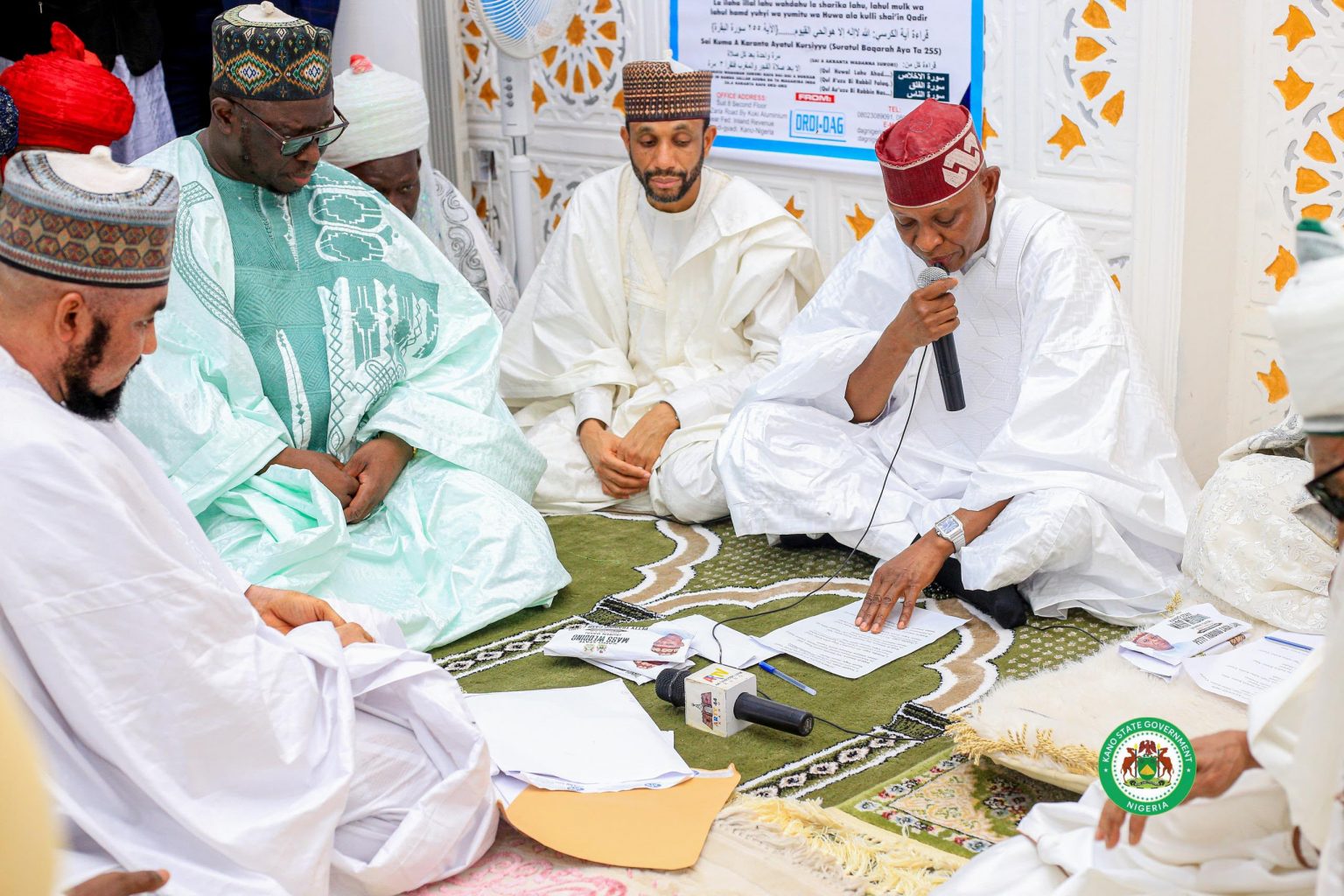
Six months after losing his wife and six children in a brutal attack that shocked Kano, Bashir found himself at the centre of another defining moment in his life when Governor Abba Kabir Yusuf personally stood as his Wali, or guardian, at the Kano State Government’s mass wedding ceremony.
Bashir was joined in matrimony with Rahinatu Jamilu Inusa at the Central Mosque, Kano, in a ceremony attended by prominent political, traditional and religious leaders.
- Advertisement -


The significance of the occasion was underscored by the presence of His Royal Highness, Khalifa Muhammad Sanusi II, the Emir of Kano, who stood as Wali for the bride.
The marriage was solemnised by the Chief Imam of Kano, Professor Muhammad Sani Zaharaddeen, with a dowry of ₦100,000.
The Governor’s decision to stand as Wali for Bashir transformed what could have been another mass wedding ceremony into a powerful public gesture of solidarity with a man whose personal tragedy had drawn widespread sympathy across Kano and beyond.
From devastating loss to a new beginning
Bashir’s story became one of the state’s most painful tragedies in January when his wife, Fatima Abubakar, and their six children were killed in an attack at their residence in the Dorayi Chiranchi area of Kano metropolis.
Police said they received a distress call at about 12:10 p.m. on January 17, 2026, following the attack. The victims were subsequently taken to Murtala Mohammed Specialist Hospital in Kano, where they were pronounced dead. Three suspects were later arrested in connection with the killings.
The incident triggered widespread grief and outrage, while the Kano State Government announced that it would take over prosecution of the case in a move aimed at ensuring that those responsible faced justice.
The tragedy also generated an outpouring of public sympathy for Bashir, who was left as the sole survivor of his immediate household. In the weeks following the incident, sympathisers reportedly raised more than ₦25 million for him through a coordinated crowdfunding effort.
Against that painful background, his appearance at Friday’s mass wedding carried an unmistakable message: that the loss of a family need not mark the end of a survivor’s life, and that communities and institutions can help people rebuild after devastating circumstances.
1,500 couples brought together, Bashir’s marriage was part of the Kano State Government’s mass wedding programme involving 1,500 couples drawn from the state’s 44 Local Government Areas.
The programme is designed to ease some of the financial pressures associated with marriage, encourage responsible family life and promote social cohesion.
Preparations for the 2026 exercise included medical screening for prospective couples, including tests relating to HIV, hepatitis and genotype compatibility, according to reports on the programme.
The programme was scheduled around a series of activities, including counselling for selected couples, wedding ceremonies, a walima and the distribution of household and empowerment support.
Reports on the programme indicated that the exercise was intended not merely as a wedding ceremony but as part of a broader social-welfare intervention.
For many of the beneficiaries, therefore, Friday’s ceremony represented an opportunity to begin married life without carrying the full financial burden that often accompanies wedding preparations.
At the Central Mosque, the symbolism of the ceremony was strengthened by the participation of the two most prominent public figures associated with the occasion.
Governor Yusuf stood as Wali for the groom, while the Emir of Kano stood as Wali for the bride.
Their participation brought together the political and traditional institutions of Kano in a ceremony centred on marriage, family and community responsibility.
Governor Yusuf and his Deputy, Alhaji Murtala Sule Garo, also represented grooms in other ceremonies held across the state, while the Emir represented brides.
Islamic scholars used the occasion to remind the newly married couples that the success of a marriage goes beyond the wedding day. They urged the couples to build their homes on faith, love, mutual respect, patience and understanding.
The message was particularly poignant in the case of Bashir, whose previous family life had ended in circumstances that remain a source of grief and public concern.
According to a statement issued by the Governor’s Chief Press Secretary, Mustapha Muhammad, the Governor’s gesture reflected his administration’s commitment to providing hope and support to citizens confronting difficult circumstances.
The gesture also highlighted the broader philosophy behind the mass wedding programme: that government social intervention can extend beyond financial assistance to include compassion, dignity and a sense of belonging.
In Kano, where marriage and family remain central to social and religious life, government-backed efforts to assist young and vulnerable couples have increasingly been presented as part of a wider strategy to strengthen communities.
The mass wedding programme seeks to reduce the financial barriers faced by prospective couples while encouraging them to embrace the responsibilities associated with family life.
A solemn reminder of the value of family
Friday’s gathering also served as a reminder of the fragility of family life.
Only months ago, Bashir’s name became associated with one of Kano’s most disturbing family tragedies.
On Friday, the same man stood before religious leaders and dignitaries to enter into another marriage.
His story therefore gave the mass wedding a human dimension that went beyond numbers and official statistics.
The ceremony was not simply about 1,500 couples exchanging vows. It was also about the possibility of rebuilding lives after hardship, finding companionship after loss and restoring hope when circumstances have left people emotionally devastated.
For Bashir, the presence of the Governor as his Wali offered a public demonstration that his tragedy had not been forgotten.
For Rahinatu, the bride, the occasion marked the beginning of a new chapter with a man whose life has been profoundly tested.
And for Kano, the marriage offered an opportunity to reflect on the importance of compassion, justice, community support and the protection of families.
Among those who witnessed the ceremony were the Secretary to the Kano State Government, Alhaji Umar Faruk Ibrahim; the Chief of Staff, Government House, Dr. Suleiman Wali Sani; members of the State Executive Council; district heads; and members of the Kano Emirate Council.
Their presence further underscored the importance attached to the mass wedding programme and to the special circumstances surrounding Bashir’s marriage.
As the newly married couples begin their lives together, religious leaders urged them to remember that the wedding ceremony is only the beginning of the journey.
For Bashir, that journey comes after an experience few people could imagine enduring.
But Friday’s ceremony offered a different picture: a survivor surrounded by community, tradition and government support, taking another step forward.
In the midst of Kano’s largest mass wedding exercise, his marriage stood out as a poignant story of loss, resilience and the courage to begin again.
(DEMOCRACY NEWSLINE NEWSPAPER 8TH AUGUST, 2026)