

Kwara Poly Banks on Commercial Farming to Boost Revenue, Equip Students with Practical Skills
KEHINDE AKINPELU ILORIN
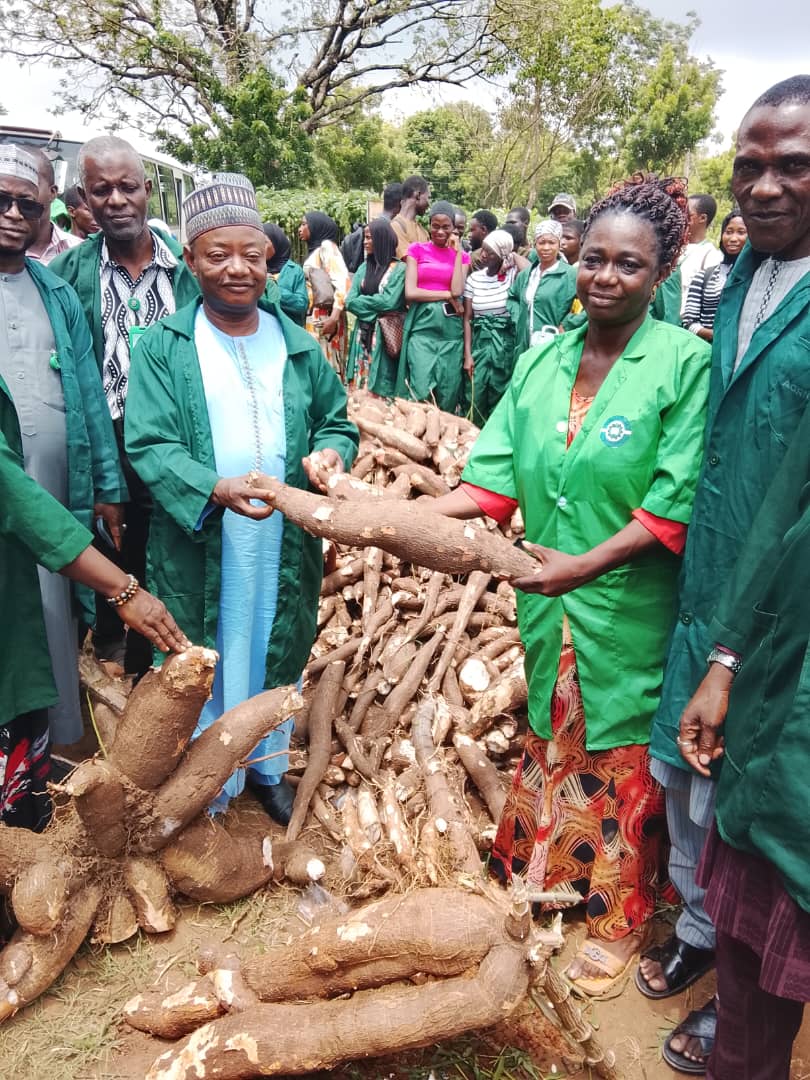
Kwara State Polytechnic, Ilorin, has intensified efforts to diversify its sources of revenue by investing in commercial agriculture, with the institution recording its first-ever cassava harvest as part of a broader strategy to strengthen food production, enhance practical learning and promote entrepreneurship among students.
- Advertisement -


The milestone was marked during the maiden harvest of cassava at the institution’s commercial farm, where the Rector, Engr. Dr. Abdul Jimoh Mohammed, said the initiative represents a long-term investment designed to benefit the polytechnic beyond the tenure of the current administration.
He explained that the institution had embraced commercial farming as a sustainable means of generating internally generated revenue (IGR), while giving students hands-on experience in modern agricultural practices.
“What we are witnessing today is just the beginning. Agriculture provides enormous opportunities for employment, ensures food availability and serves as a reliable source of income. That is why we have decided to invest in it,” the rector said.
According to him, the institution has already commenced large-scale cultivation of cassava and maize, while expanding into cocoa and oil palm plantations to create lasting agricultural assets.
“We have started with cassava and maize, and we have also expanded to cocoa and oil palm plantations. These are investments that will outlive this administration because good leadership is about planning beyond your tenure,” Mohammed added.
He disclosed that the Department of Food Science and Technology has been assigned the responsibility of processing harvested produce into value-added products, including cassava chips, palm oil and cocoa-based products that would carry the institution’s brand.
“I want to assure you that our Food Science and Technology Department has been charged with the responsibility of processing all these farm produce. In the coming years, we expect to see products such as Polytechnic palm oil, cocoa products and several processed food items produced right here by the institution,” he said.
The rector noted that income generated from the cassava harvest would be reinvested into expanding the farming project, stressing that commercial agriculture requires patience because of the high initial cost of land development and farm establishment.
“In every investment, there is always a starting capital. We do not expect to recover everything within one farming season because land clearing alone takes a significant portion of the cost. With time, however, we will break even and begin to generate profit,” he explained.
Mohammed commended the Kwara State Government for providing agricultural equipment that has reduced production costs and improved operations on the farm.
He also revealed that students are actively involved in the farming activities as part of their practical training, saying the project combines classroom learning with research and entrepreneurship.
The rector expressed confidence that the commercial farm would continue to expand and position Kwara State Polytechnic as a leading model of agricultural innovation and sustainable revenue generation among tertiary institutions in Nigeria.
Also speaking, Chairperson of the Kwara State Polytechnic Commercial Farm and Chief Lecturer in the Department of Agricultural and Bio-Environmental Engineering, Engr. Ruth Modupe Bayeri, described the maiden cassava harvest as a landmark achievement for the institution.
She said the success of the project reflects the commitment of the institution’s management to transforming agriculture into a viable enterprise for both learning and revenue generation.
“I want to welcome everyone here today. This is a significant occasion for us, and I want to say a few words of appreciation to our Rector for believing in this vision from the beginning. He gave his full support to make this day a reality,” Bayeri said.
Expressing satisfaction with the outcome of the project, she added, “We are not disappointed, and I am sure the Rector is also not disappointed with what we have achieved.”
Bayeri explained that beyond generating income, the commercial farm was established to expose students to modern farming techniques while supporting efforts to improve food security in the state and the country.
She expressed optimism that the successful harvest would encourage the expansion of farming activities and further strengthen the institution’s commitment to agricultural innovation, skills acquisition and sustainable food production.
(DEMOCRACY NEWSLINE NEWSPAPER, JULY 3RD 2026)