





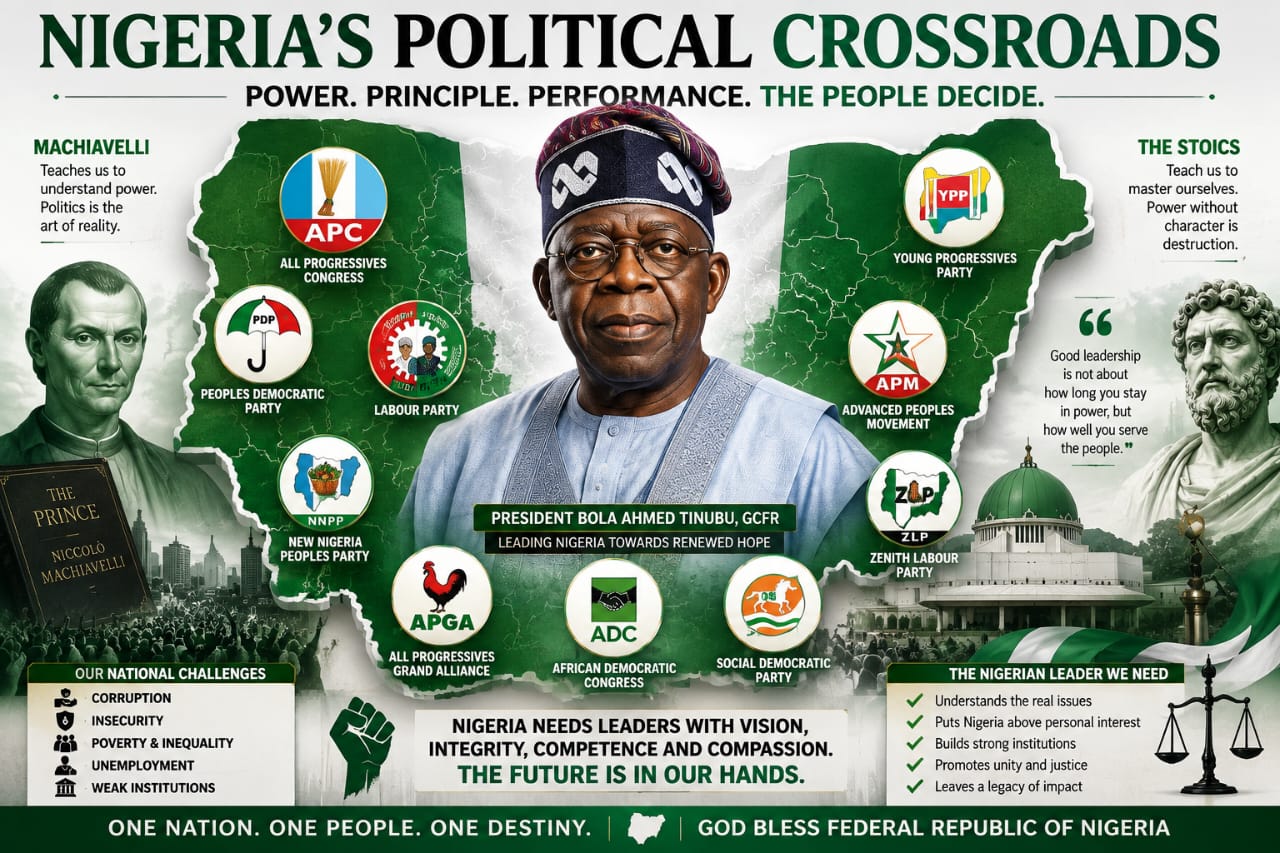

MACHIAVELLI, THE STOICS AND THE MORAL BURDEN OF POLITICAL POWER
Between the Logic of Power and the Discipline of Character: What Should Govern the Political Leader?
By Dr. Aiyeku Olufemi Samuel Adeyinka
Political, Policy & Economic Development Analyst
Politics has always lived in the uncomfortable space between what ought to be done and what can actually be done.
- Advertisement -


Few intellectual traditions expose this tension more sharply than the political realism of *Niccolò Machiavelli* and the moral philosophy of the Stoics Separated by centuries and radically different philosophical orientations, they nevertheless converge on one profound question:
What happens when human beings acquire power—and what should determine how that power is exercised?
Machiavelli asks the politician to understand the world as it is. The Stoics ask the leader to govern himself before attempting to govern others.
Between them lies one of the most enduring debates in political philosophy: *Should political leadership be judged primarily by its effectiveness, or by the moral character and ethical restraints of the person wielding power?*
That question is not merely academic. It remains central to contemporary democracy, governance, leadership succession, public accountability and the recurring struggle between political expediency and moral responsibility.
MACHIAVELLI: POLITICS AS THE ART OF REALITY
Niccolò Machiavelli’s *The Prince*, written in the early sixteenth century, challenged a long tradition that imagined political authority through the language of moral virtue, justice and religious legitimacy.
Machiavelli’s radical contribution was to insist that political analysis must confront the “effectual truth” of political life rather than merely describe an ideal world.
He was interested in how rulers actually acquire, preserve and lose power.
For Machiavelli, a political leader cannot afford to be governed exclusively by what is morally desirable. Political circumstances can be unstable, opponents can be ruthless, institutions can be fragile, and fortune can suddenly change the balance of power. A ruler who refuses to understand these realities may possess admirable personal morality and yet prove politically incapable.
Modern scholarship therefore frequently treats Machiavelli as a foundational figure in political realism. The Stanford Encyclopedia of Philosophy notes that he challenged the traditional assumption that political authority naturally follows from moral goodness and instead concentrated attention on the practical requirements of maintaining political order and power.
His famous concept of virtù is particularly important.
Machiavellian virtù does not simply mean moral virtue. It refers more closely to political capacity: courage, intelligence, adaptability, strategic judgment, decisiveness and the ability to respond effectively to changing circumstances.
The successful political actor must therefore understand fortuna—the unpredictable forces of circumstance, chance and events—and develop the capacity to respond intelligently when fortune changes.
In this sense, Machiavelli offers politics a hard lesson:
Good intentions without political competence can produce bad outcomes.
That insight remains uncomfortable—but undeniably relevant.
BUT IS MACHIAVELLI A LICENSE FOR IMMORALITY?
This is where simplistic interpretations of Machiavelli become dangerous.
Machiavelli is often reduced to the phrase commonly attributed to his philosophy:
“the ends justify the means.”
That formulation is actually too crude to capture the complexity of his political thought.
Scholars have debated for centuries whether Machiavelli was an immoralist, an amoral realist, a pragmatist, a republican thinker—or even a sophisticated critic exposing the brutal realities of princely government. The scholarly literature contains several competing interpretations rather than one settled answer.
What can not easily be denied is that Machiavelli forces political thinkers to confront an uncomfortable reality:
Political decisions can involve tragic choices.
A leader may sometimes face competing obligations in which every available option carries a cost.
The real danger begins when political realism becomes an excuse for unlimited cynicism.
There is a profound difference between saying:
“A leader must understand power.”
and saying:
“Because power matters, anything done in pursuit of power is legitimate.”
The first is realism.
The second is moral surrender.
And that distinction brings us directly to the Stoics.
THE STOIC RESPONSE: MASTER YOURSELF BEFORE YOU MASTER POWER
The Stoics approached political life from almost the opposite direction.
For thinkers such as Seneca, Epictetus and Marcus Aurelius, the central political problem was not simply how to acquire power, but how to remain morally governed while possessing it.
Stoicism teaches that human beings should distinguish between what lies within their control and what does not.
Political office, public approval, electoral victory, wealth, reputation and external circumstances may be unstable.
Character is different.
The Stoic leader asks:
Am I acting justly?
Am I exercising self-control?
Am I being governed by reason rather than anger, vanity, fear or ambition?
Am I serving the common good?
This is particularly significant politically because Stoicism does not necessarily advocate withdrawal from public life.
The Stoics developed an expansive concept of cosmopolitanism*: human beings belong to a wider moral community because they share rationality and moral worth. The Stoic conception of justice therefore extends beyond one’s immediate political faction, tribe, ethnic community or geographical boundary.
That is a remarkable political idea.
It means that leadership can not be reduced to:
“What benefits my people against everybody else?”
It must also ask:
“What is just toward human beings generally?”
SENECA: POWER MUST BE TEMPERED BY CLEMENCY
Perhaps nowhere is the Stoic political philosophy more relevant than in the writings of Seneca.
Seneca understood the extraordinary danger of concentrated political power. His answer was not political weakness but moral self-restraint.
His treatment of clementia—clemency or mercy—offers an important philosophy of leadership.
For Seneca, the powerful ruler must exercise restraint precisely because he possesses the capacity to punish.
Power without restraint becomes cruelty.
Authority without wisdom becomes oppression.
Strength without justice becomes tyranny.
The Stanford Encyclopedia of Philosophy observes that Seneca regarded clemency as especially important because the ruler possesses enormous power and must avoid abusing it. He linked this with the Stoic idea of universal human fellowship.
This gives us a powerful leadership principle:
The greatness of power is not demonstrated by how much punishment a leader can inflict, but by how much power he possesses without becoming cruel.
MACHIAVELLI VERSUS THE STOICS: THE GREAT POLITICAL DIVIDE
The contrast can be simplified into two questions.
Machiavelli asks:
Can you successfully govern the political environment?
The Stoics ask:
Can you govern yourself while governing the political environment?
Machiavelli emphasizes external reality
Stoicism emphasizes internal mastery
Machiavelli teaches adaptability.
Stoicism teaches self-command.
Machiavelli warns against political naivety.
Stoicism warns against moral corruption.
Machiavelli understands that fortune can destroy political projects.
The Stoics remind us that fortune should never be allowed to destroy one’s character.
This makes the two traditions less incompatible than they initially appear.
A serious modern leader may actually need both.
THE MACHIAVELLIAN WITHOUT THE STOIC BECOMES DANGEROUS
A politician who understands power but lacks moral discipline can become manipulative.
He may see citizens as instruments.
Opponents become enemies to be destroyed.
Institutions become tools of personal survival.
Truth becomes negotiable.
Loyalty becomes transactional.
Public resources become instruments of patronage.
And political success becomes the only measure of legitimacy.
This is the dark side of political realism.
Competence without conscience can become sophisticated corruption.
THE STOIC WITHOUT POLITICAL REALISM CAN ALSO FAIL
But there is another danger.
A leader may be personally honest, disciplined, compassionate and morally upright—and still be politically ineffective.
Good character does not automatically produce good governance.
A leader who does not understand institutions, political incentives, negotiation, public psychology, economic realities, opposition strategy, geopolitical interests or administrative capacity may possess admirable morality but fail to translate virtue into public outcomes.
This is where Machiavelli remains relevant.
Character without competence can become noble ineffectiveness.
And citizens ultimately experience consequences, not intentions.
THE SYNTHESIS: POWER WITH PURPOSE, REALISM WITH RESTRAINT
Perhaps the most useful lesson for contemporary leadership is not to choose Machiavelli over Stoicism—or Stoicism over Machiavelli.
It is to understand what each tradition gets right.
From Machiavelli, leaders can learn:
*Understand power.*
Understand incentives.
Understand human behaviour.
Understand institutions.
Prepare for uncertainty.
Do not confuse political rhetoric with political reality.
Do not mistake goodwill for strategy.
And never assume that fortune will permanently favour you.
From the Stoics, leaders can learn:
Understand yourself.
Control your passions.
Resist vanity.
Do not become intoxicated by power.
Exercise justice.
Respect human dignity.
Accept what you can not control.
And remember that public office is a responsibility, not a personal possession.
The synthesis is therefore compelling:
Machiavelli without morality risks tyranny.
Stoicism without political realism risks impotence.
Political leadership needs strategic intelligence governed by ethical restraint.
POLITICS AND THE “DIRTY HANDS” PROBLEM
Modern political philosophy has inherited what is sometimes described as the **“dirty hands” problem**.
Can a political leader remain morally pure while confronting a world in which political decisions may involve violence, compromise, deception, coercion, emergency measures and competing interests?
There are no easy answers.
But there should be boundaries.
The existence of difficult political choices cannot mean the disappearance of moral judgment.
A leader may sometimes have to make a painful decision.
That is different from deliberately cultivating a culture in which morality becomes irrelevant.
Political realism should explain constraints.
It should not become an excuse for corruption.
WHAT THIS MEANS FOR AFRICAN POLITICS
For African democracies—and particularly for emerging political systems—the Machiavellian-Stoic debate has extraordinary relevance.
Too often, politics becomes a contest for access rather than a contest of ideas.
Political loyalty can become more valuable than competence.
Patronage can replace merit.
Personality can overshadow institutions.
Political survival can become more important than public service.
And opposition can be interpreted not as a legitimate component of democracy but as an existential threat.
Machiavelli would remind political actors that power has rules.
The Stoics would remind them that *power also has moral consequences*.
A government can win an election and still lose the confidence of history.
A politician can dominate political structures and yet leave behind a morally impoverished legacy.
Conversely, a leader who combines strategic intelligence with integrity can transform political authority into institutional legacy.
That is the higher standard.
BEYOND WINNING: THE QUESTION OF LEGACY
The ultimate question of political leadership should therefore not be:
“Did you win?”
It should be:
“What did your victory produce?”
Did institutions become stronger?
Did citizens become more secure?
Did opportunities expand?
Did public resources create public value?
Did the rule of law become stronger?
Did political opponents remain citizens rather than become enemies?
Did the next generation inherit better institutions than the previous one?
These questions move politics beyond electoral arithmetic into the realm of statesmanship.
Machiavelli teaches us that political power is difficult to obtain and even more difficult to retain.
The Stoics remind us that retaining power is not the same thing as deserving history’s respect.
THE FINAL LESSON
The deepest lesson from placing Machiavelli and the Stoics side by side is that politics requires both realism and restraint
Machiavelli tells the political leader:
Do not be naïve about power.
The Stoics respond:
Do not become a prisoner of power.
Machiavelli says:
Prepare for fortune.
The Stoics say:
Prepare your character for whatever fortune brings.
Machiavelli examines the battlefield outside the individual.
Stoicism examines the battlefield within.
The mature statesman must therefore master both.
For power without wisdom becomes dangerous.
Wisdom without courage becomes ineffective.
Courage without justice becomes brutality.
Justice without competence becomes sentimentality.
And political competence without moral restraint can ultimately become a sophisticated mechanism for institutional decay.
The finest political leadership is therefore neither naïvely idealistic nor ruthlessly Machiavellian.
It is strategically intelligent, institutionally competent, morally disciplined and relentlessly focused on the common good.
That may be the political philosophy our age most urgently needs:
Know the game—but do not lose your soul playing it.
This reflection draws on the political thought of Niccolò Machiavelli, particularly The Prince and Discourses on Livy, alongside the Stoic traditions associated with Seneca, Epictetus and Marcus Aurelius. Contemporary scholarship continues to debate whether Machiavelli should be understood primarily as a political realist, republican thinker, moral critic or theorist of political necessity. Likewise, Stoic political philosophy was more complex than simple personal withdrawal from public affairs, encompassing ideas of duty, justice, cosmopolitanism, self-mastery and responsible exercise of authority.
By Dr. Aiyeku Olufemi Samuel Adeyinka
Political, Policy & Economic Development Analyst
Aiyekuolufemi@gmail.com
(DEMOCRACY NEWSLINE NEWSPAPER, AUGUST 25TH 2026)