


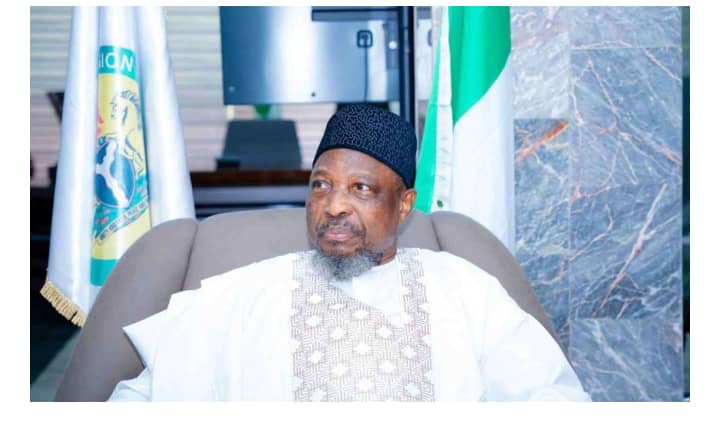

NAHCON in Turmoil: How Internal Dissent, Alleged Corruption and Power Struggles Pushed the Board to Petition Tinubu.
By Bala Salihu Dawakin Kudu
Democracy Newsline
January 23, 2026.
Abuja — What began as quiet murmurs of dissatisfaction within the National Hajj Commission of Nigeria (NAHCON) has now exploded into a full-blown institutional crisis, with the commission’s board formally petitioning President Bola Ahmed Tinubu to immediately remove its chairman, Professor Abdullahi Saleh Usman, popularly known as “Pakistan,” over allegations of corruption, financial recklessness, and gross violations of procurement laws.
In a strongly worded letter dated January 19, 2026, and signed by all serving commissioners representing Nigeria’s six geopolitical zones and major Islamic organizations, the board declared a vote of no confidence in the chairman, accusing him of conduct that has allegedly crippled the commission, undermined internal governance, and damaged Nigeria’s standing with Saudi Arabian authorities.
- Advertisement -
The petition, addressed directly to President Tinubu, accuses Prof. Usman of repeated financial and administrative breaches, including spending commission funds without board approval and awarding contracts far in excess of approved budgetary limits—actions the board says clearly violate Nigeria’s public financial management regulations.
More damning, however, are allegations of systematic procurement violations, with several Hajj-related contracts allegedly executed without the mandatory “No Objection Certificate” from the Bureau of Public Procurement (BPP), a direct contravention of the BPP Act.
“These actions were not isolated errors,” a senior commissioner told Democracy Newsline on condition of anonymity. “They were habitual, deliberate, and carried out in total disregard of the board.”
How the Crisis Started: Early Warning Signs Ignored
Investigations by Democracy Newsline reveal that the crisis did not emerge overnight. As far back as mid-2025, cracks had begun to appear within the commission following Prof. Usman’s appointment as chairman.
Several commissioners privately complained that decision-making was becoming increasingly centralized, with key operational, financial, and diplomatic decisions allegedly taken without consultation. Executive commissioners—statutorily empowered to oversee critical departments—were reportedly sidelined, while authority was said to be concentrated in the chairman’s office.
By October 2025, internal discontent spilled into the open. Multiple reports accused Prof. Usman of relying heavily on a small inner circle, notably his brother Sirajo Salisu Usman and an associate, Abdumaik Diigi, to run the affairs of the commission—an arrangement critics described as informal, opaque, and unconstitutional.
When confronted with these allegations at the time, Prof. Usman reportedly dismissed them as the “bitterness” of officials disgruntled over denied travel opportunities and personal benefits.
Financial Indiscipline and EFCC Probe
The situation worsened when concerns over extra-budgetary expenditures and unauthorized disbursements attracted the attention of the Economic and Financial Crimes Commission (EFCC).
According to the petition, Prof. Usman is currently under investigation by the anti-graft agency for financial transactions carried out without statutory approval.
While details of the EFCC probe remain under wraps, multiple commissioners confirmed that the investigation further eroded confidence in the chairman’s leadership and deepened the rift between him and the board.
Perhaps the most alarming consequence of the alleged mismanagement has been its international dimension. The board claims that administrative irregularities and poor coordination under Prof. Usman’s leadership strained relations with Saudi Arabian authorities responsible for Hajj logistics.
These tensions, according to the petition, contributed to a sharp reduction in Nigeria’s Hajj quota—from 95,000 pilgrims in 2025 to just 50,000 for the 2026 exercise. If accurate, this represents one of the most significant setbacks in Nigeria’s Hajj operations in recent history.
“This is not just about money or power,” another commissioner said. “It is about Nigeria’s credibility before the Kingdom of Saudi Arabia and the spiritual rights of Nigerian pilgrims.”
Leadership Style Under Fire
Beyond financial and legal issues, the board accused Prof. Usman of poor leadership, describing his style as dismissive, unilateral, and hostile to due process. According to the petition, limited consultation, weak coordination, and disregard for statutory procedures have left NAHCON unprepared for the 2026 Hajj and placed the entire operation at risk.
The petition was signed by prominent commissioners, including Prof. Abubakar A. Yagawal, Prince Anofi Elegushi, and others, signaling rare unanimity within the commission’s leadership.
Silence from the Chairman
Repeated attempts by Democracy Newsline to reach Prof. Usman for comment were unsuccessful as of press time. He has not publicly responded to the petition, the EFCC investigation, or the allegations raised by his own board.
The unfolding crisis now places the spotlight squarely on President Bola Ahmed Tinubu, whose administration has repeatedly pledged zero tolerance for corruption and a commitment to institutional accountability.
For NAHCON, the outcome of this petition could determine not only the future of its leadership but also Nigeria’s readiness for the 2026 Hajj and the trust of millions of prospective pilgrims.
As one insider bluntly put it:
“NAHCON cannot go into another Hajj season divided, discredited, and under investigation. Something has to give.”
(DEMOCRACY NEWSLINE NEWSPAPER, JANUARY 23RD 2026)