





One Year After Devastating Blaze, Fire Razes Over 100 Stores at Dakata Market Again in Kano.
By Bala Salihu Dawakin Kudu, Democracy Newsline
February 20, 2026.
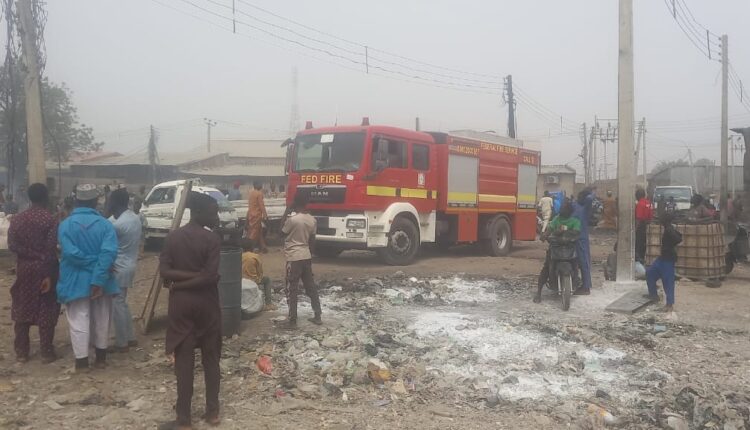
Barely one year after a devastating inferno ravaged parts of Fatima Simra Multipurpose Market at Dakata Industrial Layout in Nasarawa Local Government Area of Kano, tragedy has struck again. In the early hours of Thursday, another massive fire swept through the bustling commercial hub, destroying more than 100 stores and leaving traders counting losses estimated at over N1 billion.
The incident comes just weeks after a similar disaster at Singa Market, heightening fears over recurring fire outbreaks in Kano’s major trading centres.
- Advertisement -

Chairman of the market, Dauda Haruna Chula, said he received a distress call at about 4:00 a.m. informing him of the outbreak.
“I was called around 4:00 a.m. and told about the devastating fire at our market. Because I was not nearby at the time, I immediately contacted those who were close to the market and asked them to alert the relevant authorities to help contain the situation,” Chula said.
He noted that the exact cause of the fire remains unclear, as conflicting accounts continue to circulate among traders and residents.
“As of now, we cannot ascertain the real source of the fire. There are different versions of what might have caused it, and we are working to verify the facts,” he added.
The Fatima Simra Multipurpose Market is widely known for groundnut oil production and the trading of rubber materials, food items, bread and other consumables—many of which are highly flammable.
The combination of combustible goods and makeshift wooden structures has long made the market vulnerable to fire outbreaks.
According to Chula, oil producers were among the worst affected, with more than 100 makeshift shops completely reduced to ashes.
“This market is the only source of livelihood for many of our members,” he lamented, calling on Abba Kabir Yusuf to urgently intervene.
He expressed frustration that the N100 million support earlier promised after the previous fire incident had yet to be fulfilled.
“We are still waiting for the N100 million that we were promised after the last fire. Up till now, nothing has been given, and here we are again facing another tragedy,” Chula said.
Despite the losses, he appreciated ASPIRA Nigeria Limited as well as state and federal fire services for their efforts in containing the blaze, though he stressed that quicker intervention could have minimized the destruction.
Providing a separate account, one of the victims, Malam Auwal Mahrazu, whose stall was completely razed, said the fire started around 3:00 a.m. during a night shift.
He explained that some workers were attempting to clear a grinding filling machine that had become clogged.
“Sometimes when we are working and the filling machine gets congested, we burn it slightly and then wash it to clear the blockage so work can continue smoothly,” he said.
According to him, the workers briefly left the area—possibly to get something for their pre-dawn meal—only to return and find flames already spreading to nearby stalls and valuable goods.
“Before they came back, the fire had started catching other places. They tried to stop it, but it was beyond control,” Mahrazu recounted.
He claimed that more than 200 makeshift stalls were affected, though the swift response of firefighters prevented the blaze from engulfing the entire market.
Another trader, Isa Abubakar, described the incident as a divine test.
“This is nothing but a test from Allah. Only God truly knows how it started,” he said, adding that his entire shop was destroyed.
Abubakar commended fire service personnel for battling the flames for hours and urged Governor Yusuf to implement lasting measures to address recurring fire outbreaks in Kano markets.
Similarly, Abdulkadir Aliyu said he had not recovered from the previous disaster before this latest tragedy struck. He appealed to the government to fulfill its earlier promise of financial assistance, stressing that no support had been received despite assurances.
When contacted, the Public Relations Officer of the Kano State Fire Service, Saminu Yusuf, confirmed that the agency received information about the incident but noted that a comprehensive report had yet to be compiled.
The latest inferno underscores growing concerns about fire safety in Kano’s major markets, where traders operate in densely packed wooden stalls and handle highly combustible materials with limited access to modern firefighting equipment.
As smoke cleared over Dakata once again, traders were left sifting through ashes—haunted by memories of last year’s disaster and uncertain about how to rebuild their shattered livelihoods. For many families in Nasarawa LGA, the flames have not only consumed goods worth millions of naira but also deepened economic hardship in a time of rising costs and shrinking opportunities.
The recurring tragedies now raise urgent questions about enforcement of safety regulations, availability of emergency response infrastructure, and the need for sustainable support systems to protect small-scale entrepreneurs who form the backbone of Kano’s informal economy.
(DEMOCRACY NEWSLINE NEWSPAPER, FEBRUARY 20TH 2026)