





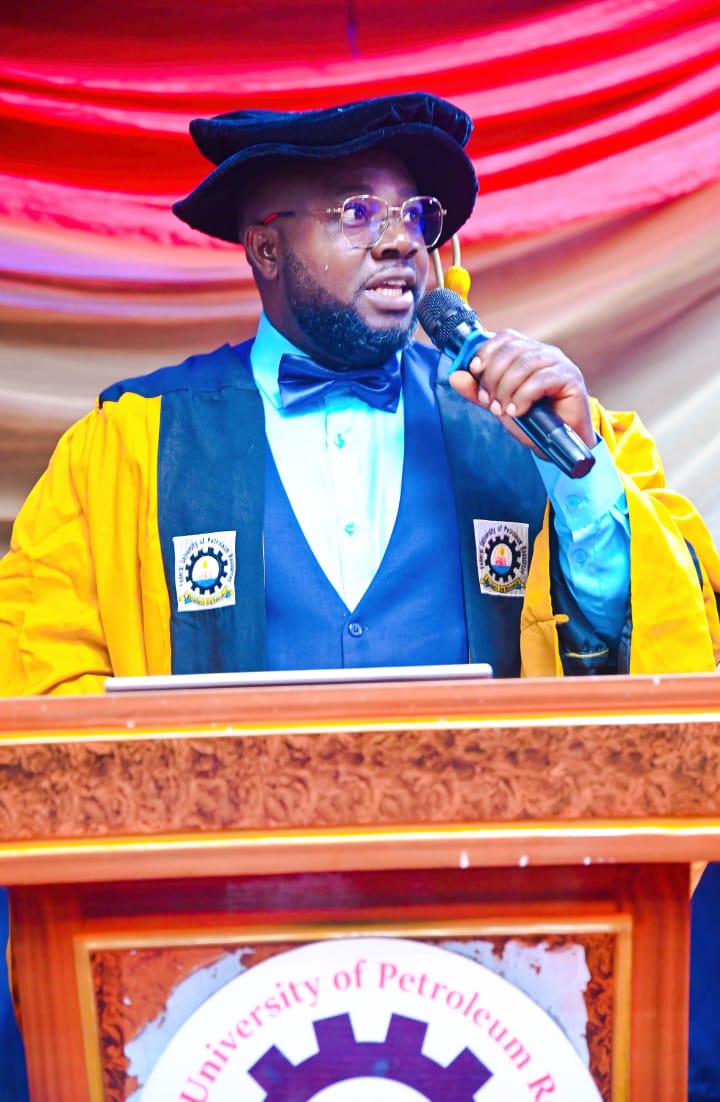

Prof. Otanocha Calls for Nature-Aligned Engineering for Sustainable Industrial Transformation at FUPRE Inaugural Lecture
By Wilson Macaulay
A call for a paradigm shift in engineering philosophy defined the 13th Inaugural Lecture held at the Federal University of Petroleum Resources, Effurun (FUPRE), Delta State, on Wednesday, April 8, 2026, as stakeholders were urged to rethink industrial progress through nature–industry harmony, emphasizing circular economy principles, advanced manufacturing, and global sustainability models as pathways to responsible and future-oriented industrial transformation.
Delivering the lecture titled “Let There Be Light: Engineered Systems Response for Nature and Industrial Harmony,” Engr. Prof. Omonigho B. Otanocha, Professor of Advanced Manufacturing Engineering and Sustainable Production Systems, emphasized the need to move away from purely production-driven engineering models toward sustainability-centred innovation anchored on ethics, wisdom, and environmental stewardship.
- Advertisement -


Drawing inspiration from biblical texts, including Genesis 1:3 — “Let there be light,” the lecturer described light as a symbol of knowledge, innovation, and the foundation of creation. He further explained that engineering must go beyond technical efficiency to embrace responsibility toward nature and future generations, stating that “we began by imagining a world where surfaces breathe… where wings glide with less resistance… where machines achieve more with less. That vision was born from light; light that sculpts, light that teaches, light that transforms industry into harmony with nature,” adding that the future of industrial development lies in aligning technology with nature rather than opposing it, as he declared that “industry must not resist Nature, but respond to it,” a principle he described as central to sustainable engineering systems and industrial transformation.
Prof. Otanocha highlighted the transformative role of emerging technologies such as advanced manufacturing, additive manufacturing, laser-based systems, and digital fabrication in reshaping global production systems, noting that these technologies are reducing material waste, lowering energy consumption, and enabling localized, on-demand production systems. He explained that “additive manufacturing and laser-based treatments form tools of precision and sustainability, bridging laboratory innovation with industrial adoption, and aligning progress with environmental responsibility.”
He further emphasized industrial symbiosis as a key pathway for sustainable production, describing it as a system where “waste from one production process becomes input for another,” reflecting natural ecosystem efficiency and forming a foundation for circular economy implementation.
Providing a global perspective, Prof. Otanocha examined sustainability models across leading economies, noting that China’s Made in China 2025 strategy and its Five-Year Plans prioritize intelligent manufacturing and automation; Japan’s Society 5.0 integrates digital technologies with human-centred development; while Germany’s Industry 4.0 framework advances digitalization and circular economy practices supported by strong environmental policies and high recycling rates. He also referenced Egypt’s Vision 2030, highlighting its integration of Strategic Environmental Assessment into national planning, alongside investments in renewable energy and waste-to-energy systems, as well as South Africa’s structured industrial policy supported by the Department of Trade, Industry and Competition (DTIC) and strong public–private partnerships driving SME development and green industrialization.
Prof. Otanocha concluded by urging engineers, policymakers, and industry stakeholders to embrace a development paradigm rooted in harmony with nature, stressing that sustainable progress must integrate technological advancement with ethical responsibility and long-term environmental stewardship.
In his remarks, the Vice-Chancellor, Prof. Ezekiel O. Agbalagba, commended the inaugural lecturer, describing him as “a distinguished scholar” whose work bridges academia, industry, and policy, with significant contributions to national development. He noted that the lecture went beyond theory, stating that it “linked light to practical applications in engineering, manufacturing, and sustainability,” while highlighting the lecturer’s patented innovations progressing toward commercialization as a model of research excellence aligned with global sustainability goals.
He further described the presentation as “a call to action,” urging participants to apply its insights across their respective fields, and congratulating the lecturer on a “remarkable presentation.”
The 13th Inaugural Lecture, which marked the third in the series under the tenure of the Vice-Chancellor, attracted a distinguished audience including the Deputy Vice-Chancellor (Academic), Prof. Omosede Osafile; the Registrar, Dr. (Mrs.) Jane E. Omoyine; the Bursar, Mr. Mark Titus Binwal; the University Librarian, Prof. Mercy Anyaegbu; as well as deans, directors, heads of departments, faculty members, students, and guests from within and outside the university community.
The event concluded with the presentation of a commemorative plaque to the inaugural lecturer in recognition of his thought-provoking lecture, reinforcing FUPRE’s commitment to research-driven innovation and sustainable industrial development.
(DEMOCRACY NEWSLINE NEWSPAPER, APRIL 18TH 2026)