



Professor Aderonke Kofo Soetan of Unilorin Calls for Mother Tongue Teaching, Technology-Driven Learning Outcomes at All Levels
KEHINDE AKINPELU, ILORIN
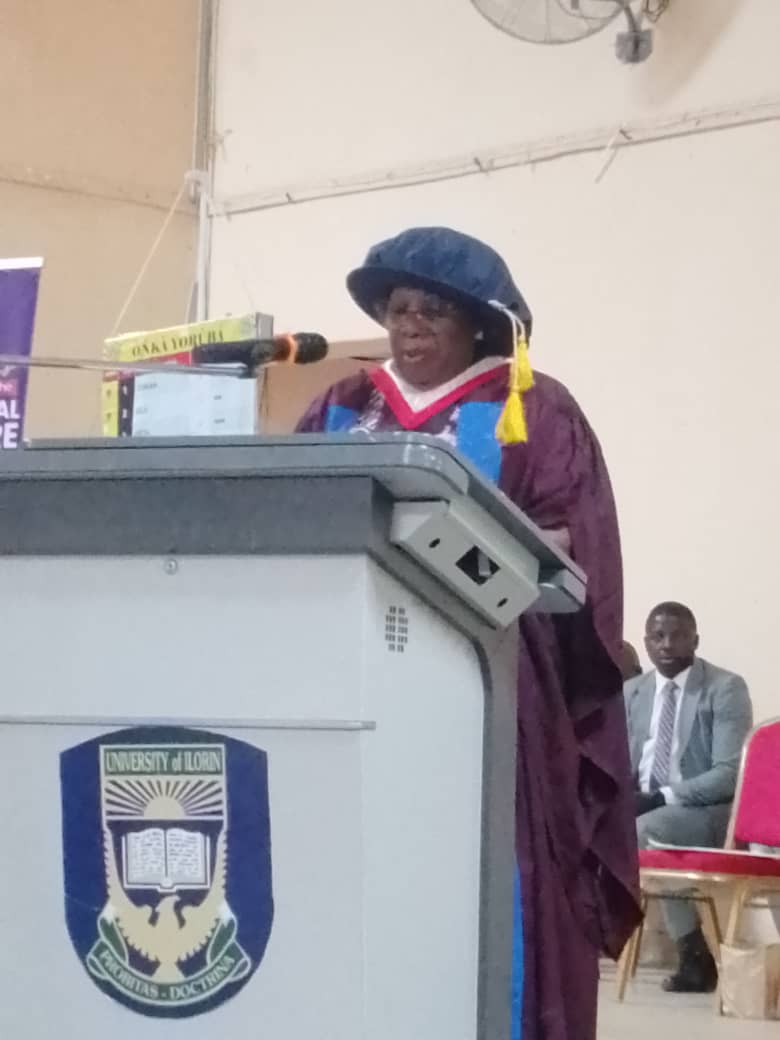
A Professor of Educational Technology at the University of Ilorin, Aderonke Kofo Soetan, has called on governments, schools and education stakeholders in Nigeria to strengthen the use of mother-tongue instruction and modern instructional technologies to improve students’ learning outcomes, especially at the foundational level.
Soetan made the call , while delivering her inaugural lecture titled “Unlocking Learning Potentials: The Right Language and Instructional Resources,” the 295th inaugural lecture of the University of Ilorin.
- Advertisement -


She said effective learning in the 21st century must be learner-focused, stressing that teachers should move away from the traditional teacher-dominated approach and embrace instructional resources that make learning more practical and engaging.
“Learning today is no longer teacher-dominated. Teachers must use appropriate instructional resources to awaken learners’ potentials and facilitate meaningful learning experiences,” the professor said.
According to her, the use of suitable language of instruction, particularly indigenous languages at the early stages of education, plays a critical role in helping children understand concepts better and build a strong academic foundation.
She urged government authorities to fully implement the National Policy on Education and the National Language Policy, with particular attention to mother-tongue instruction in the early years of schooling.
“Mother-tongue instruction, especially Yorùbá, should be effectively used in early education with adequate instructional resources to support teaching and learning,” she said.
Soetan also advocated inclusive education through the adoption of assistive technologies to support learners with special needs, noting that such tools would guarantee equal access to language learning and instructional materials.
She emphasised the need for the development of indigenous instructional resources and called on educational technologists, curriculum developers and language educators to work together to produce culturally relevant teaching materials in local languages.
Such collaboration, she noted, would not only improve learners’ comprehension but also help to preserve Nigeria’s rich linguistic and cultural heritage.
Highlighting the role of technology in modern education, the professor encouraged schools at all levels to integrate digital tools such as mobile applications, multimedia resources and interactive boards into language teaching to improve learners’ engagement.
She cited digital innovations such as Opón-Òǹkà and ÈDÈ App as practical examples of how technology can be used to strengthen indigenous language learning.
Soetan also stressed the importance of continuous professional development for teachers, recommending regular training on the design, improvisation and effective use of instructional resources, particularly technology-based and mother-tongue materials.
She further called for the establishment and strengthening of instructional resource centres in schools and higher institutions, describing them as vital hubs for the production, storage and sharing of teaching materials.
The professor also highlighted the role of parents and communities in language development, urging them to use the mother tongue at home to complement classroom teaching and ensure early language acquisition.
Explaining the value of instructional resources in reducing abstraction, she said such tools help translate complex ideas into concrete experiences for learners.
“Field trips, models, pictures, games, simulations, animations and online resources all help learners to understand better and add value to teaching and learning,” she said.
She concluded by urging increased research into indigenous language technology, calling on scholars to explore artificial intelligence, natural language processing and other digital innovations for the documentation, learning and preservation of Nigerian languages, particularly Yorùbá.
(DEMOCRACY NEWSLINE NEWSPAPER, JANUARY 12TH 2026)