





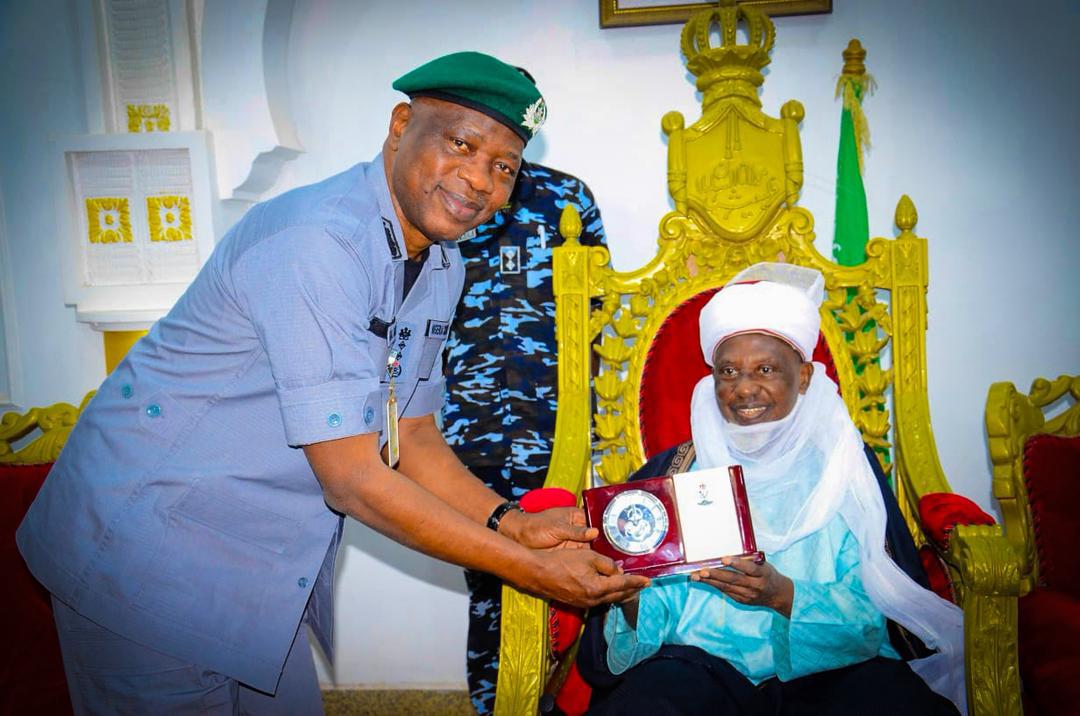

CGC Adeniyi Deepens Customs–Traditional Institutions Partnership with Landmark Visit to Emir of Gwandu….Tasks Kebbi Command on Discipline, Border Integrity, and Responsible Transit Operations.
By Queen Abayomi
In a move that reinforces the Nigeria Customs Service’s evolving strategy of inclusive border governance, the Comptroller-General of Customs (CGC), Bashir Adewale Adeniyi, on Saturday, 7 February 2026, paid a historic courtesy visit to the Emir of Gwandu, His Royal Highness Muhammadu Bashar, in Kebbi State. The visit formed part of the Service’s broader efforts to strengthen stakeholder engagement, particularly with traditional institutions whose influence remains pivotal in border security, community cohesion, and national development.
Held at the Emir’s palace, the engagement highlighted the Customs Service’s recognition that effective border management extends beyond enforcement and intelligence operations to sustained cooperation with community leaders who command trust and moral authority among border populations. The CGC was accompanied by a high-powered delegation of senior officers, including retired Deputy Comptroller-General Bello Mohammed Jibo and retired Assistant Comptroller-General Samba Dangaladima—both respected figures currently serving under the Gwandu Emirate—underscoring the long-standing institutional ties between the Service and the Emirate.
Speaking during the visit, CGC Adeniyi described the engagement as strategic and deliberate, noting that the challenges of smuggling, illicit trade, and cross-border crimes cannot be addressed by security agencies acting in isolation. He stressed that traditional rulers are indispensable partners in mobilising local support, promoting compliance with trade regulations, and fostering mutual trust between border communities and government authorities.
According to the Customs boss, traditional institutions play a frontline role in sensitising residents, discouraging economic sabotage, and providing timely intelligence that can prevent criminal activities before they escalate. He reaffirmed the Nigeria Customs Service’s commitment to sustained dialogue and collaboration with the Kebbi Emirate Council as part of a people-centred approach to border security and economic protection.
In his response, the Emir of Gwandu commended the Comptroller-General for the visit, describing it as a clear demonstration of respect for traditional authority and an acknowledgement of the Emirate’s role in maintaining peace and stability along Nigeria’s borders. His Royal Highness pledged the continued support of the Emirate Council to the Nigeria Customs Service and other security agencies operating in Kebbi State. He also called on residents of border communities to cooperate fully with authorities by providing credible information that would help curb smuggling and related criminal activities.
Beyond the palace engagement, the CGC proceeded to the Nigeria Customs Service, Kebbi Area Command, where he conducted an inspection of ongoing ultra-modern infrastructure projects designed to enhance operational efficiency and improve personnel welfare. As part of the visit, he commissioned the Bashir Adewale Adeniyi E-Learning Centre, a facility aimed at strengthening capacity building through continuous training and digital learning. He also inaugurated a newly constructed five-aside football pitch named after retired DCG Bello Mohammed Jibo, recognising his contributions to the Service and boosting staff morale.
Addressing officers and men of the Kebbi Area Command, CGC Adeniyi emphasised discipline, professionalism, and integrity as non-negotiable values, particularly given the strategic importance of Kebbi as a major border Command. He described the state as a critical corridor for legitimate trade, revenue generation, and anti-smuggling operations, while cautioning officers against any compromise in the handling of transit cargo.
The Comptroller-General stressed that goods must move strictly through approved routes and warned that any diversion of transit cargo would attract severe consequences. He noted that Kebbi State has remained a key route exploited by smugglers and economic saboteurs, especially in the illegal export of petroleum products—an issue that informed the deployment of special operations and heightened surveillance in the area.
He further disclosed that he had formally conveyed the President’s approval for the reopening of the Tsamiya border, describing the development as a significant boost to legitimate trade and regional economic integration. However, he cautioned that the reopening comes with increased responsibility, urging officers to ensure strict compliance with transit regulations and prevent the abuse of cross-border trade privileges.
CGC Adeniyi also underscored the importance of inter-agency cooperation and cross-border collaboration, noting that challenges such as smuggling, banditry, terrorism, and organised crime require coordinated responses among security agencies and neighbouring countries. He assured personnel of the Service’s commitment to improved welfare, enhanced logistics, and the continued deployment of technology to strengthen operational efficiency and accountability.
The visit concluded on a symbolic and morale-boosting note as the Comptroller-General joined officers and senior Customs officials in a friendly football match at the newly commissioned five-aside pitch—an embodiment of teamwork, camaraderie, and the human-centred leadership style that continues to define his administration.
- Advertisement -


(DEMOCRACY NEWSLINE NEWSPAPER, FEBRUARY 9TH 2026)