




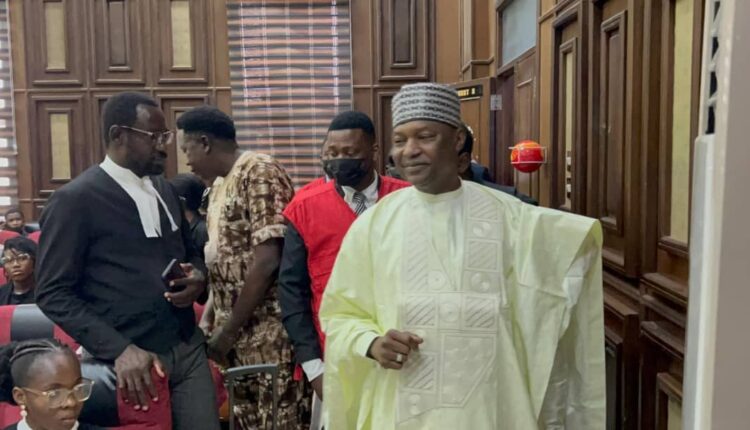

CJ Reassigns EFCC’s Cases Against Malami as Judge Fixes Feb. 27 for Hearing
By Bala Salihu Dawakin Kudu
Democracy Newsline, February 24, 2026.
The Chief Judge of the Federal High Court, Justice John Tsoho, has reassigned the two high-profile cases instituted by the Economic and Financial Crimes Commission (EFCC) against former Attorney-General of the Federation (AGF), Abubakar Malami, to a new trial judge following the recusal of Justice Obiora Egwuatu.
The development marks another significant turn in the legal battle involving the former chief law officer of the federation, whose tenure as AGF and Minister of Justice spanned from 2015 to 2023 under former President Muhammadu Buhari’s administration.
- Advertisement -
Justice Egwuatu had, on February 12, withdrawn from the civil and criminal suits filed by the EFCC against Malami, his wife, Hajia Asabe Bashir, and their son, Abdulaziz. The judge cited personal reasons and the “better interest of justice” as grounds for his decision to step aside.
The case files were consequently remitted to the Chief Judge, who, after the court’s vacation period, reassigned them. The matters have now been fixed for February 27 before Justice Joyce Abdulmalik.
Legal analysts note that judicial recusal, though not common in high-stakes corruption cases, is a recognized mechanism to preserve impartiality and public confidence in the judiciary. Under Nigerian judicial ethics, a judge may withdraw from proceedings where circumstances could give rise to a perception of bias.
The Civil Forfeiture Case
One of the suits is a multi-billion naira civil asset forfeiture case involving 57 properties allegedly linked to Malami. The properties, located in Abuja, Kebbi, Kano, and Kaduna States, are said by the EFCC to be proceeds of unlawful activities.
During the vacation period, Justice Emeka Nwite had, on January 6, granted an interim forfeiture order in respect of the properties. The order followed an ex parte motion marked FHC/ABJ/CS/20/2026 and moved by EFCC counsel, Ekele Iheanacho, SAN.
The court directed the anti-graft agency to publish the order in a national daily, inviting interested parties to show cause within 14 days why the properties should not be permanently forfeited to the Federal Government.
According to EFCC filings, 41 of the properties are located in Kano and the Federal Capital Territory (FCT), Kebbi State, and are collectively valued at over N212 billion. The agency alleges that the assets were acquired through funds reasonably suspected to be linked to unlawful activities.
Malami has, however, challenged the interim forfeiture order. In a motion on notice filed on January 27 by his legal team led by Joseph Daudu, SAN, the former AGF accused the EFCC of suppressing material facts and misrepresenting issues to obtain the interim order.
He urged the court to dismiss the suit to avoid what he described as “conflicting outcomes and duplicative litigation,” arguing that the proceedings infringe upon his constitutional rights, including the presumption of innocence and the right to own property as guaranteed under Section 44 of the 1999 Constitution (as amended).
Several other applicants have also approached the court seeking to vacate the interim forfeiture order.
The Criminal Charge
Parallel to the civil action is a 16-count criminal charge marked FHC/ABJ/CR/700/2025, in which Malami, his wife, and son were arraigned on December 30, 2025, before Justice Nwite.
The charges border on alleged money laundering to the tune of N8,713,923,759.49.
They pleaded not guilty to the charges.
Malami and his son were initially remanded at Kuje Correctional Centre, while Asabe was remanded at Suleja Correctional Centre. On January 7, the court admitted each of the three defendants to bail in the sum of N500 million with two sureties each in like sum.
Legal observers note that money laundering offences in Nigeria are prosecuted under the Money Laundering (Prevention and Prohibition) Act, which prescribes stringent penalties, including imprisonment and forfeiture of assets upon conviction.
Fresh Terrorism Charges
In a dramatic twist, Malami and his son were subsequently re-arrested by the Department of State Services (DSS) over allegations bordering on terrorism.
The duo was arraigned on February 3 before Justice Abdulmalik on a separate five-count terrorism charge. The commencement of trial in that matter has also been scheduled for February 27.
The overlapping timelines have drawn public attention, as February 27 is expected to witness proceedings in both the money laundering and terrorism cases, alongside arguments relating to the interim forfeiture of the 57 properties.
The cases against Malami represent one of the most high-profile corruption prosecutions involving a former Attorney-General in Nigeria’s democratic history. As the nation’s chief law officer during his tenure, Malami played a central role in prosecutorial decisions, anti-corruption policy, and high-level litigation on behalf of the Federal Government.
Political analysts say the proceedings could test the resilience of Nigeria’s anti-corruption framework and judicial independence. The EFCC, established in 2003, has secured numerous convictions in financial crime cases but has also faced criticism over selective prosecution and delays in high-profile trials.
With Justice Abdulmalik now seized of the matters, attention will turn to whether the defendants will be re-arraigned as scheduled and whether the court will sustain or set aside the interim forfeiture order.
As the February 27 date approaches, the legal community and the public alike await what could be a defining chapter in Nigeria’s ongoing battle against corruption and financial crimes.
(DEMOCRACY NEWSLINE NEWSPAPER, FEBRUARY 24TH 2026)