





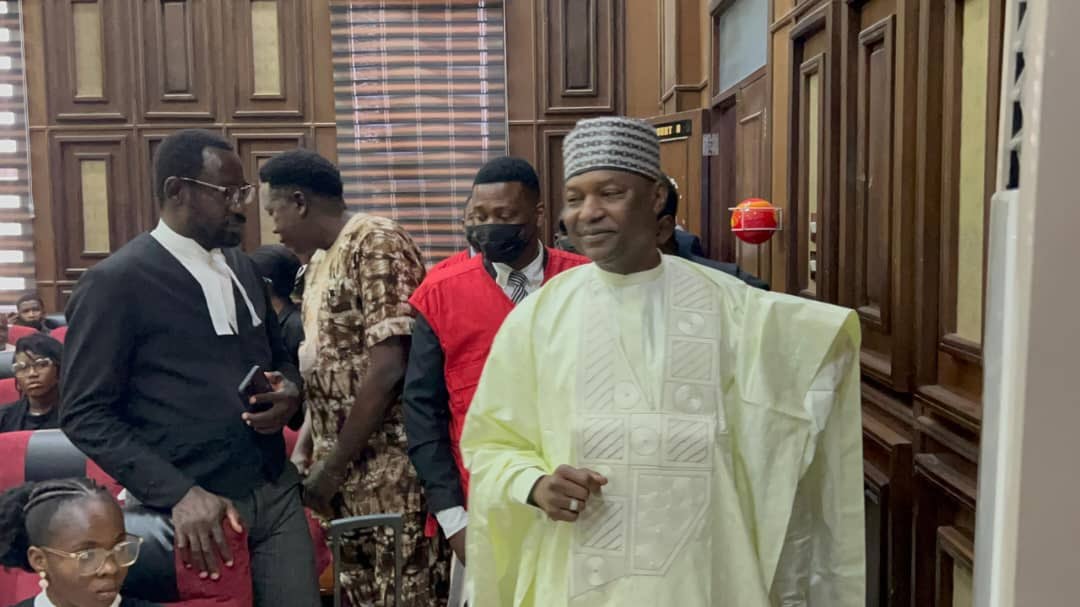

Court Adjourns ‘Terrorism Financing’ Trial of Malami, Son.
By Bala Salihu Dawakin Kudu, Democracy Newsline
March 10, 2026.
Abuja — Proceedings in the high-profile terrorism financing case involving former Attorney-General of the Federation, Abubakar Malami, and his son, Abdulaziz Malami, were on Tuesday adjourned by the Federal High Court sitting in Abuja.
The presiding judge, Joyce Abdulmalik, fixed April 15 and 16 for the commencement of trial following a request by the prosecution for additional time to prepare its case.
Malami, who served as Attorney-General during the administration of former President Muhammadu Buhari, and his son were arraigned on February 3 by Nigeria’s secret police, the Department of State Services (DSS), on a five-count charge bordering on alleged terrorism financing and unlawful possession of firearms.
- Advertisement -


When the matter was called on Tuesday, the defendants were present in court alongside their legal representatives.
Counsel for the prosecution, Akinlolu Kehinde, informed the court that he had only recently been instructed to take over the prosecution of the case. The senior advocate explained that he required time to study the case file and consult with witnesses before the trial could commence.
“I got the instruction to take over the prosecution of the case on Monday, and so I need time to interface with the witnesses. I most humbly ask for another date,” Kehinde told the court.
Defence counsel, Shuaibu Arua, who represented the former attorney-general and his son, did not oppose the request for adjournment.
In her ruling, Justice Abdulmalik granted the application and subsequently adjourned the case until mid-April.
The adjournment follows an earlier ruling by the court on February 27, granting both defendants bail in the sum of N200 million each, with two sureties in like sum.
The court had directed that the sureties must be responsible individuals with verifiable addresses and financial standing, in line with the stringent bail conditions often imposed in cases involving serious criminal allegations such as terrorism financing.
According to the DSS, Malami allegedly failed to act on intelligence reports and case files relating to suspected terrorism financiers that were forwarded to the Office of the Attorney-General during his tenure.
Investigators also accused the defendants of unlawful possession of firearms, which formed part of the charges filed before the court.
While the prosecution maintains that it has credible evidence and witnesses to substantiate the allegations, the defendants have denied any wrongdoing.
The case has drawn considerable public attention due to Malami’s previous role as Nigeria’s chief law officer and a key figure in the country’s legal and political landscape.
Legal analysts say the proceedings could set an important precedent in Nigeria’s ongoing efforts to tackle terrorism financing, particularly amid persistent security challenges in parts of the country.
Nigeria has faced a prolonged battle against extremist groups and criminal networks involved in funding violent activities. Authorities have increasingly emphasized the prosecution of individuals suspected of financing such operations as part of broader counterterrorism efforts.
With the matter now adjourned, the prosecution is expected to finalize preparations, assemble witnesses, and present evidence when the trial begins on April 15.
Observers say the forthcoming hearings are likely to attract significant national attention as the court begins the substantive examination of the charges.
For now, both Malami and his son remain on bail pending the continuation of the trial.
(DEMOCRACY NEWSLINE NEWSPAPER, MARCH 11TH 2026)