
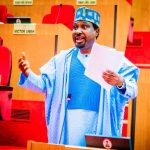






FUL Seeks NASENI Partnership to Drive AI Investment, Digital Innovation
The Vice-Chancellor of Federal University Lokoja (FUL), Professor Gbenga Solomon Ibileye, has called for a strategic partnership between the institution and the National Agency for Science and Engineering Infrastructure (NASENI) to accelerate investment in artificial intelligence (AI) and strengthen digital technology across Nigerian universities.
Prof. Ibileye made the appeal on Thursday in Lokoja during the 4th Memorial Lecture held in honour of the late Engineer Joseph Oyeyani Makoju.
He said the university had placed the commercialisation of research and the translation of knowledge into tangible development outcomes at the core of its Vision Plan 2026–2031.
- Advertisement -


“At Federal University Lokoja, we have made the commercialisation of research and the translation of knowledge into development outcomes a cornerstone of our Vision Plan. We are building an Innovation and Entrepreneurship Hub, supported by our operational solar farm at the Felele Permanent Campus,” he said.
The Vice-Chancellor disclosed that the institution is establishing Centres of Excellence in renewable energy, environmental sustainability, entrepreneurship, agriculture, and biotechnology, alongside reforms to its research governance framework.
“Our goal is to ensure that research at this University is not only rigorous but also relevant, well-funded, and commercially viable,” he added.
Speaking on artificial intelligence, Ibileye described AI as a transformative frontier critical to Nigeria’s knowledge economy, stressing that the global race in the field is already underway.
“The global race in Artificial Intelligence is not a future event; it is happening now and at great speed. At Federal University Lokoja, we are making a deliberate choice to be part of that race,” he stated.
He acknowledged that while the university is still laying the foundation, its direction and commitment remain firm.
“Our aspiration is to build a critical mass of AI-active researchers and postgraduate scholars working across sectors such as health, agriculture, environmental monitoring, biotechnology, computing, and engineering. This will position the University on both the national and continental AI map,” he said.
Ibileye emphasised that achieving this vision requires significant investment in infrastructure, including high-performance computing systems, advanced GPU clusters, data centres, and specialised laboratories.
“Without this infrastructure, the aspiration remains theoretical. We are determined to make these structural investments and are actively seeking partners who share our conviction that Nigeria cannot afford to be a passive observer in the AI revolution,” he said.
He also announced plans to establish an Annual FUL Innovation Fair to connect researchers and students with funding opportunities.
“The Innovation Fair will serve as a bridge between knowledge production and commercialisation. Artificial Intelligence will be a defining theme because it is not just a research subject but a commercial frontier and a national strategic asset,” he noted.
The Vice-Chancellor expressed confidence that NASENI, as Nigeria’s leading agency in science and engineering infrastructure, would play a vital role in supporting the university’s ambitions.
“What we need now are partners who understand that investing in AI infrastructure at a federal university is a strategic national priority. We are ready, willing, and aligned with that vision,” he said.
Reflecting on the legacy of the late Engr. Makoju, Ibileye said the memorial lecture remains a vital intellectual platform for advancing practical solutions to Nigeria’s development challenges.
“The late Engineer Makoju believed in practical solutions. The best tribute we can pay is to ensure that research produced within these walls solves real problems, creates jobs, and drives national development,” he said.
Delivering the memorial lecture titled “Commercialisation of Research and Development Projects: Prospects and Challenges,”the Executive Vice Chairman/Chief Executive Officer of NASENI, Khalil Halilu, urged Nigerian universities to go beyond academic pursuits and focus on economic and societal impact.
“Universities must evolve beyond teaching and research to embrace a third mission—delivering economic and societal impact through innovation,” Halilu said.
He noted that while Nigeria possesses abundant talent and ideas, the country must build systems that convert knowledge into economic value.
“The commercialisation of research and development outputs remains the missing link in Nigeria’s development equation. We must prioritise industry engagement, application-driven research, and real-world outcomes,” he added.
Halilu highlighted the role of institutions like NASENI in bridging gaps in infrastructure, funding, and industry linkages.
“As we honour Engr. Joseph Oyeyani Makoju, let us commit to building a Nigeria where research leads not just to publications but to production—where ideas translate into industries and innovation drives prosperity,” he said.
In her remarks, Dr. Gladys Makoju, wife of the late engineer, reaffirmed the family’s commitment to supporting the university through scholarships and initiatives that promote creativity and talent development.
“Our family will continue to invest in the future of this institution by encouraging deserving students and fostering innovation,” she said.
(DEMOCRACY NEWSLINE NEWSPAPER, APRIL 24TH 2026)