





Heavy on Titles, Light on Desks: How Kogi’s Army of Political Appointees Redefines Governance
Ponle Adeniyi
ponleadeniyi457@gmail.com
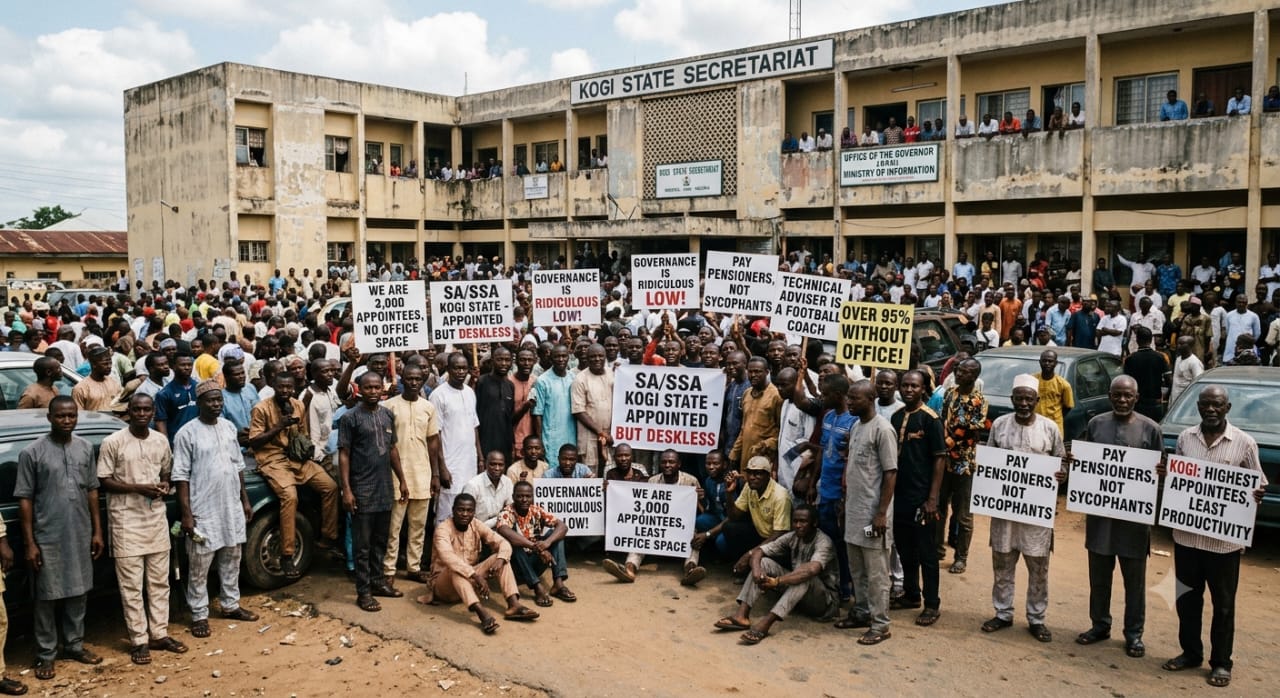
In Kogi State, political appointment is no longer an exception—it has become a mass-employment scheme for party loyalists. With an estimated tally exceeding 3,000 Special Advisers (SAs) and Senior Special Assistants (SSAs), the state holds a dubious national record for maintaining the most bloated political structure in Nigeria.
Yet, step into the ministries, agencies, or government secretariats across Lokoja, and a striking irony emerges: over 95% of these appointees do not have an office, a desk, or a designated chair.
In standard administrative governance, Special Advisers hold cabinet-adjacent rank, tasked with offering high-level strategic policy counsel. Senior Special Assistants are meant to handle critical administrative execution and cross-departmental coordination.
- Advertisement -

In Kogi, however, many of these roles exist purely on paper and social media graphics.
The absurdities peak in the designations themselves. Roles that belong in local community clubs or football pitches—such as *”Special Technical Adviser”*—are regularly stamped with government seals and converted into political titles.
Without offices to report to or operational portfolios to manage, thousands of appointees function as an unsalaried-looking “deskless army.” For the vast majority, daily duties begin and end with:
Defending state policies and attacking critics across digital platforms.
Serving as crowd fillers during party events and official tours.
Monthly Payday: Waiting for monthly bank alerts funded directly from the state treasury.
While thousands of loyalists receive monthly stipends for zero measurable output, essential public services and vulnerable citizens feel the squeeze.
The contrast is stark. Across the state, pensioners and retirees—men and women who spent decades in active civil service—frequently face delayed gratuities and agonizing payment cycles. While those who served the state wallow in neglect, an army of sycophants enjoys state patronage purely for political allegiance.
Governments around the world use advisory roles to inject fresh ideas and specialized expertise into public administration. In Kogi, however, the system fails even as an apprenticeship model. Appointees learn neither policy design nor administrative discipline; instead, they are conditioned into a cycle of political dependency.
By turning high-level policy positions into low-level political handouts, governance in Kogi State has hit a concerning low—where title inflation is high, accountability is non-existent, and the public purse bears the heavy cost.
(DEMOCRACY NEWSLINE NEWSPAPER 29TH JULY)