

ECHONO IN TETFUND: AS THE BUREAUCRAT – SCHOLAR CLOCKS FOUR
By Tunde Olusunle
Ours is a society famous for addiction to titular prefixes and grandiose appellations. Single individuals want to be acclaimed “High Chief;” “Rt. Honourable,” “Senator;” “Engineer;” “Dr;” “Pastor,” and more, in a single fare. The obsession with being addressed as “Dr” albeit honorary, and most probably procured from nondescript, backwoods, recently compelled the National Universities Commission, (NUC), to come very hard on the misuse and desecration of the hallowed title. It can indeed only be publicly worn by those who have attended institutions accredited to run doctorate degrees, who have duly undergone, completed and passed relevant courses and prescribed examinations, whose dissertations have been assessed and adjudged successful, and who been officially approved as qualified by the awarding citadel, upon internal and external attestation.
That he has elected to maintain the title by which he has been known and addressed for four full decades and more, despite duly earning the highest attainable educational qualification in the academia, is testament to Sonny Togo Echono’s uncommon humility. To be sure, he graduated with a bachelor’s degree honours and a masters in architecture in 1983 and 1985, respectively. He is also a revered *Fellow* of the profession which umbrella body he presently serves as National President. Through decades therefore, the title by which he has been known and addressed is that of “Architect.” He equally holds a string of traditional titles from his homeland in the Idoma country of Benue State. Friday July 18, 2025, the Abuja Leadership Centre, (ATC) of University of Abuja, which has since been rechristened *Yakubu Gowon University,* certified Echono qualified for the award of a doctorate in Public Governance and Leadership. Director of the Centre, Prof Philip Dahida, acknowledged Echono’s “excellent presentation, courage and relentless efforts in navigating the challenges of the doctorate programme, despite his schedule as a very notably busy public officer holder in Nigeria.”
- Advertisement -
Echono spent the last five years of his most eventful career as Permanent Secretary in the Federal Ministry of Education. One finding which agitated his mind was the deep-seated controversies and subsequent acrimony which attended the selection of Vice-Chancellors who are chief executives of universities. He was a student at the Ahmadu Bello University, (ABU), back in the early 1980s when selections into university leadership was strictly merit-based and devoid of sentiments, consistent with global best practices, a tradition which impacted quality and global respect even for Nigerian institutions. This gold standard, however, had been impacted over time, by creeping parochialism and extraneous considerations, such that frictions between university governing councils and university administrations had become prevalent.
Despite the imminence of his retirement from public service nonetheless, Echono reckoned it would be worthwhile to contribute to rectifying this situation by way of a dedicated doctoral engagement. Central to his research findings was the imperative for transparency and inclusiveness in public sector decision making, in relation to selection processes in Nigeria’s university ecosystem. Like he noted when he addressed his panel of examiners that July 18, 2025, “My thesis is directly relevant to the selection processes which have accentuated conflicts between governing councils and university administrations, as well as between ministries and governing bodies. Issues of localisation, politics and nepotism are prevalent. By implementing a transparent and accountable template which incorporates stakeholders, which rewards merit and performance, which has inbuilt mechanisms for checks and balances, we can make progress as a nation.”
It was as if Echono was clairvoyant that he would still have a role to play in the administration of Nigeria’s education sector when he undertook his doctorate. Just weeks after his retirement from service, former President Muhammadu Buhari recalled him on Friday March 4, 2022, to serve as Executive Secretary of the Tertiary Education Trust Fund, (TETFUND). The organisation was first birthed in 1993 as the *Education Tax Fund,* (ETF), to help stem the decline in the public tertiary education system, encompassing universities, polytechnics and colleges of education. The deafening drop in standards across the deck at the time was attributed to poor funding by the federal government. The ETF mutated into TETFUND in 2011. It had been administered by Mallam Tijani Ahmed Abdulkadir; Mallam Mustapha Abba Aji; Prof Mamood Yakubu; Mallam Aliyu Na’Iya; Dr Abdullahi Baffa and Prof Suleiman Elias Bogoro, before Echono was beckoned to step forward.
Increasing demand for tertiary education by the nation’s rapidly growing population has culminated in the expansion of tertiary institutions across the country. The NUC recently confirmed a total of 309 universities in Nigeria for instance, about 140 of which are publicly owned and almost evenly split between the federal and state governments. Public polytechnics are said to number about 86, and colleges of education around 80. It is the statutory responsibility of TETFUND to intervene in the sustenance of this behemoth in key intervention areas like infrastructure (construction of classrooms, laboratories, theatres and halls); research and publication (funding for research, book development and academic publishing), and staff development (sponsorship of academic staff training and development).
Since his assumption of duties on Friday March 18, 2022, a fortnight after his appointment was announced, Echono has been at the fore of quiet, well reasoned reforms and innovations, which have revolutionised the operations of our tertiary institutions. These include digital transformation through the digitization of TETFund’s operations, moving from paper-based processes to electronic systems, reducing processing times and improving transparency in project monitoring. Procurement reforms entail rigorous quality assurance mechanisms, stricter oversight, and enhanced monitoring to ensure projects meet specified standards, curbing practices like contract splitting and job padding. To ensure transparency and accountability, Echono has established a national research bank, launched the Tertiary Education Research and Applications Systems (TERAS) platform, and introduced anti-plagiarism software to promote academic integrity.
Capacity Building has equally received deserved attention under his watch as he has organized seminars and workshops to reorientate the workforce, emphasizing ethics and best practices, and sponsored thousands of academic staff for advanced training. Echono has equally expanded institutional partnerships by forging collaborations with international institutions, such as the University of Brazil and Campus France, to enhance research and training. These initiatives aim to improve service delivery, promote transparency, and enhance the overall quality of tertiary education in Nigeria. Public universities have witnessed phenomenonal infrastructural intervention under Echono’s leadership such that nearly 1000 physical infrastructural projects have been completed, providing essential facilities for academic activities.
Probably more than most of his predecessors, Echono has won more friends and associates for TETFUND which is ever in the business of receiving dignitaries. Governors, legislators, diplomats, heads of ministries, departments and agencies, service chiefs and commandants of military and paramilitary agencies and others, are regular callers at TETFUND. It is perhaps this reality which reawakened the compulsive architect in Echono to initiate some facelift and facility upgrades in the administrative headquarters of TETFUND. The approach and sentry is being redeveloped, just as primordial omissions in the original design are being unobtrusively corrected and updated.
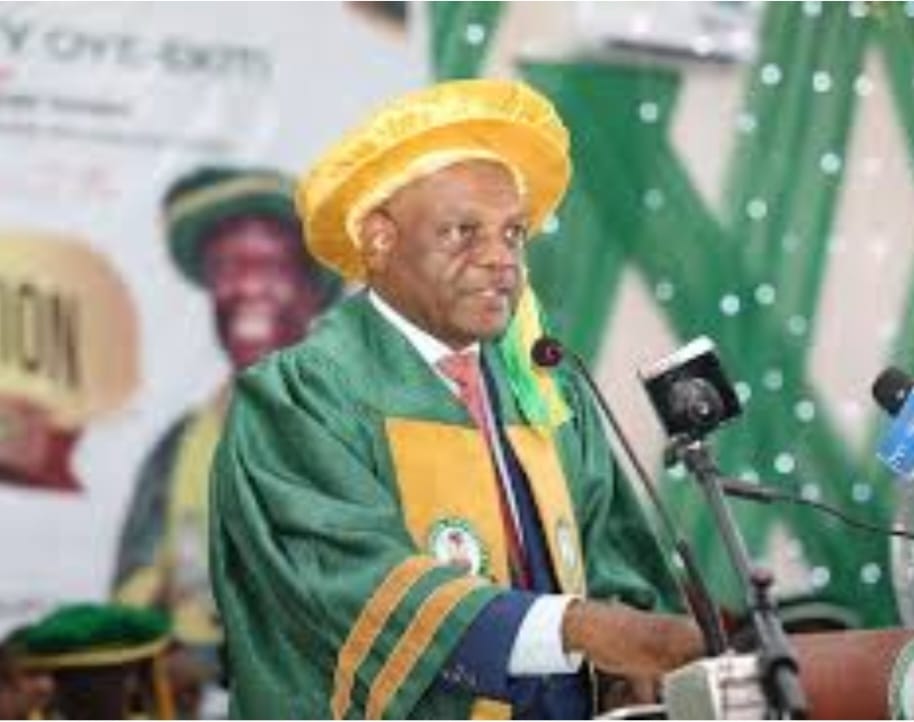
From Abuja to Accra, Lagos to London, and thenceforth to Orlando in the United States of America, Echono continues to receive accolades and awards for his transformative work in education. All of these after he was duly decorated with the national honour of *Officer of the Order of the Niger, (OON),* by former President Buhari in October 2022, in acknowledgement of his sterling services to fatherland. Yet he is not resting on his oars, ever thirsty for knowledge, ever pursuing innovation. It is not uncommon to find him participating in online classes between attending to official work, usually after official work hours. For him, the contemporary public servant must be proactively savvy, especially in a sector such as that which fate has thrust him in the past decade, where changes and advancement can be rapid, even dizzying. Which is why he’s often on the road, from Owerri to Oye-Ekiti, Oshogbo to Uyo, a prime choice for convocation and distinguished lectures, for institutions desiring that he shares his expertise and experiences in a sector where he has evolved into an undisputed expert and institution.
*Tunde Olusunle, PhD, Fellow of the Association of Nigerian Authors, (FANA), is an Adjunct Professor of Creative Writing at the University of Abuja*
(DEMOCRACY NEWSLINE NEWSPAPER, MARCH 9TH 2026)