

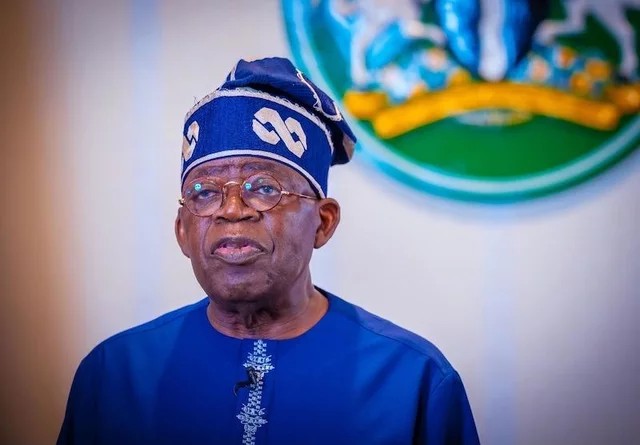

Tinubu Pledges Swift Establishment of State Police, Reaffirms Commitment to National Unity and Economic Recovery.
By Bala Salihu Dawakin Kudu
Democracy Newsline | February 24, 2026.
President Bola Ahmed Tinubu on Monday reaffirmed his administration’s resolve to confront Nigeria’s security challenges head-on, pledging that the long-debated establishment of state police would be implemented without delay.
The President made this declaration during an interfaith Iftar with governors, ministers, and senior government officials at the Presidential Banquet Hall in Abuja. The gathering marked the first breaking of fast for the 2026 Ramadan and brought together political leaders across party, ethnic, and religious lines in a symbolic show of unity.
- Advertisement -
“What I promise you is not to be postponed,” President Tinubu stated firmly. “We will establish state police to combat insecurity.”
The issue of state police has remained central to Nigeria’s constitutional reform discourse for years. Advocates argue that decentralizing policing powers would enable states to respond more effectively to local security threats, including banditry, kidnapping, communal clashes, and insurgency. Critics, however, have warned about the risks of political misuse and uneven standards.
Tinubu’s pledge signals what may become one of the most consequential security reforms of his presidency. Observers note that successful implementation would require constitutional amendments, broad political consensus, and clear operational guidelines to prevent abuse.
Security experts believe that state-controlled police formations, working in synergy with federal agencies, could improve intelligence gathering and community trust—key components in modern policing strategy.
“We Are Out of the Woods”
Beyond security, the President struck an optimistic tone about the country’s economic trajectory.
“We are out of the woods. We are out of the dark tunnel of uncertainty. The economy is showing up,” he declared, referencing ongoing fiscal and monetary reforms undertaken by his administration.
Since assuming office, Tinubu’s government has implemented structural adjustments aimed at stabilizing public finances, boosting domestic production, and attracting foreign investment. While the reforms initially triggered economic hardship and public criticism, recent indicators suggest gradual stabilization in key sectors.
In a moment that drew attention, President Tinubu addressed Abba Kabir Yusuf, Governor of Kano State, urging restraint amid political tensions in the state.
“I’m glad I see Abba from Kano… I saw the crisis on TVC News. Please temper justice with mercy,” the President appealed, emphasizing the importance of calm and dialogue in resolving disputes.
The remark underscores the federal government’s interest in maintaining stability in politically sensitive states, particularly those experiencing electoral or governance-related conflicts.
President Tinubu also used the occasion to call for greater tolerance within the ruling party and across political lines.
“Let’s see the young ones breathe too. Tolerate everybody,” he urged leaders of the All Progressives Congress, encouraging inclusivity and generational cooperation.
He commended Babagana Umara Zulum, Governor of Borno State, for his Ramadan outreach efforts to both Muslims and Christians, describing the gesture as reflective of “a very, very good spirit.”
“As long as we bridge together and move together and determine to rescue this country, the best is yet to come to Nigeria,” Tinubu added, reinforcing a message of collective responsibility.
Speaking earlier on behalf of the Chairman of the Nigeria Governors’ Forum, Hope Uzodimma, Governor of Imo State, described the gathering as divinely inspired.
“This convergence is a special situation created by God to remind us Christians and Muslims not to allow religious and ethnic differences to guide our political activities,” he said.
The event was attended by Vice President Kashim Shettima, Chief of Staff Femi Gbajabiamila, and several governors and senior officials, highlighting the administration’s effort to sustain dialogue across various tiers of government.
Monday’s dinner marked the third consecutive year of President Tinubu’s annual Ramadan Iftar with political and government leaders—a tradition aimed at fostering interfaith harmony and national cohesion.
As Nigeria navigates complex security and economic realities, the President’s renewed promise on state police may prove pivotal. Whether the pledge translates into swift legislative action remains to be seen, but the message delivered at the Iftar was unmistakable: unity, reform, and decisive action are at the core of the administration’s agenda.
For many Nigerians, the coming months will test not only the feasibility of state policing but also the resilience of a nation striving to move from uncertainty toward stability and shared prosperity.
(DEMOCRACY NEWSLINE NEWSPAPER, FEBRUARY 24TH 2026)